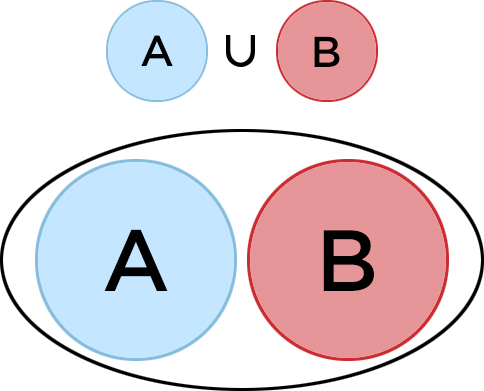
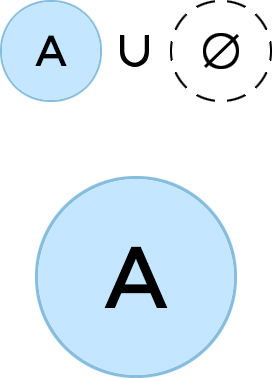
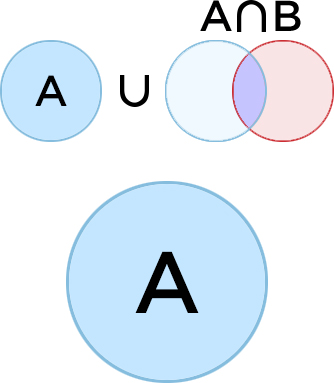
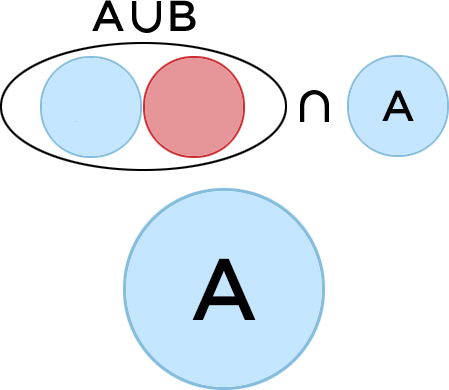
সেটের সংযোগ

Before this, knowসেট প্রকাশের সেট গঠন পদ্ধতিসেট: কিভাবে উপসেট বের করতে হয়

Interactive · 2 questions

Union of Sets

The union of two (or three, or four, or more) sets contains the elements common to any of the sets. The union of sets is a set, itself!

The union of sets AA and BB (denoted as A∪BA \cup B) is the set containing the elements that are in AA or B!B!

Finding the union of sets is similar to solving OR compound inequalities!

Here is a graphic that visually represents the union of sets using Venn diagrams:
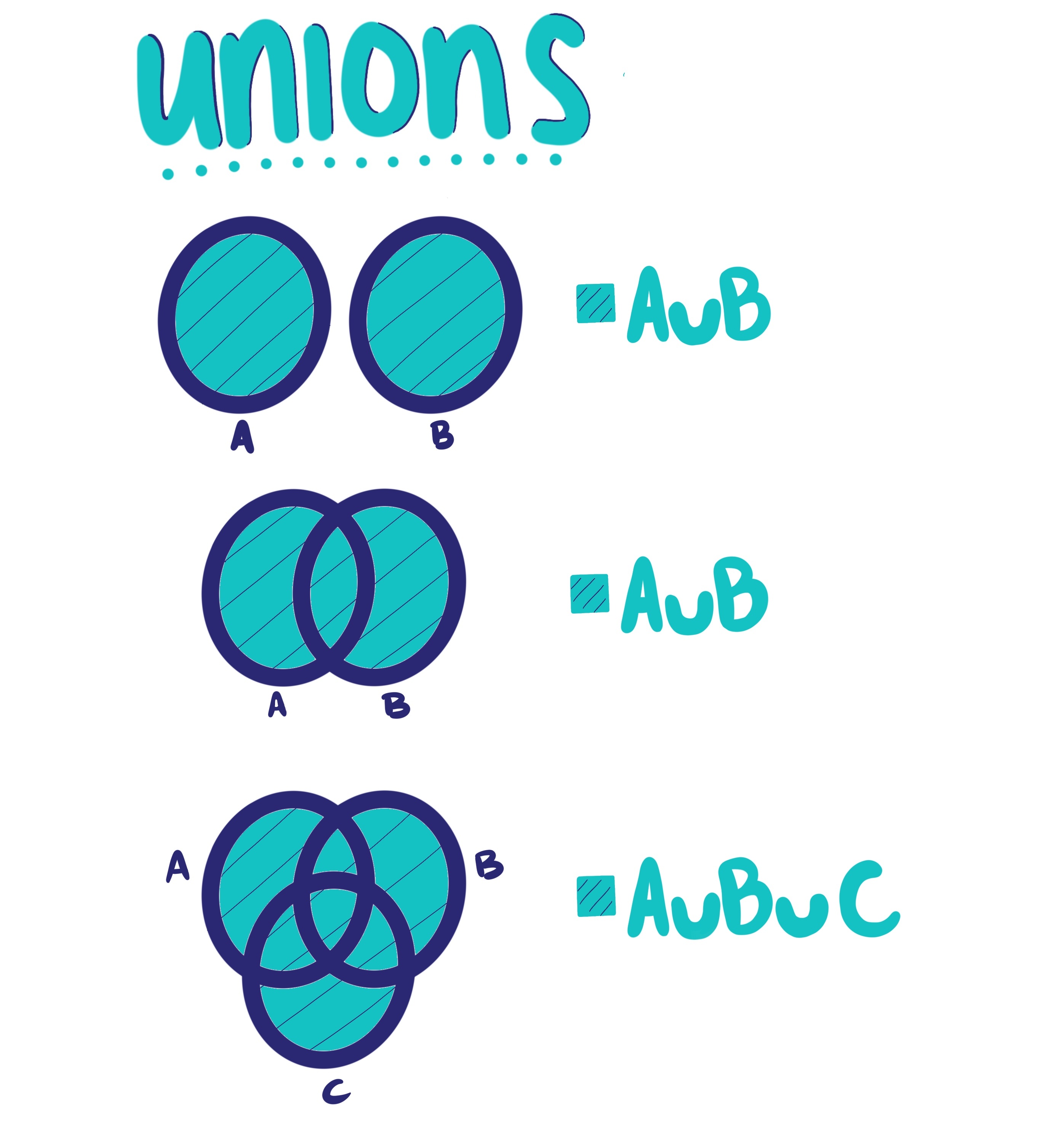
Visual representation of the union of sets using Venn diagrams. The regions of union are denoted in turquoise. On the first line, sets A and B do not intersect but they are both turquoise, on the second line A and B intersect and both of them are turquoise, and on the third line sets A, B, and C all intersect and all of them are turquoise.

Image source: Caroline Kulczycky

A∪BA \cup B is just a set with every element of AA and every element of B.B.

Example

Let's start off with an example with two sets. Consider the following sets: A={a,b,c,d}A = \{a, b, c, d\} and B={c,d,e}.B = \{c, d, e\}.

A = {a, b, c, d} and B = {c, d, e}

Image source: Caroline Kulczycky

The union of sets AA and BB, A∪BA \cup B, is the set of elements that are in either AA or BB. The union includes all of the elements of AA and all the elements of B.B. A={a,b,c,d} and B={c,d,e}A = \{a, b, c, d\} \text{ and } B = \{c, d, e\} We know A∪BA \cup B includes all the elements of A,A, so let's write those down first: A∪B={a,b,c,d,0000}A \cup B = \{a, b, c, d, \phantom{0000}\} We also know that A∪BA \cup B includes all the elements of B,B, so let's write those as well: A∪B={a,b,c,d,00c,d,e}A \cup B = \{a, b, c, d, \phantom{00}c, d, e\} Sets don't have repeat elements (unless it is otherwise noted that the set is a multiset), so we can rewrite this as: A∪B={a,b,c,d,e}A \cup B = \{a, b, c, d, e\}

Unions in Set-Builder Notation

When you're learning how to find the union of two sets (let's call them PP and QQ to differentiate them from our previous example) you might encounter this set-builder notation: P∪Q={x ∣ x∈P or x∈Q}.P \cup Q = \{x \: | \: x \in P \text{ or } x \in Q\}. Don't let this notation scare you! It simply means that the union of sets PP and QQ is equal to the set of all elements xx that are in PP or Q.Q.

Unions and Subsets

Say PP is a subset of Q.Q. If we take the union of PP and Q,Q, the result is just Q!Q! Why? Think about it like this: P∪Q={the elements that are either in P or Q}={the elements that are in P and the elements that are in Q}\begin{align} P \cup Q &= \{\text{the elements that are either in P or Q\}}\\ &= \{\text{the elements that are in P and the elements that are in Q\}}\\ \end{align} But since PP is a subset of Q,Q, all the elements of PP are also in Q.Q. The union is just Q!Q!

Union of Three Sets

You can also find the union of more than two sets! Consider sets X={1,2,5,7,8},Y={2,3,5,7,9},X = \{1, 2, 5, 7, 8\}, Y = \{2, 3, 5, 7, 9\}, and Z={4,5,7,8,9}.Z = \{4, 5, 7, 8, 9\}.

Venn diagram of *X* = {1, 2, 3, 5, 7}, *Y* = {2, 4, 5, 7}, and *Z* = {1, 5, 4, 7, 9}

Image source: Caroline Kulczycky

What is X∪Y?X \cup Y?

Choose one answer

Interactive · 5 questions

The union of two sets, AA and BB, consists of all those elements that are in at least one of those sets. The union is written as A∪BA \cup B.

Here's a simple example: A={1,2,3}B={−7,0,2}\begin{align} A &= \{1,2,3\}\\ B &=\{-7,0,2\} \end{align} On your own, try to work out what A∪BA \cup B would be.

A∪B={1,2,3,0,−7}A\cup B = \{1,2,3,0,-7\}

Notice that this new set has five elements, not six. That's because 22 was already in both sets, and every element in a set has to be unique.

Let's try to formalize this notion:

Which is the following gives the correct definition of a union of sets? \\ (If you're wondering about the notation we're using here, check out set-builder notation.)

Choose one answer

Video · + 1 min read

(Video) Sets: Union and Intersection

by PatrickJMT

This video by PatrickJMT covers set union and set intersection.

Summary\large{\text{Summary}}

The most important thing to know with unions and intersections of sets are the symbols, and how they relate to each other. So here they are!

∪\cup: The union symbol. It means that you combine the sets, so each element in each set in the union is included. This symbol also formally means "or", so you might see it described that way other places!

∩\cap: The intersection symbol. It means that you take the similarities between the sets, so only the elements that are in every set are included. This symbol also means "and."

Let's try these out using two sets:

A={2,3,5,9,17,18}B={2,3,6,9,33,51,81,123}\begin{align} A &= \{2, 3, 5, 9, 17, 18\}\\ B &= \{2, 3, 6, 9, 33, 51, 81, 123\} \end{align}

What is A∪BA \cup B?

A∪B={2,3,5,6,9,17,18,33,51,81,123}A \cup B = \{2, 3, 5, 6, 9, 17, 18, 33, 51, 81, 123\}

Notice that each element is only in the answer once, and every single element from both AA and BB are somewhere in the set.

What is A∩BA \cap B?

A∩B={2,3,9}A \cap B = \{2, 3 ,9\}

This set is much smaller than A∪BA \cup B! That's because instead of combining everything, we sort of used AA as a filter for BB. All the numbers that had a match got caught, and everything else fell away.

Type a concept, like “slope” or “photosynthesis”.

↑ ↓ to choose · Enter to openSearch explanations and problems