Interactive · 6 questions
When we were looking at two-sided limits, we pointed out several examples that did not have limits to better understand what limits were. We promised, however, that one of those examples did have one-sided limits. Let's review that function quickly:
What is the limit of at ?
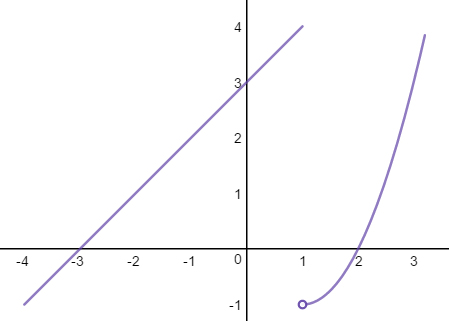
And once again, we look at the graph of the function to see what's going on.
No one value can "bridge the gap" between the positive part of this function and the negative part. That's why it doesn't have a limit at . Nevertheless, there are two conspicuous circles on the graph that suggest possible values for it at that would at least make half of the graph nice. Surely those circles are meaningful in calculus.
Yes: they are exactly the one-sided limits.
Intuitively, a one-sided limit at is the value that would make one side of the function continuous --- either the side where or the side where . Defining that value for a function at that point may not make the function fully continuous, but it's better than adding a point floating in the middle of nowhere.
Or, to use the idea of a limit as "getting really close", a one-sided limit is only different in that we restrict that must "get really close" from one side of the point.
What is the limit of if approaches from above (which is "from the right" on the graph)?
The idea is that if gets close to but is still greater than , then gets really close to . (In this example, it is , but that's not necessary.) Note that we don't care about the values of when (just like for two-sided limits) or when .
If you understand this, the other side should be very easy:
What is the limit of if approaches from below (which is "from the left" on the graph)?
We write the limit of when approaches from above as and when approaches from below, as The important feature is the or superscript above .
Let's look at more functions. This function should look familiar to you if you've done the questions on two-sided limits.
What is the limit of if approaches from above?
What is the limit of if approaches from below?
We see here a function that has one of its one-sided limits but not the other.
It seems it's about time to formalize the idea of a one-sided limit now. In fact, we only need to change a few words from the two-sided limit definition. And most of the changes are just to give the name of the concept we're defining (one-sided limits aren't quite as common as two-sided limits or limits at infinity in calculus, so a short name isn't very necessary.)
Reference definition: The limit of a function at is a value such that, for all , we can find a number such that is within of for all values of within of but not equal to itself.
Try changing the definition yourself before continuing:
Here are my definitions.
Definition: The limit of a function at as approaches from above is a value such that, for all , we can find a number such that is within of for all values of within of and greater than itself.
Definition: The limit of a function at as approaches from below is a value such that, for all , we can find a number such that is within of for all values of within of and less than itself.
(Equivalent ways to write the final condition on is that or .)
So that's what a one-sided limit is.
A few final thoughts should be given to the relationship between two-sided limits and one-sided limits:
Which of the following statements are true?
Congratulations! You now understand one-sided limits.