Interactive · 2 questions

কোন চতুর্ভুজের শীর্ষবিন্দু ৪টি দিয়ে একটি বৃত্ত আঁকা গেলে সেই চতুর্ভুজকে বৃত্তস্থ চতুর্ভুজ বলে। বৃত্তস্থ চতুর্ভুজ নিয়ে কথা বলার আগে ত্রিভুজ নিয়ে কিছু বলি।

আচ্ছা, যেকোন ত্রিভুজের শীর্ষবিন্দুত্রয় দিয়ে কি বৃত্ত আঁকা সম্ভব?

Choose one answer

Check what you really know

If you can solve a contest problem with this idea, you know it well. If not, you know exactly what to review. These are real problems from the AMC 12, the national math competitions for middle and high school students, each with a worked solution on LIVE by Po-Shen Loh.

Interactive · 5 questions

No coincidences - just math

Ancient mathematicians were fascinated with geometric coincidences. Let's get a feel for this ourselves.

I drew a triangle in the sand, and noticed that it was possible to draw a perfect circle through the the 3 points. Wow!

Is that special?

Choose one answer

Interactive · 1 question

There are several fundamental criteria that help determine if a quadrilateral is cyclic.

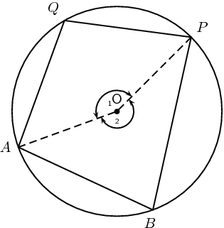
First, a quadrilateral is cyclic iff opposite angles sum to 180∘180^\circ. This is because an inscribed angle of a circle equals half the measure of the arc, so ∠ABC+∠ADC=ADC^2+ABC^2=360∘2=180∘.\angle ABC+\angle ADC=\dfrac{\widehat{ADC}}2+\dfrac{\widehat{ABC}}2=\dfrac{360^\circ}2=180^\circ.

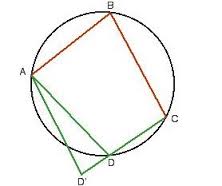
A quadrilateral ABCDABCD is also cyclic iff ∠ABD=∠ACD\angle ABD=\angle ACD. This equality holds in cyclic quads because both angles subtend the same arc AD^\widehat{AD}. By examining each of the other three arcs, similar equality conditions can be obtained.

[The "if" directions were proven earlier here. The "only if" direction can be proven many ways; for instance, we may use the "angle-arc inequalities" discussed earlier.]

These are the two most important criteria to remember when starting off with cyclic quadrilaterals. Well, why are these important, you may ask? Well, cyclic quadrilaterals allow us to shift between different sets of angle equalities that would be very difficult to work out otherwise.

Try it out on the following simple application.

In the diagram △ABC\triangle ABC be a right triangle with ∠B=90∘\angle B=90^\circ. Point DD is an arbitrary point on leg BC‾\overline{BC}, and EE is the foot of the perpendicular from DD to AC‾\overline{AC}. We wish to prove that ∠DBE=∠DAE\angle DBE=\angle DAE.

In order to prove the statement above, it suffices to show that ABDEABDE is a cyclic quadrilateral. Why is this true?

Choose one answer

Interactive · 8 questions

When is a quadrilateral cyclic?

A

B

Which of the above is a cyclic quadrilateral?

Choose one answer

Interactive · 6 questions

Let ABCABC be a triangle, and D,E,FD, E, F lie on BC,AC,ABBC, AC, AB respectively. Let ⊙AEF\odot AEF and ⊙BDF\odot BDF intersect at PP. We're going to show that in fact the third circle (⊙CDE\odot CDE) ALSO goes through PP!

Here's a diagram for reference:

Ok, let's start now that we have a nice picture to look off. :)

We want to show that PP lies on ⊙CDE\odot CDE.

What's another way to say this?

Choose one answer

Interactive · 1 question

When does a Quadrilateral become Cyclic?(Incomplete)

Fundamental definition:

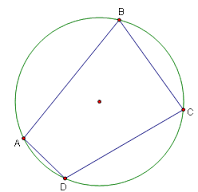
A quadrilateral ABCDABCD is cyclic\textbf{cyclic} if there is a circle passing through four vertices of the quadrilateral.

What's a cyclic hexagon?

Choose one answer

Video

Let's take this video and add even more life. This person is very enthusiastic!

What angle is opposite ∠ABC\angle ABC?

Choose one answer

Interactive · 7 questions

Quadricyclicity given side lengths?

Here's one you might have to think about for a while:

Let us say that you have a quadrilateral with side lengths aa, bb, cc, and dd. These side lengths are given such that the quadrilateral is convex; i.e. a+b+c>da+b+c>d, a+b+d>ca+b+d>c, etc. Is it always possible to arrange the sides in a way that the quadrilateral is cyclic? Don't just click. Play around with a few.

Choose one answer

Type a concept, like “slope” or “photosynthesis”.

↑ ↓ to choose · Enter to openSearch explanations and problems