Illustrated · 4 min

+1 contributors
We're beginning our study of thermodynamics. It's a subset of physical chemistry. It began as the study of gases, and this is still how it is primarily used. It started in the 1650s when Otto von Guericke developed the first vacuum pump. It was a great example of pure chemistry. He wanted to disprove the philosopher Aristotle. Aristotle made the claim that nature abhors a vacuum. He proposed that nature would immediately fill a vacuum because a vacuum is nothing. And nothingness cannot exist.
Eventually, thermodynamics shifted to applied chemistry. Many famous chemists began to study the chemical and physical properties of gases. Their hope was to improve steam engines. Out of these investigations, chemists developed the various gas laws and thermodynamic definitions.
But, what does thermodynamics have to do with chemistry? It often seems more related to physics. It is true that there is a significant overlap with physics. But, let's consider chemical reactions. For example, let's look at the single-replacement reaction between Zinc and sulfuric acid. The balanced chemical equation is . We see the products are solid zinc sulfate and diatomic hydrogen gas. Let's say we did this reaction in a piston. As the gas was produced the pressure would increase and move the piston. We know that energy is conserved. So, by recording the movement of the piston, we can learn about the energy of our chemical reaction. So, thermodynamics helps us understand chemical reactions!
What is Work?
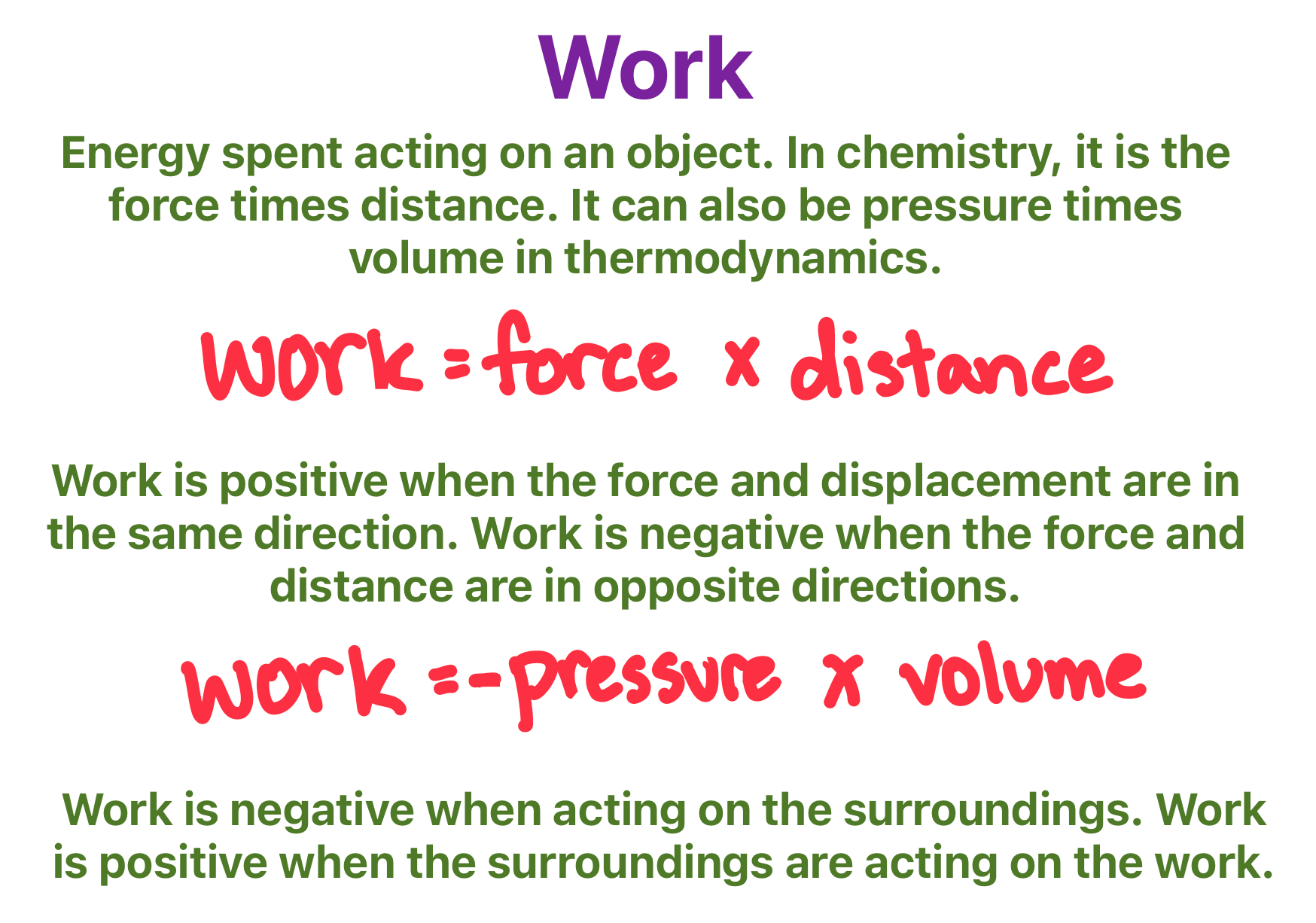
You've probably heard of work before. It is energy that has been spent acting on an object. Typically work is expressed as force times distance (displacement length). So, our formula is . But in thermodynamics, this definition is a little impractical. So instead, we use pressure-volume work. Its formula is . Let's break this down a bit.
We can see that work has the same units as energy. Remember force is measured in Newtons (). The expanded form of a Newton is . So, it's mass multiplied by length, divided by time squared.
But, what about pressure-volume work? Is it any different? No. We can see our new definition also has the same units.
Explaining the Work Equation
The big question, is "why is there a minus sign?" There are two reasons. One physical, and the other mathematical.
Remember at its core, thermodynamics studies gases. To this effect, let's imagine a gas in a piston. We know that gases are expandable and compressible. So, in a piston, the gas will have variable volume. Why? The piston can move up and down. How does this affect the system's pressure? Do you remember when we studied Boyle's law? We learned that volume and pressure are inversely related. In a piston, the volume will change to keep the pressure constant. The pressure will always equal the atmospheric pressure outside the piston.
Let's say we decreased the temperature of our gas. We know the movement of the molecules or atoms slows. So, the piston will push down on the gas. This is also an application of Charles' Law. To keep the pressure constant, our volume decreases. The system did work on the gas. When the system does work, we define the work as positive. But, the change in volume is negative. To counterbalance the decrease in volume, we add the negative sign in .
Now, let's imagine we increase the temperature of our gas. That means we increased the kinetic energy of the gas molecules. From the kinetic molecular theory, we know that the gas will collide more with its container. So, it exerts a greater force on the piston. The gas pushes the piston upward. In this case, the gas is doing work on the system. It exerted a force that caused displacement. So, the work done is negative. Again, let's look at our equation: . The pressure remains constant and the volume increased. So, the negative sign offsets the volume increase.
The diagram below illustrates these two scenarios.

The other explanation of the minus sign relies on internal energy. Internal energy (), is given by the equation below.
This equation signifies that changes in the internal energy are caused by changes in the heat and available work (the đ signifies that these are inexact differentials). This equation can be rewritten as a sum of exact differentials in the following way.
By comparing these two equations, we can see that we require the minus sign to flip the sign.