Read · 3 min
Steven Kwon has written about the intuition and proof behind the MVT here.
But why do we need the Mean Value Theorem (MVT)?
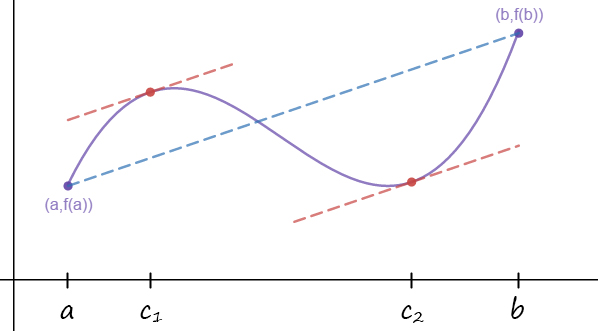
Well, the MVT tells us that for any interval , we can find an interior point where the derivative/"sensitivity" "represents" the overall change of the function, in the sense that equals .
So the rough answer is that if we have information about the derivative/"sensitivity" of a function at lots of points (e.g. on an interval ), then we can use the MVT to translate that into properties of the function itself. For example, in (1) below, we're given lots of "local" derivative information, e.g. that always (the derivative is always positive), and we can use MVT to translate that into a more "global" statement about increasing functions (i.e. whenever ).
Well, the rough answer is that it allows us to use "local" derivative/"sensitivity" information to say interesting things about "global"/big-picture function properties. (The limit definition of a derivative already tells us how to use "global"/big-picture function information---namely the function values themselves---to say interesting things about "local" derivative/"sensitivity" properties.) In applications 1, 2, and 3 below, this is how the MVT is used. *
On the other hand, the MVT can seem kind of arbitrary (&), especially if you don't care so much about rigor. Is it really necessary to learn/teach?
Well, you can read the thread if you're interested. But for me, here's the key takeaway, stolen from Jeff Strom's excellent answer:
The MVT is the basis for all proofs that geometric intuition about slopes of tangent lines holds for the limit definition. That is, the metamathematical content of the MVT is that the intuition definition matches the formal definition.
In other words, the MVT is just a rigorous way to capture our geometric intuition about derivatives, which you use a lot in sketching derivatives. But again, don't worry if you find the MVT arbitrary. You'll be fine if you understand the intuition for some of its most important applications:
(1) Increasing and decreasing (monotone) functions in terms of derivatives.
(2) Functions with always-zero derivatives (this is later applied to answer the very important question of whether anti-derivatives are unique, but don't worry if you haven't heard of anti-derivatives yet).
(3) When tangents lie above or below graphs.
In all of these, we have some intuition involving some sort of inequality (&&) in a function or graph: the notion of increasing/decreasing in (1), a graph "resembling a horizontal line everywhere" in (2), and the notion of above/below in (3). And in each case, the MVT is just a simple way to formalize our graphical intuition.
(4) Precursor to Taylor's "Weak" Theorem *
Additional comments (feel free to ignore these)
(&) The reason MVT seems arbitrary is because it just says there exists some point with , while it would possibly be more natural to have a statement like "the average value of the derivative is ". And it turns out that this is true, in some sense (it's half of the fundamental theorem of calculus, which you'll encounter later on). The caveat? To prove that, we use (2) from above, which comes from MVT.
(&&) More precisely, it's worth clarifying why MVT works to prove these inequalities, because (&) makes MVT seem kind of unnatural or artificial. Roughly speaking, the reason MVT works for 1, 2, and 3 is that the information on derivatives we have in these cases is uniform:
(1) We're using MVT on a function with for all .
(2) We're using MVT on a function with for all .
(3) We're using MVT on a function with for all .