Illustrated · 2 min
+2 contributors


Absolute Value
Think of the absolute value of a real number the distance from it is on the number line. || is , because is that distance away from . Now ||'s absolute value is also , because though it is negative, the distance to is also .
What if we are asking the absolute value of ||? In this case there is another number with the also between the parentheses! Well, this is just like the distance from .
If you ever see another number or variable next to the 'main one' (in this case the main one is ), just switch its sign, like how we did it with , and find the distance to that new number.
Absolute Value Functions
The basic absolute value function looks like this:
Always watch for the absolute value bars around a variable in a function.
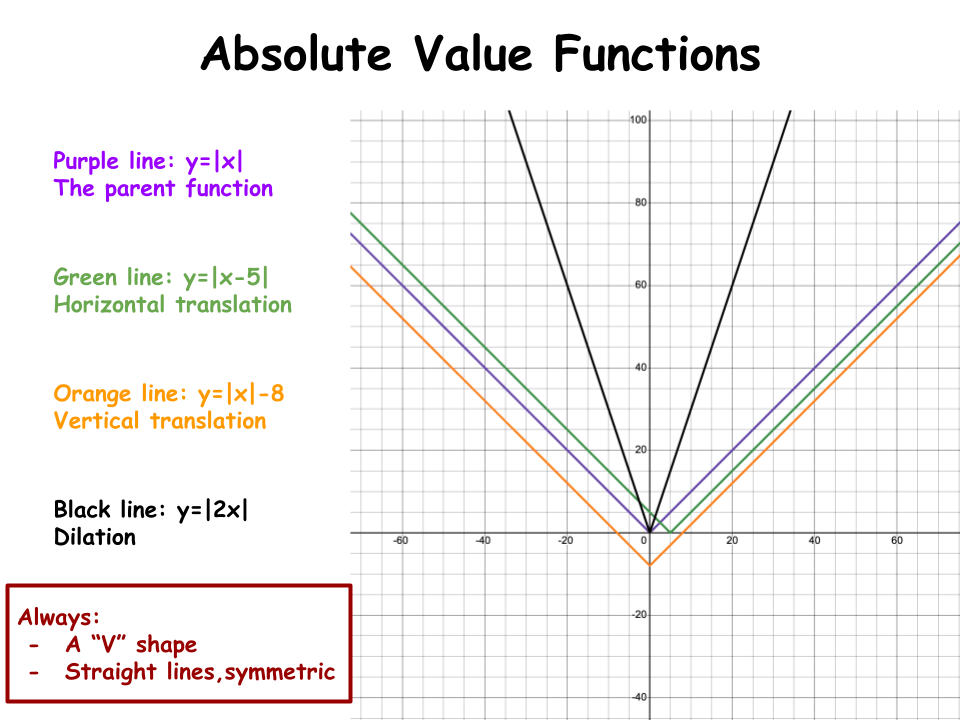
When graphed, absolute value functions look like 's with the point at the origin, and the - axis splitting them in half.
The reason for this is that the absolute value of is always a positive number. Which means can never be negative. This is why the graph of absolute value functions always stay above the - axis, except when they are at the origin.
For our basic absolute value function, this is the reason why it looks like a symmetrical . Our function can be 'split' into two very simple functions: and . All we have to do now is slice off the halves of our new functions which are under the - axis, and connect the rest.
From here we get the exact description above: a symmetrical .

Made using Desmos
A quadratic absolute value function goes by this same reasoning. The only difference is that the absolute value term on the right side of the equation is squared. This is the basic quadratic absolute value function's form:
As you can see, it's basically a quadratic function, but involving absolute value.

Made using Desmos
Looking Further
You can also apply transformations to the absolute value function, such as the function being shifted left, right, up, or down. You'll learn about this later!