Interactive · 6 questions
+4 contributors



The Rules
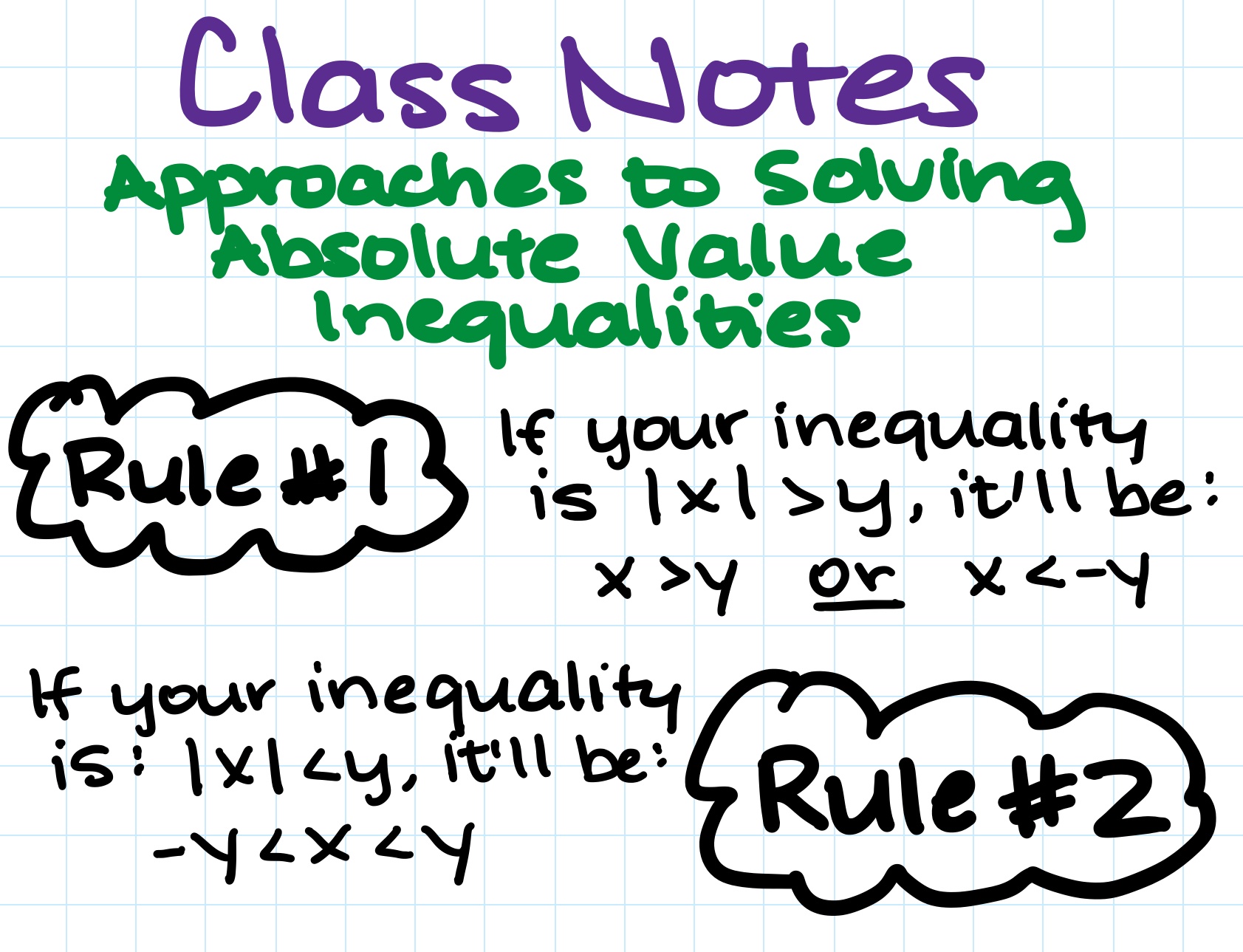
There are two rules to follow when you've got an inequality with an absolute value.
-
If your simplified inequality looks like , then set up and solve two inequalities: or , the word "or" links the two inequalities.
-
If your simplified inequality looks like , then set up and solve one inequality:
(Note: inequalities that use (i.e., greater than or equal to) will follow Rule 1 and inequalities that use (i.e., less than or equal to) will follow Rule 2.)
To review steps required to solve compound inequalities, check out this lesson.
Sometimes, it may be easier to imagine these shortcuts when you plot points on a number line. With really big numbers, though, that may be hard to do.
Note
In order for these rules to work, arrange the inequality to have the variable on the left side and the constant on the right side of the inequality symbol.
Also, always be mindful of negative numbers and positive numbers - this is the place where most students mess up when solving problems with a linear inequality.
This easy setup works for real numbers and variables.
Make sure you keep track of what are the absolute value bars and what is the number !
Alright, let's get started!
Let's review. Consider this inequality:
Which of these choices represents the inequality we will solve?
Now, consider this inequality:
Let's look at examples of both cases.
This inequality will follow Rule 1.
This inequality uses a sign. It falls under the first rule.
Now we need to set up and solve two inequalities:
Check off the two correct inequalities from the list below.
Now that we've got the two inequalities set up, we need to solve each one for .
Solve the first inequality. What is the value of ?
Solve the second inequality. What is the value of ?
You can plot both values on a number line, too.
Should we use closed or open circles to plot and on the number line?
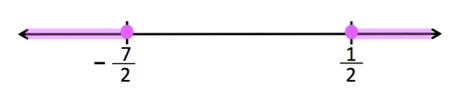
Image source: by Hannah Bonville
You can also give your answer in interval notation. Check out this lesson to refresh on how to do that!
You can take this concept a step further and solve word problems or tackle piecewise functions.