Illustrated · 1 min

So far, we have learned about sine, cosine, and tangent, but now it's time to learn about the inverses of these functions. Let's start with the cosecant function!

##Cosecant

Cosecant is the reciprocal of sine: csc⁡(θ)=1sin(θ)\csc(\theta) = \frac{1}{sin(\theta)}.

Just like the other trigonometric functions, it is a periodic function, with properties such as an amplitude, midline, and period. Keep in mind that csc⁡(x)\csc(x) looks very different from sin⁡(x)\sin(x), so these parts on the graph will also look very different.

Thinking of a triangle, sin⁡=oppositehypotenuse\sin = \frac{opposite}{hypotenuse}.

Therefore, csc⁡=hypotenuseopposite\csc = \frac{hypotenuse}{opposite}.

Cosecant can be used to solve equations such as csc⁡(θ)+π=4π2\csc(\theta) + \pi = \frac{4\pi}{2}.

It can also be used in trig identities, which you will learn about in later math courses!

Graph of csc(x)

Made using Desmos

The above is a graph of the csc⁡(x)\csc(x) function. While this looks very complicated, the process to graphing it is very similar to how we graphed sin⁡(x)\sin(x).

Keep going to learn more inverse trig functions as well as how to graph these! You will also learn how to calculate their exact values.

Illustrated · 1 min

The Cosecant Function

The next item in our set of trigonometric functions is the cosecant function! The cosecant of an angle is the reciprocal of the sine. From SOHCAHTOA, we know that sine is the ratio of the opposite angle to the hypotenuse of a right triangle.

sinx=oppositehypotenuse\text{sin}{x} = \frac{\text{opposite}}{\text{hypotenuse}}

The reciprocal of the sine function would mean that the cosecant is the ratio of the hypotenuse to the opposite angle.

cscx=hypotenuseopposite\text{csc}{x} = \frac{\text{hypotenuse}}{\text{opposite}}
Title: Cosecant Function

Graph of cosecant function with asymptotes labeled

Image source: by Trisha

The graph kind of looks likes a grid!

If you want to take this concept a step further, you could explore the table of cosecants. This table will be entirely the reciprocals of the sine function!

You can also use the unit circle to find cosecant.

Video · + 1 min read

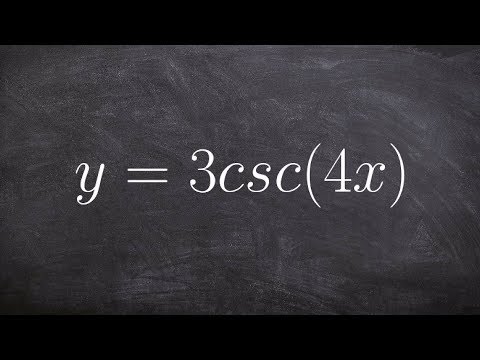
(Video) Graphing the Cosecant Function

by Brian McLogan

In this video by Brian McLogan, you will learn how to graph the cosecant function.

Summary

Graph the following function: y=3 csc (4x)y=3 \text{ csc }(4x)

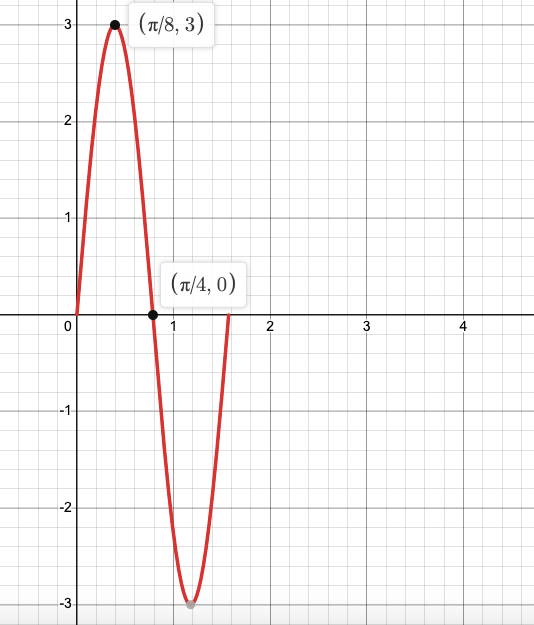
Cosecant is the reciprocal of sine! To graph the cosecant function, let's first try to graph the sine function, y=3 sin (4x)y=3 \text{ sin }(4x). The amplitude is: 33, the period is π2\frac{\pi}{2}. The graph looks like:

Graph of y=3sin(4x)

Made using Desmos

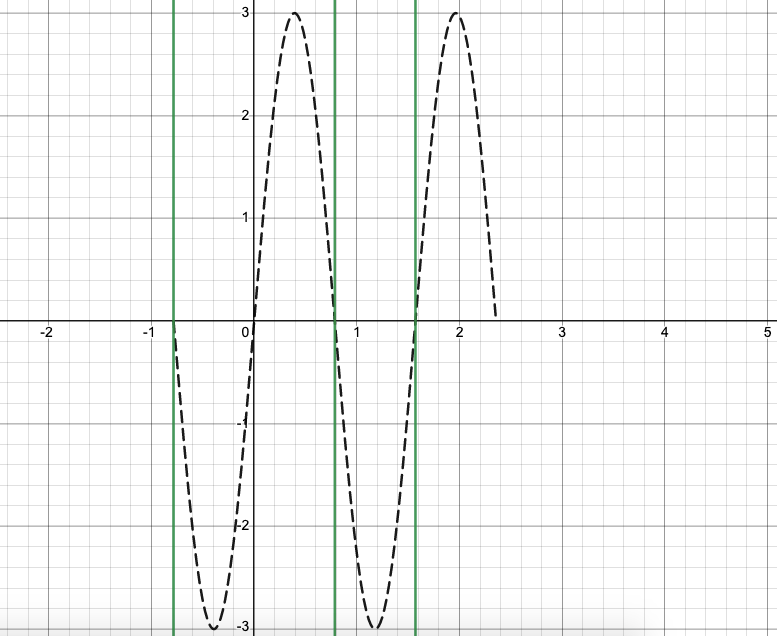
The above sine graph is NOT the solution to our problem! But we will use this sine graph to graph the cosecant function. Let's look at this graph over two periods, and let's make it dashed.

Dashed sine function of y=3sin(4x)

Made using Desmos

We know that  csc (x)=1 sin (x)\text{ csc }(x) = \frac{1}{\text{ sin }(x)}, so we can say that:

 csc (π4)=1sin(π4)= csc (π4)=10\text{ csc }(\frac{\pi}{4}) = \frac{1}{sin(\frac{\pi}{4})} = \text{ csc }(\frac{\pi}{4}) = \frac{1}{0}

This is undefined! So we know that there will be a vertical asymptote at x=π4x=\frac{\pi}{4}. We can extend this to: at all of the xx-intercepts on the sine graph, there will be a vertical asymptote on the cosecant graph. On the next graph, the asymptotes are labeled in green.

Graph with vertical asymptotes

Made using Desmos

We now have everything we need to graph the cosecant function. It looks like:

Graph including cosecant function

Made using Desmos

Without all of the extraneous information, our cosecant graph looks like:

Cosecant graph

Made using Desmos

Type a concept, like “slope” or “photosynthesis”.

↑ ↓ to choose · Enter to openSearch explanations and problems