Perbandingan langsung: menemukan konstan dan grafik

Before this, knowPendahuluan tentang perbandingan langsung (sebanding)

Interactive · 1 question

Directly Proportional Graphs

Let's take a look at some directly proportional graphs when k=2k=2, k=12k=\frac12, and k=6k=6.

Direct proportionality graphs when k=1/2, k=2, and k=6.

Made using Desmos

Notice anything? They're all linear! And they all pass through the origin. So any linear equation that passes through the origin is a direct proportion.

If we write the above equations out, we get: y=12xy=2xy=6xy={\color{#4079b2}{\frac12}} x\quad\quad y={\color{#bf4f4c}{2}}x\quad\quad y={\color{#419d51}{6}}x The constant of proportionality is just the slope of the linear equation.

Example

Suppose we're told to draw the graph of a proportion whose constant of proportionality is 1010. Can we?

Yes! Remember, the constant of proportionality is just the slope of a line. The equation is: y=10xy=10x

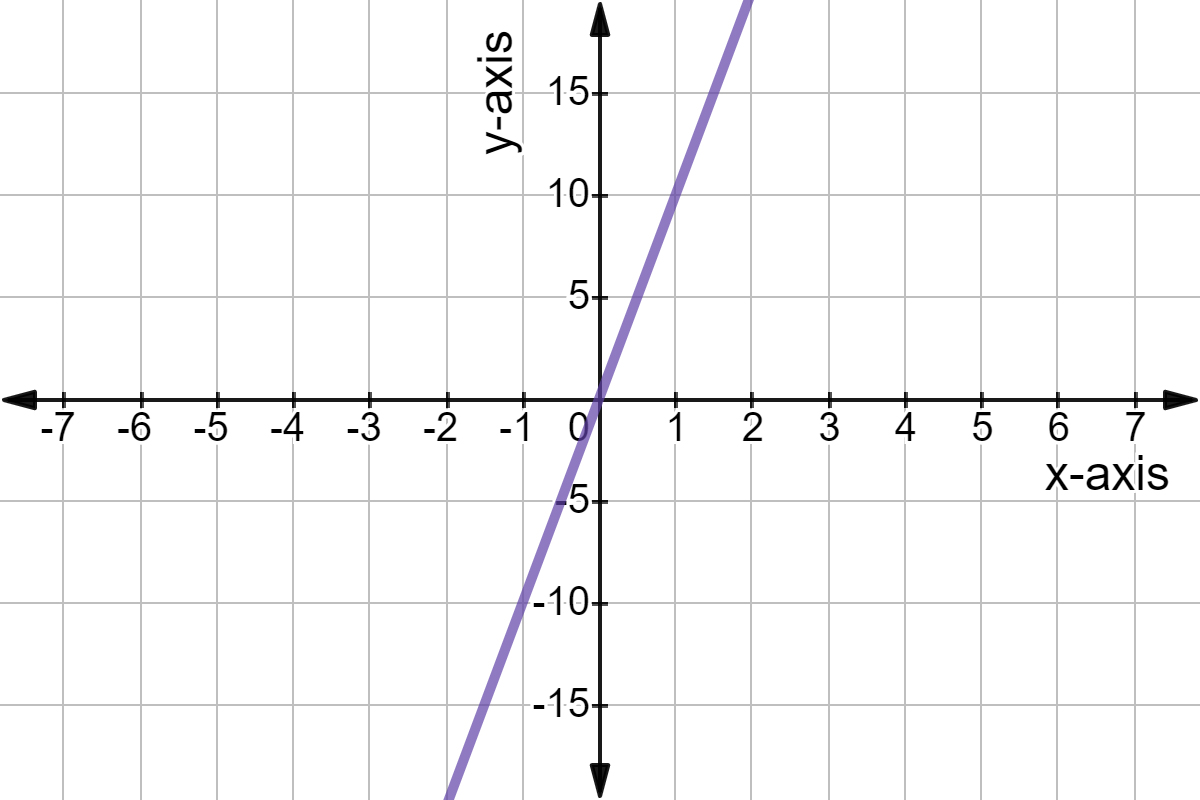
Graphing this gives us:

Graph of y = 10x.

Made using Desmos

Practice Problem

A graph is given showing that the amount of money you make is directly proportional to the hours you worked.

Graph of y = 18x.

Made using Desmos

How much do you make an hour?

Choose one answer

Video · + 1 min read

(Video) Learn and Understand Direct Variation

by AlgebraTestHelper

This video by AlgebraTestHelper goes over how to do a direct variation problem.

Direct Variation

In algebra, we will see direct variation, inverse variation, and joint variation. This lesson will cover direct variation.

Here is the standard equation for direct variaiton:

y=kxy=kx

Where yy and xx vary directly. kk is the constant of variation.

For example, think of boiling water on a stove. As the pot is on the flame, the temperature is increasing, but so is the pressure in the pot. Temperature and pressure vary directly. As temperature increases, pressure increases.

Let's look at an example.

Example 1: If x=3x=3 and y=15y=15, what is yy when x=5x=5?

First, let's solve for kk.

y=kxy=kx 15=k(3)15=k(3) 5=k5=k

So we know that the constant of variation, kk, is 55. So now, instead of having a general equation, we have a new equation for this relationship:

y=5xy=5x

What is yy when x=5x=5? Let's take a look:

y=5(5)y=5(5) y=25y=25

Most direct variation problems will work out pretty similar to this example!

Illustrated · 1 min

Direct Variation

We can use direct variation to describe a specific type of relationship between two variables.

Say we wanted to track the number of people who go to the beach and the temperature outside. If we sat on a park bench and counted the number of people who go to the beach everyday for one year, and we tracked the temperature for one year, we may notice that as the temperature increases, so does the number of people who go to the beach. This is an example of direct variation.

If we want to mathematically graph these numbers, there's an equation for it!

Direct variation
y=kx
k= constant of variation
y and x vary directly
x,y-coordinate graph, with a line going up and to the left

Image source: by Anusha Rahman

Type a concept, like “slope” or “photosynthesis”.

↑ ↓ to choose · Enter to openSearch explanations and problems