Eliminasi

Before this, knowSubstitusi

Interactive · 1 question

Nonlinear Systems: Elimination

We've learned how to use substitution to solve nonlinear systems. We can also use elimination, just like we do with linear systems. We will learn about the intersection of nonlinear equations using elimination.

Let's look at an example.

{x2−y=32x2+6y=14\begin{cases}x^2-y=3\\ 2x^2+6y=14\end{cases}

We need to find a way to change one of our equations so we can eliminate one of our variables. We're going to multiply the top equation by 22. 2(x2−y)=2(3)2x2−2y=6\begin{align}2(x^2-y)&=2(3)\\ 2x^2-2y&=6\end{align} Now we can subtract the second equation from the first eliminate xx. 2x2−2y=6−0002x2+6y=142y=−2y=1\begin{align}2x^2-2y&=6\\ -\phantom{000}2x^2+6y&=14\\ \hline 2y&=-2\\ y&=1 \end{align}

Now that we have a value for yy, we can plug it into one of our original equations to find our xx-values.

x2−y=3x2−(1)=3x2=4x=±2\begin{align}x^2-y&=3\\ x^2-(1)&=3\\ x^2&=4\\ x&= \pm 2 \end{align}

We have solutions at (2,1)(2,1) and (−2,1)(-2,1). Let's check this on a graph.

We have crossing points at the points (2,1) and (-2,1)

Made with Desmos

The solution set includes the points of intersections.

Remember that the first step in solving any system with elimination is to adjust one of your equations until a variable is ready for elimination.

Here's a practice problem:

Find the solution(s) to the following system: {23x2−y=3x2+y2=18\begin{cases} \frac23x^2-y=3\\x^2+y^2=18 \end{cases}

Choose all correct answers

Video · + 1 min read

(Video) Multi-Variable Systems of Non-Linear Equations

In the video below, The Art of Problem Solving's Richard Rusczyk walks you through how to solve two different forms of non-linear equations using two methods: substitution and elimination. Watch the video (feel free to skip around!) to see how you can manipulate equations in a system to make easier equations to solve.

The first equation Richard solves may look complicated at first, but it is actually a linear equation in disguise.

If you see an equation that looks hard, don’t despair. Try to move terms around and simplify it as much as you can. Many equations become much easier once they are simplified.

Simplifying your work helps in two important ways. It makes the problem easier to solve, and it also reduces the chance of making mistakes.

The next two equations cannot be linear because they include exponents. Equations with exponents do not form straight lines.

To solve these equations, Richard uses the elimination method. He does this by dividing one equation by the other to remove a variable.

If you want to see this step in action, this part of the video starts at 7:50.

Video · + 1 min read

(Video) Solving a System of Nonlinear Equations by Elimination

by Brightstorm

This video by Brightstorm walks you through an example of how to use elimination to solve a system of nonlinear equations.

Summary

2x2−10y2=8x2−3y2=6\begin{align} 2x^2 -10y^2 &=8 \\ x^2 -3y^2 &= 6 \\ \end{align}

Solving a system of equations with nonlinear terms is very similar to solving a system of equations with linear terms. We want to choose one of our variables to eliminate. For this system, it would be easiest to get rid of the x2x^2 terms, but in order to do that, we have to manipulate the equation a little.

x2−3y2=6→(−2)(x2−3y2=6)→−2x2+6y2=−12x^2 -3y^2 = 6 \rightarrow (-2)(x^2 -3y^2 = 6) \rightarrow -2x^2 +6y^2 = -12

So our new system looks like:

2x2−10y2=8−2x2+6y2=−122x2−10y2=8−2x2+6y2=−12−4y2=−4y2=1y=±1\begin{align} 2x^2 -10y^2 &=8 \\ -2x^2 +6y^2 &= -12 \\ \hline \cancel{2x^2} -10y^2 &=8 \\ \cancel{-2x^2} +6y^2 &= -12 \\ \hline -4y^2 &= -4 \\ y^2 &= 1 \\ y&=\pm 1 \\ \end{align}

Now we need to find the associated xx coordinates that go with these yy values.

For y=1y=1,

x2−3=6x2=9x=±3\begin{align} x^2 -3 &= 6 \\ x^2 &= 9 \\ x &= \pm 3 \\ \end{align}

That gives us the points: (3,1),(−3,1)(3, 1), (-3, 1).

In our equation, because the yy value is squared, we don't need to test the value y=−1y=-1. The xx values will be the same. But we do still need to consider those coordinates. So, we can determine that the points are also: (3,−1),(−3,−1)(3, -1), (-3, -1).

So, we end up with four total points as our solution: (3,1),(−3,1),(3,−1),(−3,−1)(3, 1), (-3, 1), (3, -1), (-3, -1).

Illustrated · 2 min

System of Nonlinear Equations: Elimination

Elimination is a method used to simplify and solve systems of nonlinear equations. The main idea is to remove one variable at a time.

By carefully combining the equations, you can eliminate a variable and create a simpler equation. This often reduces the number of variables you are working with.

Once the system is simpler, it becomes much easier to solve and find the solution.

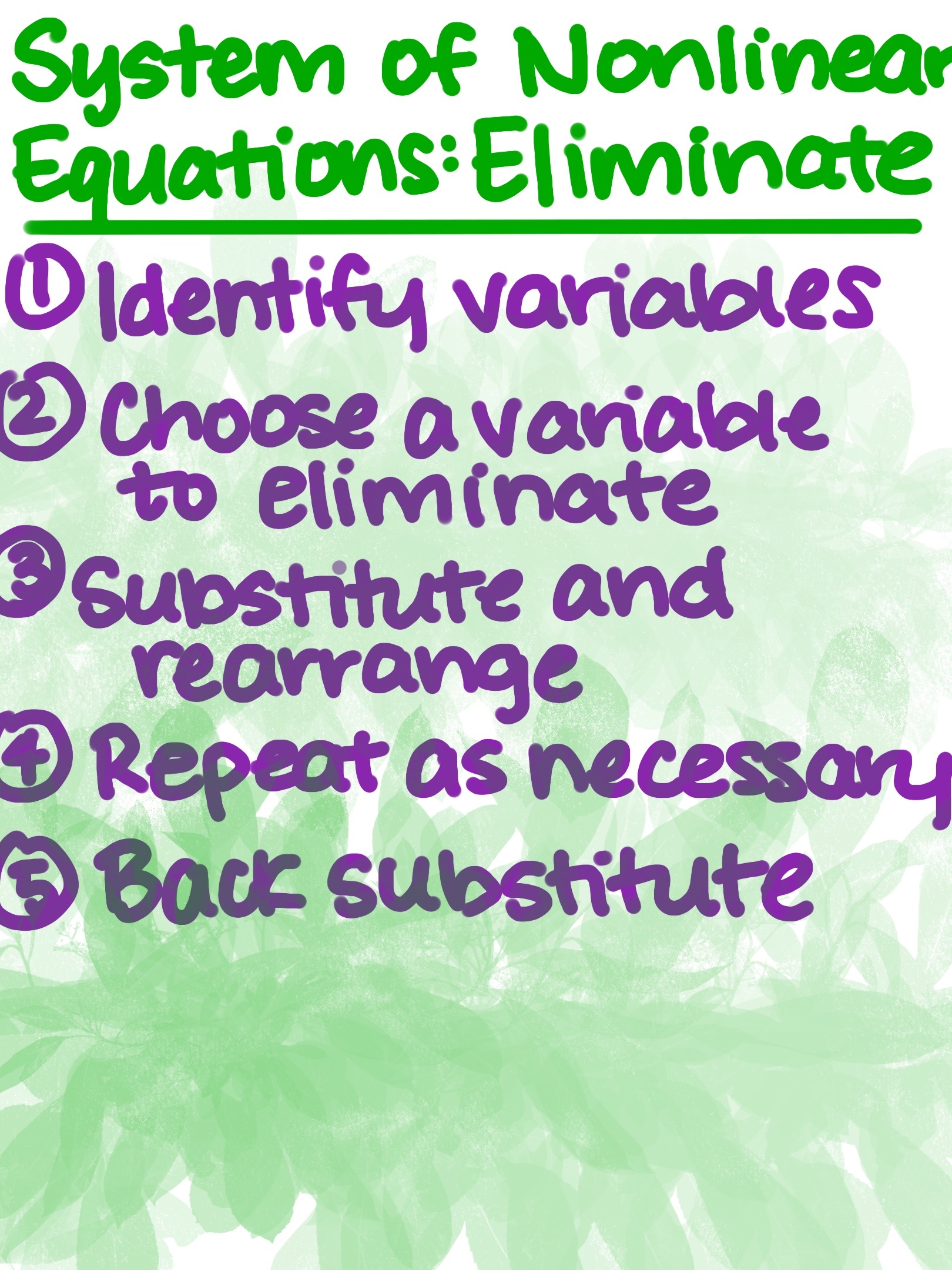
System of Nonlinear Equations: Eliminate
1. Identify variables
2. Choose a variable to eliminate
3. Substitute and rearrange
4. Repeat as necessary
5. Back substitute

Image source: by Anusha Rahman

We can break down elimination into five steps:

  1. Identify variables: Begin with a system of nonlinear equations that includes more than one variable. Each equation gives information about how the variables are related. Our goal is to use this information to simplify the system and find the solution.

  2. Choose a variable to eliminate: Next, choose one variable to focus on for elimination. This is the variable you want to remove from the system. To do this, you often need to isolate that variable in one of the equations. In other words, you solve the equation for that variable. Once the variable is isolated, you are ready to eliminate it in the next step.

  3. Substitute and rearrange: Now, substitute the expression for the chosen variable into the other equation. This means you plug it in wherever that variable appears. After substituting, you may need to rearrange terms and simplify the new equation. This helps make the equation easier to solve.

  4. Repeat as necessary: If there are multiple variables to eliminate, repeat the same process. Each time, remove one variable from the system. Keep simplifying until you reach one equation with only one variable. This is the goal of elimination.

  5. Back substitute: Once you find the value of the last variable, you are not done yet. Next, substitute it back into the earlier equations. This is called back substitution. It helps you find the values of the other variables. By doing this, you can find the full solution to the system.

And...always, always check your work!

To do this, plug each solution back into the original equations. A correct solution will make every equation true.

If the values work in all of the equations, then your solution is correct. If not, go back and check your steps for mistakes.

Checking your answers helps you catch errors and feel confident about your final solution.

Type a concept, like “slope” or “photosynthesis”.

↑ ↓ to choose · Enter to openSearch explanations and problems