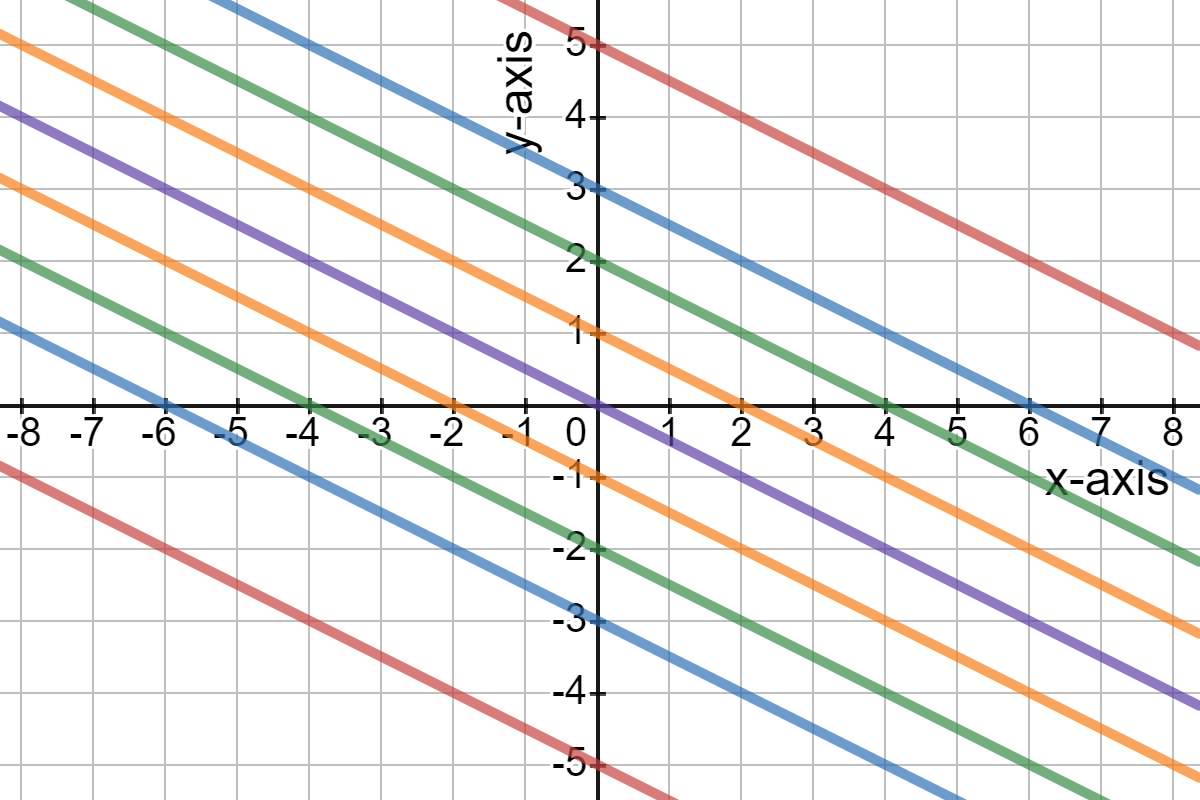
Garis-garis sejajar

Before this, knowMenentukan kemiringan dan perpotongan dengan sumbu-y

Video · + 1 min read

(Video) Writing Equations of Parallel Lines

by Friendly Math 101

Here's a video by Friendly Math 101 explaining parallel line equations.

Summary\large{\text{Summary}}

Parallel lines are lines that will never intersect. Both lines can go onto infinity, and they will never meet.

If we have an equation in the form y=mx+by=mx+b, parallel lines will have the same slope but different yy-intercepts.

Let's look at an example. If we have a line given by the equation y=5x−1y=5x-1, what would be the equation of a line parallel to it?

A line parallel to this will have the same slope and a different intercept. Since, the slope in the equation is m=5m=5 the slope for the parallel line will be m=5m=5.

Finally, we need to choose any yy-intercept that isn't the same as b=−1b=-1. y=5x+2y=5x+2 Here's one possible answer. There are essentially an infinite number of options.

Try it yourself!

Find the equation of a line parallel to y=34x+7y=\frac34x+7.

Choose one answer

Interactive · 2 questions

Changing only the yy-intercept keeps lines parallel

Parallel lines are lines that will never intersect. One special property shared by parallel lines is that the slopes are equivalent. Intersecting lines will never have equal slope. Parallel lines' slopes are equivalent, so the only thing setting them apart from equivalent lines is the difference in yy-intercept.

Practice

Are these two lines parallel: (y−7)=54(x−8)(y-7)=\frac{5}{4}(x-8) and y=54x−100y=\frac{5}{4}x-100?

Choose one answer

Illustrated · 1 min

Parallel Lines

If you keep the slope of a line the same but change the yy-intercept, you're basically moving the line uniformly (all points by the same amount) in a vertical direction. The two lines won't intersect, so we call them parallel. Lines that meet at a 90o90^o angle are perpendicular. The perpendicular slope are opposite reciprocals of the parallel slope.

Example

In the example below, the blue line, y=0.5x−2y = 0.5x - 2, has been moved upwards by 77 units, to get the green line y=0.5x+5y = 0.5x + 5.

The two lines are parallel: they have the same slope, 0.50.5, but the yy-intercept has changed by +7+7 units, from −2-2 to +5+5.

Blue line: y = 0.5x - 2

Green line: y = 0.5x + 5

Made using Desmos

There are infinitely many parallel lines because you can have any line with the same slope and infinitely many different yy-intercepts. Here are some examples of parallel lines in graphs.

Graph of y = 3x - 2 and y = 3x + 5.

Made using Desmos

Parallel lines.

Made using Desmos

The graph above shows 88 parallel lines. Notice how more lines could be graphed in between those lines. There are infinite possibilities because the real numbers are the numbers on a number line or Cartesian plane. The real numbers are infinite, so the number of parallel lines are also infinite.

Type a concept, like “slope” or “photosynthesis”.

↑ ↓ to choose · Enter to openSearch explanations and problems