
Interactive · 3 questions
+5 contributors



Equivalent Inequalities
Equivalent inequalities are inequalities that communicate the same information.
There are a few different ways to produce equivalent inequalities.
First, an inequality is equivalent to its mirror image. Let's see what that looks like:
Notice how one inequality is essentially a backwards version of the other. The pointy part of the inequality sign is always pointing towards the ! When this is the case, the inequalities are equivalent. However, it is important that you are VERY mindful of the direction of the inequality sign.
Example 1: These two inequalities are NOT equivalent because the pointy part of the inequality sign is pointing to in the first inequality, and in the second inequality:
Example 2: These two inequalities are equivalent because they are mirror images....the pointy part of the inequality sign is facing the in both cases:
Example 3: These two inequalities are not equivalent because the orientation of the inequality signs are opposites....these two inequalities convey opposite information!
It helps to read the inequalities aloud. For our two equivalent inequalities, the first one tells us that " is greater than " and the second says that " is less than ." That is equivalent information.
If that's still confusing, there are a few more ways to determine if inequalities are equivalent.
Method One: Plug in the same value for the variable(s) in both of the following inequalities:

Notice how both of these inequalities tell us the same information.
Method Two: Create a number line that represents each inequality. Then compare.

The number lines look the same!
Method Three: Write the solutions to each inequality in interval notation and then compare.

The interval notation is the same!
How would you write each of these inequalities in interval notation?
and
Are the two inequalities (above) equivalent?
Method Four: Another way to produce equivalent inequalities is to perform the same operation on both sides of the inequality.
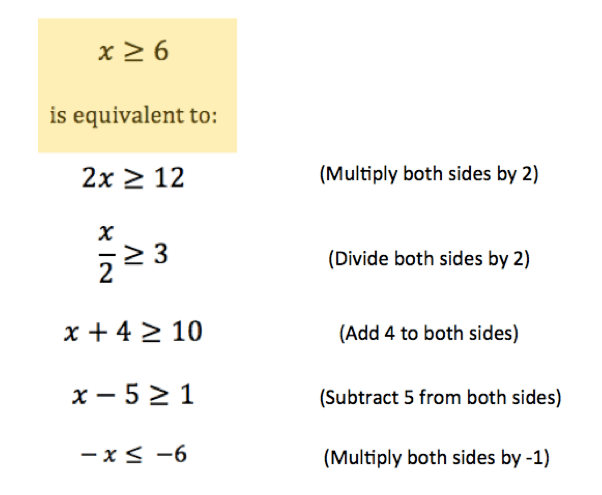
All of these inequalities are equivalent!
NOTE that we FLIPPED the inequality sign in the last example. Whenever you multiply or divide by a negative number, you need to reverse the inequality sign.
Check off any inequality that is equivalent to .


