Illustrated · 1 min

+2 contributors


To estimate a possible solution to an equation, you can always look at the graph. We can estimate different features in order to create the equation of the function.
Let's take the equation . Here's what the graph looks like.

Made using Desmos
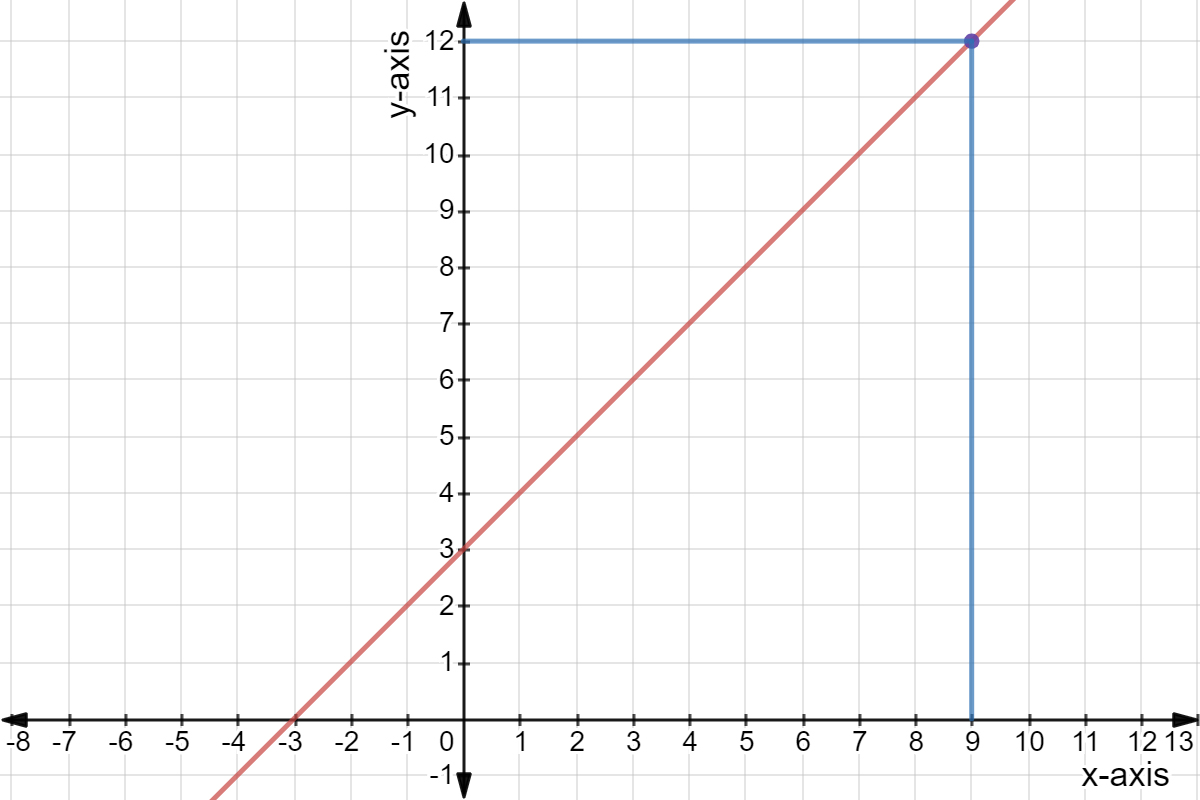
Okay so what if I asked you to find the value of when ? Well I certainly can't do that in my head, and I don't have a calculator near me. But I can estimate the value by looking at the graph. We are essentially going to find the corresponding value to our value by reading the graph!
This looks like a quadratic function. First let's find on the -axis.

Made using Desmos
Here's roughly where is on the -axis. Now we have to move up in a straight line until we reach our graph.

Made using Desmos
And now we just have to move in a straight line towards the -axis and see what number it lands on.

Made using Desmos
As you see it lands around . So we can say that when where that . If you want to be a little more accurate you can notice is a little above . So you can choose a value a little above . Let's say .
And hey look I found my calculator. Let's see what the actual answer is and see how close we were. If where then . As you can see both and were fairly close.
Be careful though. While estimations might be helpful for some quick calculations, it's always best to be as accurate with your numbers as much as possible. This method is good for approximations, or if you're looking for a way to double check your work, but it does not provide an accurate number. Even if the value you found is right on a line, it is always good practice to double check with exact calculations.