Fungsi Genap

Video · + 1 min read

(Video) Odd and Even Functions

by Eddie Woo

Here's a video by Eddie Woo explaining even and odd functions.

Even and odd are symmetries that are categories for describing functions. A function can be even, odd, or neither.

Even Functions

An example of an even function would be y=x2y=x^2. It is symmetric over the yy-axis. This means that if you were to fold the graph across the yy-axis, the two sides would line up.

Graph of y=x^2

Graphed with Desmos

If you were to shift the function to the right, it would shift the line of symmetry. Let's look at y=(x−1)2y=(x-1)^2.

Graph of y=(x-1)^2

Graphed with Desmos

This function is now symmetric over the line x=1x=1. But this is not an even function anymore. Even functions must be specifically symmetric over the yy-axis.

Even Algebraic Definition

The algebraic definition is a good way to prove that the function is even.

If a function is even, then: f(x)=f(−x)f(x)=f(-x)

This just means if you plug some xx into the function it will give you the same result as if you plugged in the negative version of xx.

To prove if a function is even we plug both xx and −x-x into it and show they equal the same thing. For the function y=x2y=x^2: f(x)=(x)2=x2f(−x)=(−x)2=x2f(x)=(x)^2=x^2\\ f(-x)=(-x)^2=x^2 So you can see f(x)=f(−x)f(x)=f(-x). Therefore, f(x)f(x) is even.

Odd Functions

An example of an odd function is y=x3y=x^3. It is symmetric over the line y=xy=x. This means that if you were to rotate the graph at the origin, the two sides would match up. This is sometimes known as point symmetry or rotational symmetry.

Graph of y=x^3

Graphed with Desmos

Odd Algebraic Definition

If a function is odd, then: −f(x)=f(−x)-f(x)=f(-x)

This means if you plug in some xx value it will equal to negative result of what you get when you plug in the negative xx value.

To prove a function is odd, plug in xx and −x-x and show they are opposites of each other. −f(x)=−[(x)3]=−x3f(−x)=(−x)3=−x3-f(x)=-[(x)^3]=-x^3\\ f(-x)=(-x)^3=-x^3 So you can see f(−x)=−f(x)f(-x)=-f(x). Therefore, f(x)f(x) is odd.

Illustrated · 1 min

An even function, f(x)f(x) satisfies the following relationship:

f(x)=f(−x)f(x)=f(-x)

This means that for any positive value of xx, f(x)f(x) outputs the same number as −x-x.

When plotting, even functions are symmetrical about the y-axis.

Graph of y=x^2, graphed on desmos

Graphed with Desmos

An example of an even function would be f(x)=x2f(x)=x^2. We know that this is a even function because x2=(−x)2x^2=(-x)^2. From the graph above, one can see that function is symmetrical with the y-axis as the axis of symmetry.

Illustrated · 1 min

An odd function, f(x)f(x) satisfies the following relationship:

f(x)=−f(−x)f(x)=-f(-x)

This means that for any positive value of xx, f(x)f(x) outputs the additive inverse of −x-x.

When plotting, evens functions are symmetrical about the origin.

Graph of y=x^3

Graphed with Desmos

Video

(Video) Even and Odd Functions

by ThinkwellVids

Here's a video by ThinkwellVids explaining the difference between even and odd functions and how you find out if a function is one of them.

Illustrated · 1 min

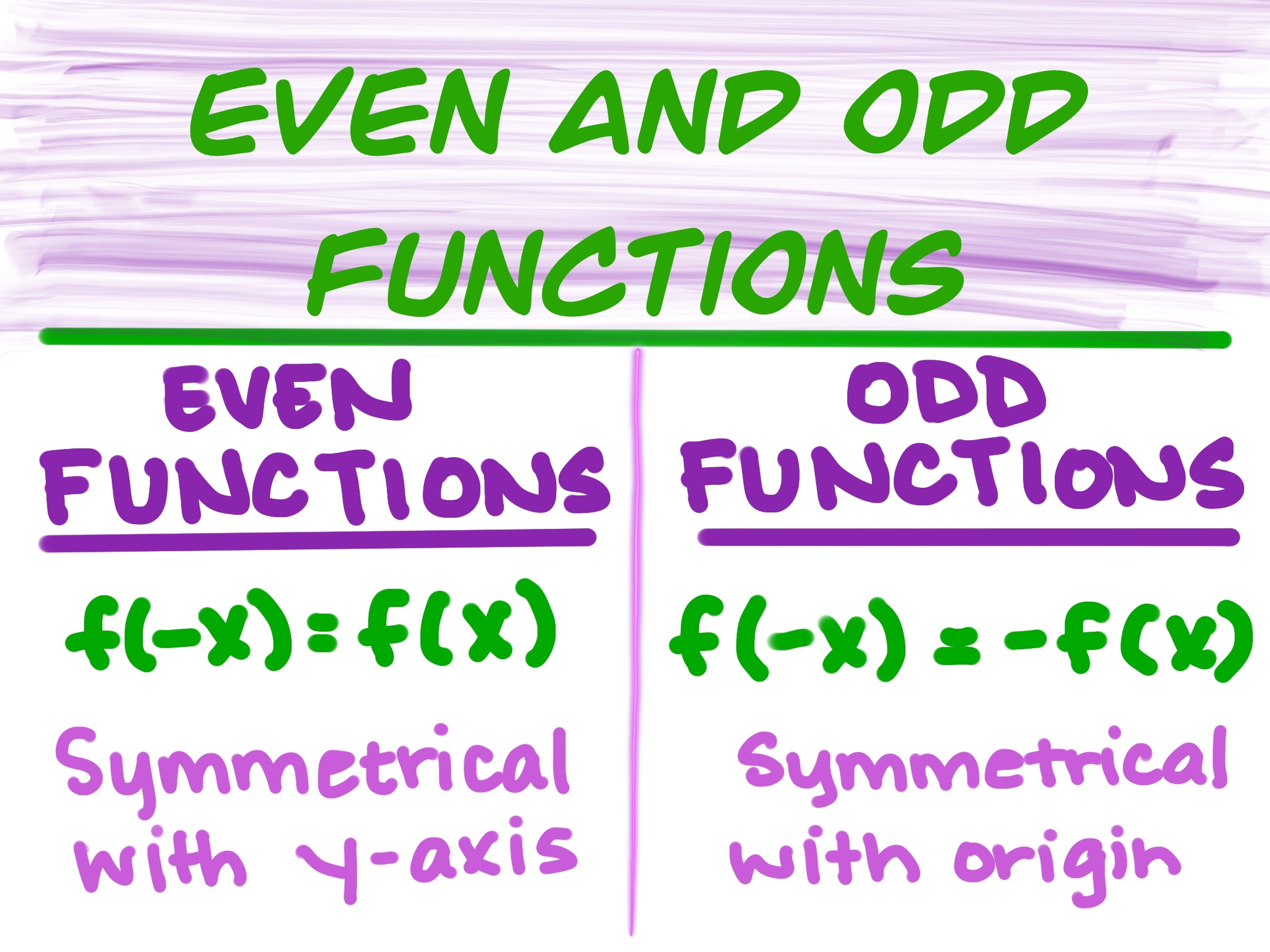
Even and Odd Functions

The characteristics of even and odd functions has to do with the original function's symmetry with certain elements.

Even functions: f(-x)=f(x) ; symmetrical with y-axis
Odd functions: f(-x)=-f(x) ; symmetrical with origin

Image source: by Anusha Rahman

For even functions, there is symmetry with the yy-axis. With odd functions, there is symmetry with the origin.

A nifty trick to keep in mind is that the function is a sum of odd exponents (i.e., the exponents are all odd), then the function is also odd. Similarly, if the exponents in the function are all even, then the function is also even.

Taking it a step further, the product of two even functions is even. The product of two odd functions is also even.

Looking Further

In the next lesson, you will be able to prove functions are even or odd algebraically. Once you've mastered that, you'll find out that nearly every function is a sum of even and odd functions!

Type a concept, like “slope” or “photosynthesis”.

↑ ↓ to choose · Enter to openSearch explanations and problems