Read · 2 min

+2 contributors

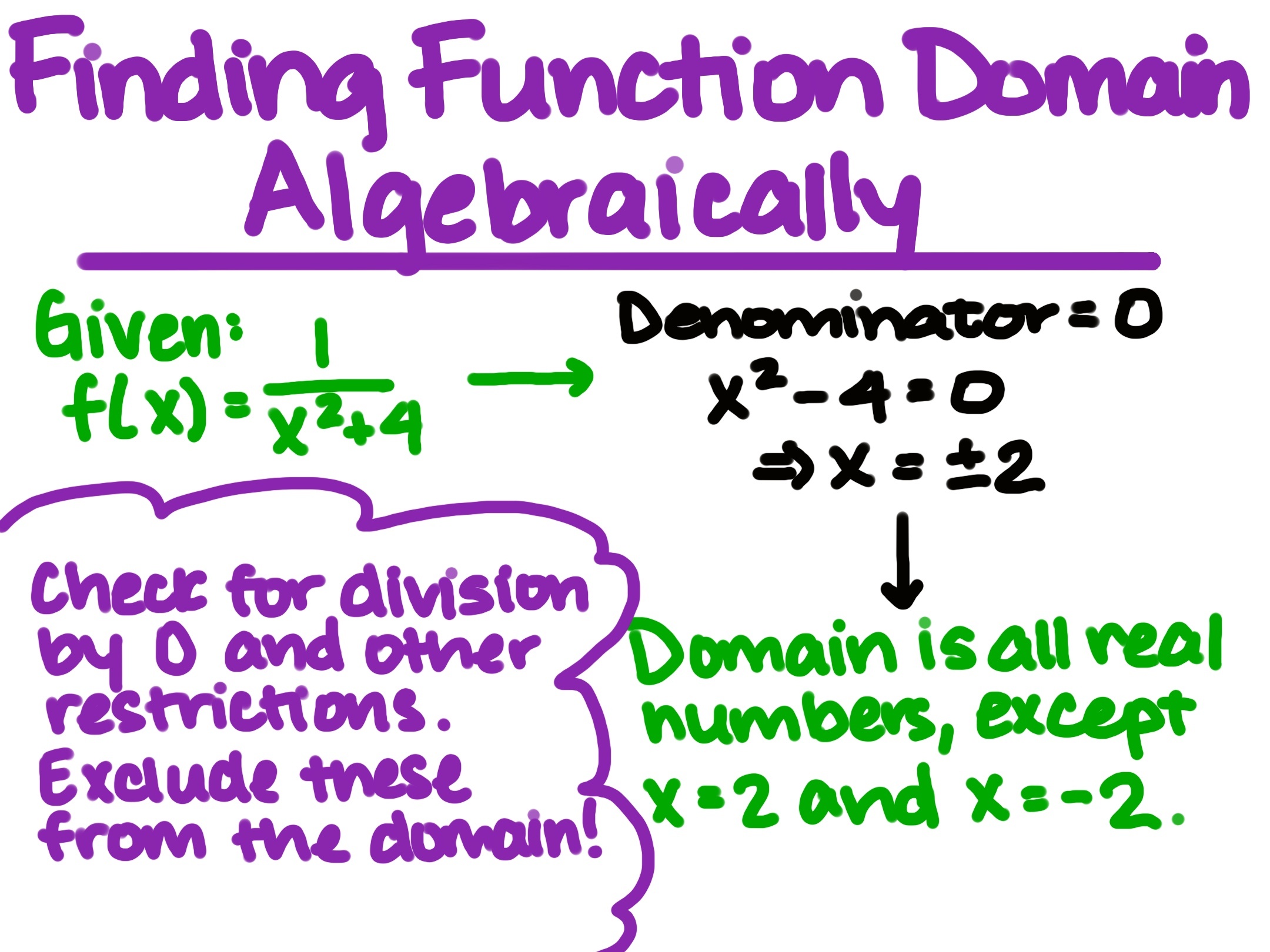
When you are trying to find the domain of a function algebraically, it may be helpful to find all the values that CANNOT be in the domain these are the values that would "break" the function, or make the function undefined. Values that cause you to you divide by take the square root of a negative real number, or take the log of a non-positive number will not be in your domain, because they yield undefined functions.
When you divide by your function is undefined. So, any value that gives you a in the denominator of your function will not be in the domain. For example, let's look at the function What value of will cause the denominator to be
When then which is undefined. Thus, cannot be in our domain. So, our domain is
When we restrict ourselves to working with real numbers (as opposed to complex numbers), recall that the square root of a negative real number is undefined. So, any value that gives you a negative number under the square root will not be in the domain. Take a look at What value(s) of gives you a negative number under the square root? When then will be the square root of a negative number, and will therefore be undefined. Thus, all real numbers less than cannot be in our domain. So, our domain is
If you take the log of a negative number or the result will be undefined. So, any value that causes you to take the log of a non-positive number will not be in the domain. For example, take a look at What value(s) of gives you a non-positive number? When then will be the log of a non-positive number, and will therefore be undefined. Thus, all real numbers between (and including) and cannot be in our domain. So, our domain is