Pertidaksamaan

Before this, knowMengenali solusi EkstrinsikMenggambar grafik fungsi-fungsi radikal

Read · 2 min

So far, we've seen pretty simple inequalities with linear and polynomial terms. But those are not the only types of inequalities we can have! Just like equations, inequalities can get complex with powers, roots, and radicals. If we wanted to go even further, we can introduce negative numbers (but we'll deal with this much later!).

Exponential Inequalities

Exponential inequalities are inequalities with at least one variable that is raised to an exponential power. We've seen this concept previously when we've solved equations with the quadratic formula. When we raise a value to an even power, the raised value is always positive, so it's possible that the original value was either positive or negative. In contrast, when we raise a value to an odd power, the raised value can be positive or negative, depending on the original sign.

Here are some examples:

32>7 AND (−3)2>73^2 > 7 \text{ AND } (-3)^2 > 7 23>6 AND (−2)6<62^3 >6 \text{ AND } (-2)^6 < 6

Always look very closely at your signs!

Inequalities with Radicals

When solving radical equations and radical inequalities, there are a couple of standards points to keep in mind.

  • Start off by solving the inequality normally, by first isolating the radical, then eliminating the radical.

  • Always remember that the radicand must be greater than 00, so this will need to play a part in your answer. You will need to set up a second inequality where you solve for the radicand being greater than zero.

Let's walk through an example.

Example

x−1>6(x−1)2>62x−1>36x>37\begin{align} \sqrt{x-1} > 6 \\ (\sqrt{x-1})^2 > 6^2 \\ x-1 > 36 \\ x > 37 \\ \end{align}

Remember that if you want to get rid of the square root, you need to square both sides.

We've finished the first step, but we have to remember that the value under the radical sign cannot be negative. So, we can set up our second inequality.

x−1≥0x≥1\begin{align} x-1 \geq 0 \\ x \geq 1 \\ \end{align}

Now, we have two solutions. However, only one of them can be true! We are going to select the inequality that is more restrictive, meaning that there are less possible solutions. If we imagine a number line, we can see that the solution to this inequality is x>37x>37.

Video

(Video) Solve an Inequality with a Square Root

by Brian McLogan

In this video by Brian McLogan, you will be able to walk through an example of solving an inequality with a square root.

Summary
2x+4+1≥5\sqrt{2x+4} + 1 \geq 5

We know that we cannot square both sides to get rid of the square root, since there's a 11 on the left side. So, the first step is to isolate the radical.

2x+4≥4\sqrt{2x+4} \geq 4

Now that we have the radical isolated, we can square both sides.

2x+4≥162x+4 \geq 16

Now, we want to isolate the xx like usual.

x≥6x \geq 6

Illustrated · 1 min

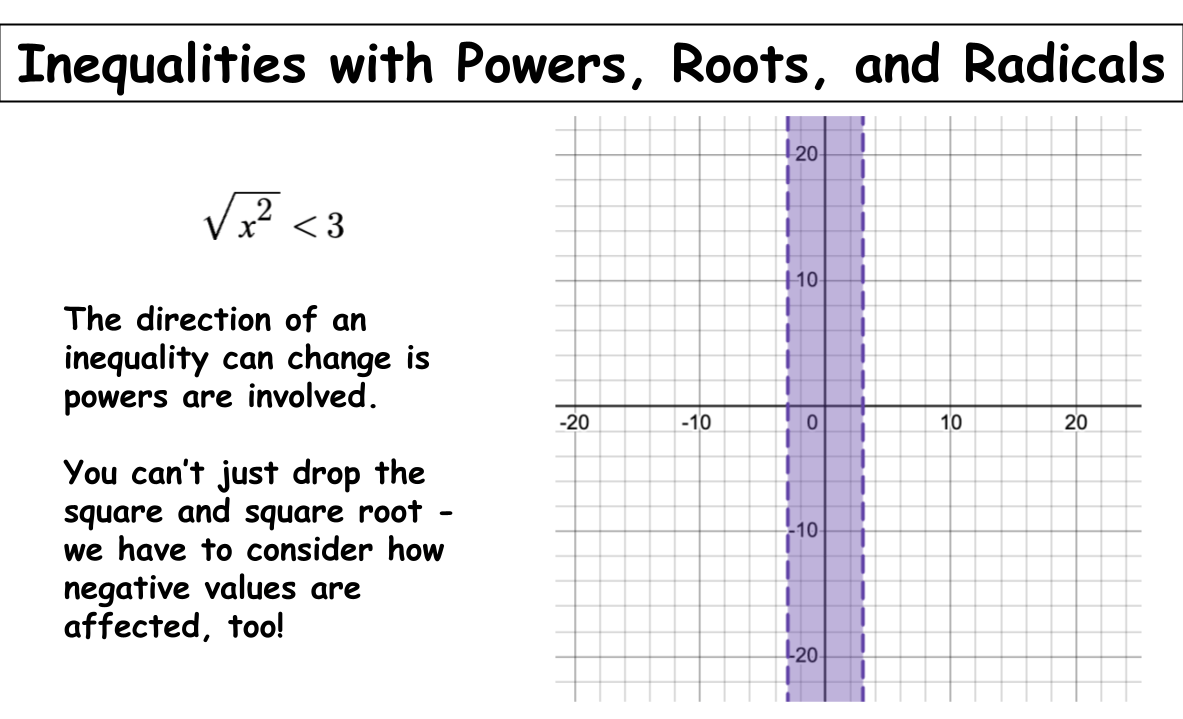
Inequalities with Powers, Roots, and Radicals

We know that inequalities compare two values using symbols like >>, <<, ≥\geq, and ≤\leq. When we add powers or roots to inequalities, we have to think carefully about how they change numbers.

Inequalities with Powers, Roots, and Radicals
The direction of an inequality can change is powers are involved.

You can’t just drop the square and square root - we have to consider how negative values are affected, too!

Made using Desmos

Squaring a number always gives a positive result, even if the number started out negative. This can make inequalities tricky, especially if you're not sure if a number is positive or negative. Therefore, the direction of the inequality can change if powers are involved.

Square roots only work with non-negative numbers in most math problems. They tend to make numbers smaller - so we need to be careful when comparing values after using square roots.

With inequalities, we need to watch how powers and roots affect the size and direction of what we're comparing. We need to always think about whether the numbers involved are positive, negative, or zero.

Type a concept, like “slope” or “photosynthesis”.

↑ ↓ to choose · Enter to openSearch explanations and problems