Deret geometri tak hingga

Before this, knowApakah itu deret tak hingga

Read · 1 min

A geometric series is the sum of the terms of a geometric sequence.

Let a geometric sequence be: a,ar,ar2,ar3,...a, ar, ar^2, ar^3, ... S=a+ar+ar2+ar3+...arn−1S = a+ar+ar^2+ar^3+...ar^{n-1} S⋅r=ar+ar2+ar3+...+arnS\cdot r=ar+ar^2+ar^3+...+ar^n Subtracting these two equations gives us S(1−r)=a−arnS(1-r)=a-ar^n S=a(1−rn)1−rS=\dfrac{a(1-r^n)}{1-r} where aa is the first term, rr is the common ratio, and nn is the number of terms.

If we have an infinite geometric sequence (where ∣r∣<1|r|<1), we find that as nn continuously increases, rnr^n approaches 00. So, the sum formula of an infinite geometric series is a(1−0)1−r=a1−r\frac{a(1-0)}{1-r} = \frac{a}{1-r}.

Note that if r>1r > 1 then the sum will be ∞\infty, but if r<−1r<-1, then the sum will be undefined.

####Practice Problem:

What is the sum of the infinite geometric sequence: 1,12,14,...1, \frac{1}{2}, \frac{1}{4},...?

Well, a=1a = 1 and r=12r=\frac{1}{2}, so plugging these numbers into the formula, 11−12=2\frac{1}{1-\frac{1}{2}}=\boxed{2}.

Check what you really know

If you can solve a contest problem with this idea, you know it well. If not, you know exactly what to review. These are real problems from the AMC 8, AMC 12 and AIME, the national math competitions for middle and high school students, each with a worked solution on LIVE by Po-Shen Loh.

Read · 1 min

If we have a sequence such as 12+14+18+116+…\frac{1}{2} + \frac{1}{4} + \frac{1}{8} + \frac{1}{16} + \dots, which never stops, our sequence is called an infinite sequence. Now let's think about what we need in order to find the sum of the terms of our infinite sequence. It is impossible to add up all the terms; there are infinity of them. So we have to use this algorithm. First, let's call the sum of our terms SS. We have:

S=12+14+18+116+…S = \frac{1}{2} + \frac{1}{4} + \frac{1}{8} + \frac{1}{16} + \dots

Then notice that if we divide each side of the equation by 22, we find: S2=14+18+116+132+…\frac{S}{2} = \frac{1}{4} + \frac{1}{8} + \frac{1}{16} + \frac{1}{32} + \dots

The 12\frac{1}{2} term just disappeared! So S=S2+12S = \frac{S}{2} + \frac{1}{2} !

Therefore, 2S=S+12S = S + 1, so S=1S = 1.

From here we can conclude that SS, the sum of the terms in our sequence, is equal to 11!

We solved our infinite series.

Video

(Video) Geometric Series and the Test for Divergence

by PatrickJMT

The video above by PatrickJMT explains how to identify a Geometric series and test it for series divergence or convergence.

Video

(Video) Geometric Series

by Mathispower4u

The video above by Mathispower4u explains how to determine if a Geometric series converges or diverges.

Video

(Video) Sum of an Infinite Geometric Series

by PatrickJMT

In the above video by PatrickJMT examples of finding the sum of geometric series are given.

Video

(Video) Writing a Geometric Series Using Sigma Notation

by PatrickJMT

In the above video by PatrickJMT it is shown how to write geometric series in sigma notation.

Video

(Video) Infinite Geometric Series Finding the Sum

by The Math Sorcerer

In the above video by The Math Wizard it is shown how to find the sum of a geometric series.

Video

(Video) The Super Formula for Infinite Geometric Series

by The Math Sorcerer

In the above video by The Math Sorcerer he explains what he calls the "super formula" for Infinite Geometric series.

Video · + 2 min read

(Video) Limiting Sum of a Geometric Progression

by Eddie Woo

Here's a video by Eddie Woo where he explains what a limiting sum is and how you figure it out.

Recall that the sum of nn terms for a geometric series is given by the equation: Sn=a(rn−1)r−1=a(1−rn)1−rS_n=\frac{a(r^n-1)}{r-1}=\frac{a(1-r^n)}{1-r}

Choosing rr

If we choose an integer value for rr our series gets bigger and bigger and heads towards infinity. For example, if our ratio is 22 the series becomes: 1+2+4+8+⋅⋅⋅1+2+4+8+\cdot\cdot\cdot

If we choose an rr that's between −1-1 and 11, or ∣r∣<1|r|<1, then the series actually converges to some point. If we choose rr to be 12\frac12 our series becomes: 1+12+14+18+⋅⋅⋅1+\frac12+\frac14+\frac18+\cdot\cdot\cdot

So how do we find this point that the series converges to? We first need to figure out an equation for series of all the terms, not just nn of them. We begin by looking at what happens to rnr^n where ∣r∣<1|r|<1. As nn begins to get bigger what happens to our rr? We can denote this question with limit notation. lim⁡n→∞rn\lim_{n\rightarrow\infty}r^n This is just a way to write, as nn gets bigger and bigger and bigger, what happens to the expression rnr^n? Look at our series above where r=12r=\frac12. As it continues the number in the denominator is getting bigger and bigger. This means that the number itself is getting smaller and smaller. As nn increases, the expression rnr^n actually gets closer and closer to zero. (Just for your reference: if the number is getting larger and larger, the series is diverging).

lim⁡n→∞rn=0\lim_{n\rightarrow\infty}r^n=0

So what happens to our series of all the terms? "All the terms" is another way to say when n=∞n=\infty. Sn=a(1−rn)1−rS=S∞=a(1−r∞)1−rS=a(1−0)1−rS=a1−r\begin{align} S_n&=\frac{a(1-r^n)}{1-r}\\ S=S_{\infty}&=\frac{a(1-r^{\infty})}{1-r}\\ S&=\frac{a(1-\color{#8925AE}{0})}{1-r}\\ S&=\frac{a}{1-r} \end{align}

This formula is what we call the limiting sum! If your ratio is −1<r<1-1<r<1, then this formula tells you what the whole thing will approach.

Limiting Sums in Repeating Decimals

We can use limiting sums to figure out the fractional form of a repeating decimal. This is because fractions that repeat are actually geometric progressions! They're the sum of the whole thing.

For example, take the decimal 0.15ˉ0.\bar{15}. This is equal to the fraction 1599\frac{15}{99}. Let's write this out to get a better look at it. 0.15ˉ=0.151515151515⋅⋅⋅0.\bar{15}=0.151515151515\cdot\cdot\cdot How would we rewrite this as an infinite geometric progression? First, take the first iteration of the repeating decimal (the purple) and try to write it as a fraction. 0.151515151515⋅⋅⋅=151000.\color{#8925AE}{15}1515151515\cdot\cdot\cdot=\frac{15}{100} Next move on to the next iteration. We moved down two more decimal places so our fraction will be over 100 with two more zeros on its end. 0.151515151515⋅⋅⋅=15100+15100000.15\color{#8925AE}{15}15151515\cdot\cdot\cdot=\frac{15}{100}+\frac{15}{10000} This pattern continues of adding on two more zeros. 15100+1510000+151000000+⋅⋅⋅\frac{15}{100}+\frac{15}{10000}+\frac{15}{1000000}+\cdot\cdot\cdot If you still cant spot the geometric progression, let's rewrite it once more. 151001+151002+151003+⋅⋅⋅\frac{15}{100^1}+\frac{15}{100^2}+\frac{15}{100^3}+\cdot\cdot\cdot

So now, what's the first term? 15100\frac{15}{100}. a=15100a=\frac{15}{100}

What's the common ratio? 1100\frac{1}{100}. r=1100r=\frac{1}{100}

If we plug these into our limiting sum equation, we get: S=a1−rS=151001−1100S=1510099100S=15100⋅10099S=1599\begin{align} S&=\frac{a}{1-r}\\ S&=\frac{\color{#8925AE}{\frac{15}{100}}}{1-\color{#8925AE}{\frac{1}{100}}}\\ S&=\frac{\frac{15}{100}}{\frac{99}{100}}\\ S&=\frac{15}{100}\cdot\frac{100}{99}\\ S&=\frac{15}{99} \end{align}

Illustrated · 2 min

Infinite Geometric Series and the Geometric Series Test

As we've learned previously, an infinite geometric series is a geometric series that continues forever. Each term is found by multiplying the previous term by the common ratio. We use ellipses to show that the pattern never ends.

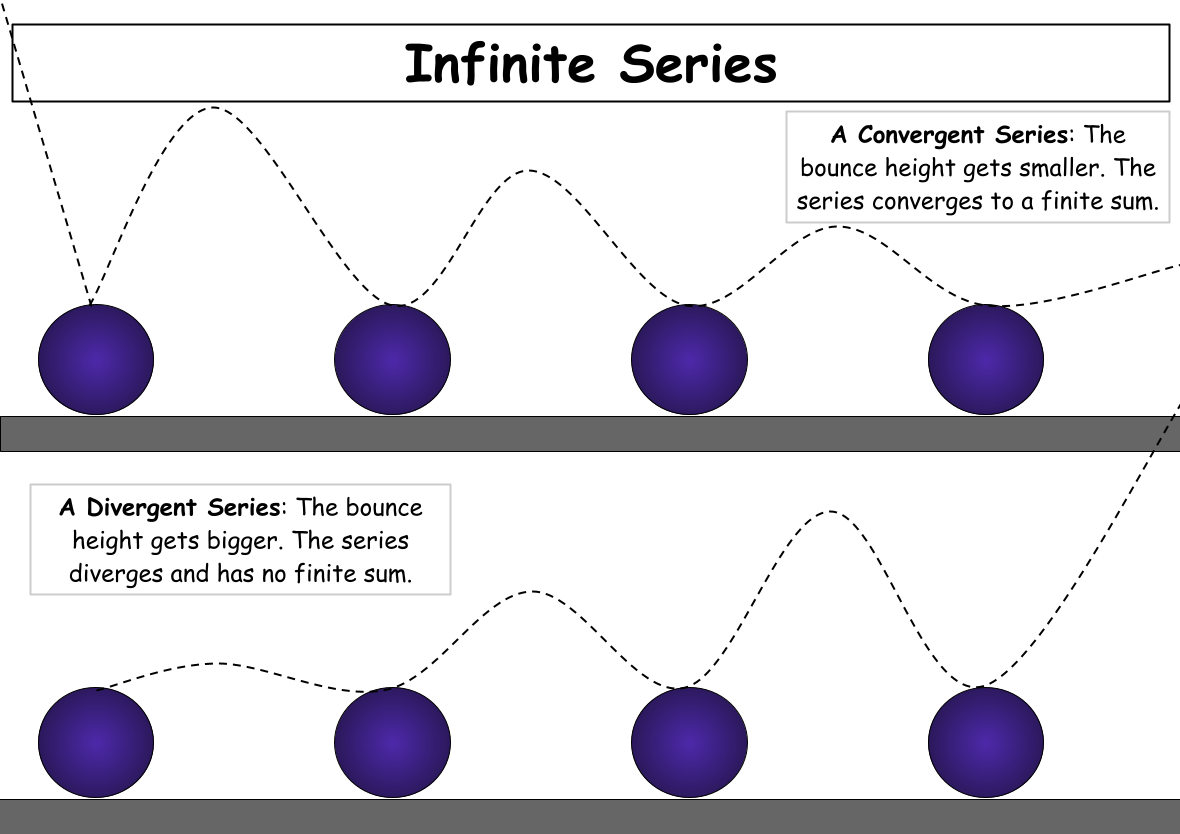
A Convergent Series: The bounce height gets smaller. The series converges to a finite sum.
A Divergent Series: The bounce height gets bigger. The series diverges and has no finite sum.

Image source: by Anusha Rahman

Even though an infinite geometric series has infinitely many terms, it does not always have an infinite sum. The key is the value of the common ratio. If the terms get smaller and smaller, the total can approach a fixed number called a limit. This is called the geometric series test.

The test says that an infinite geometric series converges only when the absolute value of the common ratio is less than 1. In other words, the series converges if ∣r∣<1|r| < 1.

When this happens, each new term adds less and less to the total. Eventually, the added terms become so small that the partial sums get closer and closer to a single value.

If the common ratio is greater than or equal to 11, or less than or equal to −1−1, the series does not converge. Instead, the terms either grow larger or continue oscillating without approaching a single value. These series are called divergent series.

The same conditions that determine convergence also make it possible to write Infinite Geometric Series as Rational Functions. A common ratio with absolute value less than 1 is required.

####Example

For example, look at the following series:

8+4+2+1+0.5+...8 + 4 +2 + 1 + 0.5 + ...

It has a common ratio of 12\frac{1}{2}. Since 12<1\frac{1}{2}<1, the series converges to a finite sum.

On the other hand, look at this other series:

8+16+32+64+...8 + 16 + 32 + 64 + ...

It has a common ratio of 22. Because ∣2∣≥1|2| \geq 1, the terms keep growing, and the series diverges.

####Geometric Series Test

The Geometric Series Test is a quick way to decide whether an infinite geometric sum has a finite sum. Before trying to find the sum of an infinite series, always check the common ratio first. If the ratio satisfies ∣r∣<1|r| < 1, the series converges. If it does not, the series diverges and has no finite sum. Understanding this simple test makes it much easier to analyze infinite geometric series.

Type a concept, like “slope” or “photosynthesis”.

↑ ↓ to choose · Enter to openSearch explanations and problems