Read · 1 min

In the previous lesson, we looked at adding and subtracting rational expressions. This lesson will look at the other two operations - multiplying and dividing expressions. Both of these lessons will help in simplifying rational expressions.
Multiplying and Dividing Fractions
It's helpful to review how to multiply and divide fractions.
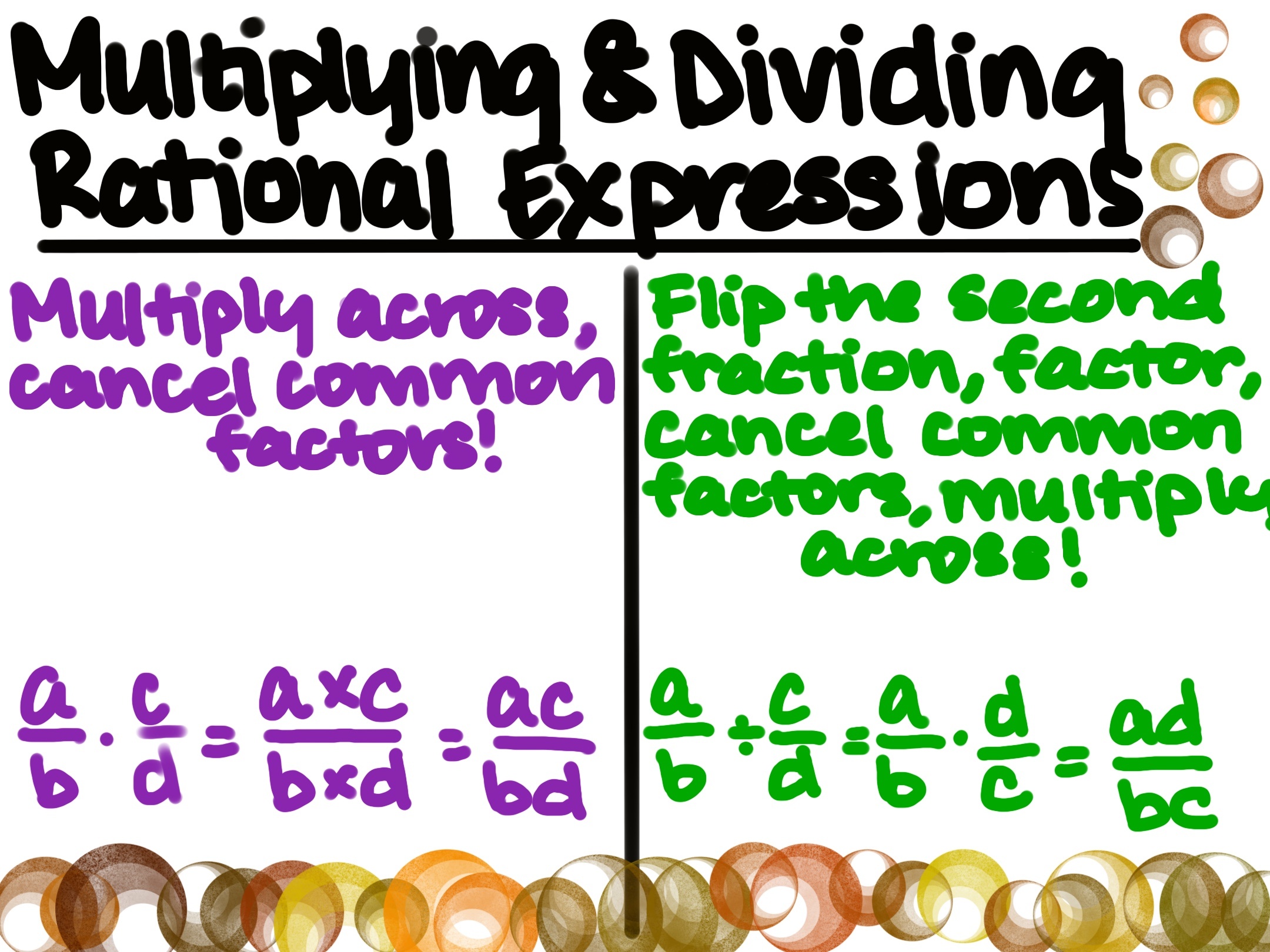
To multiply fractions, we multiply straight across the numerators and denominators. That means we multiply the numerator by the numerator, and we multiply the denominator by the denominator.
Dividing fractions has just one extra step. We multiply the first fraction by the reciprocal of the second fraction.
Multiplying Rational Expressions
We use this same concept when we are evaluating rational expressions! Since rational expressions are essentially a ratio of two expressions, we set up the expressions like a fraction.
Let's think about what happens if we want to multiply two rational expressions together! Then we're multiplying two fractions together!
Now, we'll multiply the two numerators together for the new numerator of the product. Then, we'll multiply the two denominators together for the new denominator of the product.
Dividing Rational Expressions
When we divide rational expressions, we use the same steps we'd use when dividing fractions! We multiply the first rational expression by the reciprocal of the second rational expression.
Let's say we want to divide the following rational expressions:
We're going to flip the second the fraction, i.e., find the reciprocal!
Now, we can multiply the numerators together, and then multiply the denominators together!