Mengalikan suku tunggal

Video

(Video) Multiplying Polynomials

by mathman1024

This video by mathman1024 covers monomial multiplication.

Summary\large{\text{Summary}}

Let's go through the steps for multiplying monomials

  1. Multiply the coefficients
  2. Use the product rule to multiply variable factors.

Let's try an example:

(6x7)(9x5)(6x^7)(9x^5)

First, we multiply the coefficients.

6⋅9=546 \cdot 9 = 54

Next, we multiply the factors using the product rule.

x7⋅x5x7+5x12x^7 \cdot x^5\\ x^{7+5}\\ x^{12}

We combine these two to get our answer.

(6x7)(9x5)=54x12(6x^7)(9x^5)=\boxed{54x^{12}}

Try these next ones on your own!

  1. (37x12y8)(54x10y8)(\frac37x^{12}y^8)(\frac54x^{10}y^8)
  2. (5x49y7)−2\left(\frac{5x^4}{9y^7}\right)^{-2}

Interactive · 1 question

Multiplying Monomials

When multiplying monomials, first multiply the coefficients, then multiply like variables using the exponent product rule.

Multiplying Monomials: Step One: multiply the coefficients. Step Two: multiply the variables using the exponent product rule. For example: (9x^6y^7)(10x^5y^3) = (9 * 10)x^6y^7 * x^5y^3) = 90(x^6y^7 * x^5y^3) = 90x^{6+5}y^{7+3} = 90x^{11}y^{10}

Image Source: Caroline Kulczycky

Let's do an example to practice!

Practice Problem

Simplify (2x6yz11)(15x2z5)(3y3).(2x^6yz^{11})(15x^2z^5)(3y^3).

Choose one answer

Illustrated · 1 min

Example Walk Through

Its daunting to see a lot of variables and numbers! Let's walk through an example and devise a strategy to tackle it.

First, do the following problems to warm up:

(2x)(x)=(2x)(2y)=(2x)(2xy)=(2xy2)(2xy)=\begin{align} (2x)(x) &=\\ (2x)(2y) &=\\ (2x)(2xy)&=\\ (2xy^2)(2xy)&= \end{align}

Each problem gets a little bit more complicated. Notice how you combine the constants, xx and yy. Now, try the following problem:

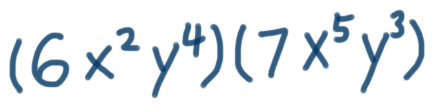
(6x^2y^4)(7x^5y^3)

Image Source: Christine

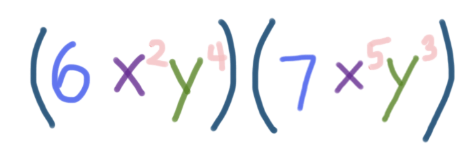
I color coded the expression:

6 and 7 - blue
x and x - purple
y and y - green
2, 4, 5, and 3 - pink

Image Source: Christine

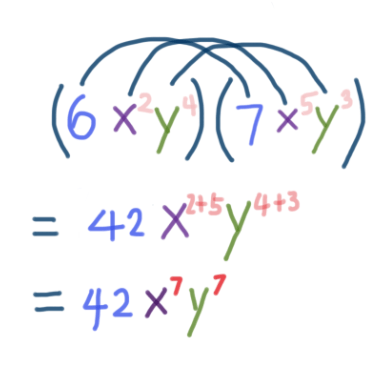
When multiplying and dividing monomials, we want to combine like terms—terms with the same base. We combine the constants, the xx's and the yy's.

(6x^2y^4)(7x^5y^3)
= 42 x^(2+5) y^(4+3)
= 42 x^7 y^7

Image Source: Christine

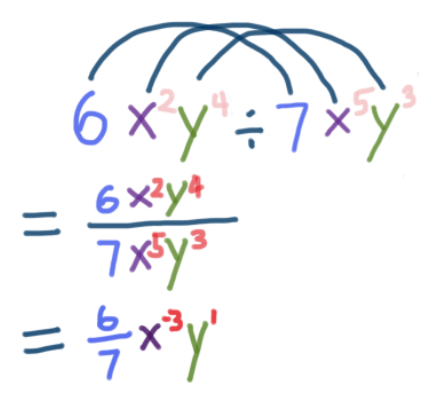
Division is similar. Instead of adding the power, we want to subtract (in the right order, of course).

(6x^2y^4)(7x^5y^3)
= 42 x^(2+5) y^(4+3)
= 42 x^7 y^7

Image Source: Christine

Interactive · 1 question

Match the Variables

We usually think of monomials as just one sort of unit in algebra, since mono means one. However, they can be made up of different variables multiplied together!

Let's say we have two monomials that we're trying to multiply: (4xy3z5)(9x3z2)(4xy^3z^5) (9x^3z^2) You want to focus on multiplying the like terms of these monomials. The constants multiply together, the xx variables multiply together. The yy variables multiply together. The zz variables multiply together.

The constants, 44 and 99, aren't a mystery, so we can multiply them together like we would normally.

The variables are a mystery, so we have to represent how many times they're multiplied with themselves. For multiplying exponents, we add together the exponent parts.

Let's solve the example given above. First, let's split the problem into the multiplication of its like terms. (4xy3z5)(9x3z2)=(4⋅9)×(x⋅x3)×(y3)×(z5⋅z2)\begin{align} &(4xy^3z^5) (9x^3z^2)\\ &=(4\cdot9)\times(x\cdot x^3)\times(y^3)\times(z^5\cdot z^2) \end{align} Then, multiply the like terms. Remember to add the exponent parts of the variables. =36×x1+3×y3×z5+2=36x4y3z7\begin{align} &=36\times x^{1+3}\times y^3\times z^{5+2}\\ &=36x^4y^3z^7 \end{align}

Let's try another problem.

Say we want to find the area of a rectangular garden, but we don't know the exact measurements. We do know that the length is equal to 6xyz6xyz and the width is equal 2xy2xy.

Rectangle with length 6xyz and width 2xy

Image Source: Amy Feraco

The area of a rectangle is given by the formula: Area=length×width\text{Area}=\text{length}\times\text{width}

What is the area of the rectangular garden?

Choose one answer

Type a concept, like “slope” or “photosynthesis”.

↑ ↓ to choose · Enter to openSearch explanations and problems