Interactive · 1 question

+3 contributors



Percent Error
Percent error (PE), also known as percentage error or absolute error, compares an experimental, approximated, or estimated value to a theoretical, actual, or known value. The lower the error, the closer the experimental value is to the actual value.
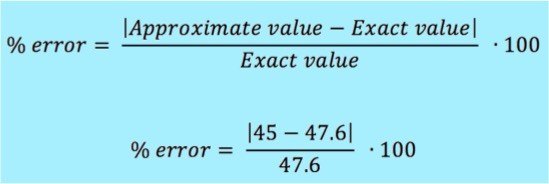
Here's how to calculate it:

Image source: by Caroline Kulczycky
Why is it multiplied by ? Because we want the value in a percent!
Keep in mind, your value can be positive or negative. You may also notice that this formula looks quite similar to percent change! At their core, they're very similar but used in different contexts and will be used differently.
Let's do an example.
The soccer field next to your house is long. One day, you and your pals decide to measure it yourselves, and you get What is your percent error?
First, let's determine our experimental and actual values.
We are given that the soccer field is long—this is the actual length of the field.
The measured length of the field, is the experimental value. Usually the experimental value is the one that you measure or estimate yourself.
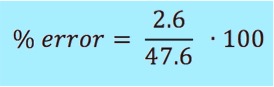
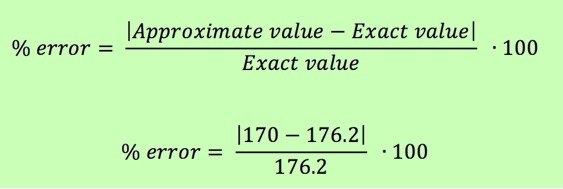
Now that we have our two values, we can substitute them into our equation and find the percent error:
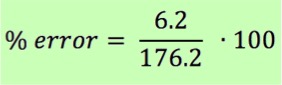
This was an equation with decimals, and our error is positive.
So, your percent error is, Not bad!