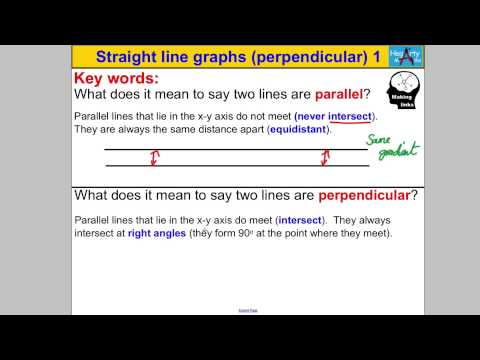
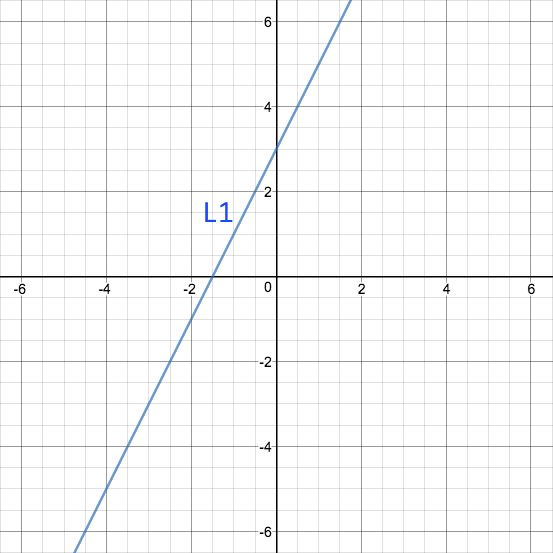
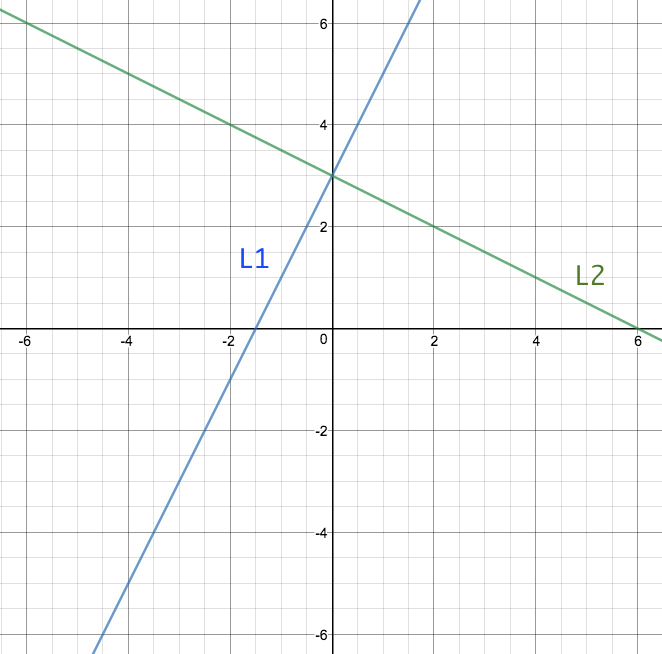
If two lines are not parallel, one other interesting possibility is that the lines are perpendicular, which means the lines form a right angle (90 degree angle—a square corner) where they meet. In this case, the slopes when multiplied together will equal −1. Solving for one slope leads us to the definition:
Perpendicular Lines
Given two linear equations f(x)=b+m1x and g(x)=b+m2x.
The lines will be perpendicular if m1⋅m2=−1, and so m1=m2−1
We often say the slope of a perpendicular line is the "negative reciprocal" of the other line's slope.
Example 9
Find the slope of a line perpendicular to a line with:
a)b)c)a slope of 2a slope of −4a slope of 32
If the original line had slope 2, the perpendicular line's slope would be m2=2−1.
If the original line had slope −4, the perpendicular line's slope would be m2=−4−1=41.
If the original line had slope 32, the perpendicular line's slope would be m2=32−1=2−3.
Example 10
Find the equation of a line perpendicular to f(x)=6+3x and passing through the point (3,0).
The original line has a slope m=3. The perpendicular line will have a slope m=3−1. Using this and the given point, we can find the equation for the line.
g(x)=b−31x
then at (3,0),
0=b−31(3)b=1
This line we're looking for is g(x)=1−31x.
Example 12
A line passing through the points (−2,6) and (4,5). Find the equation of a perpendicular line that passes through the point (4,5).
From the two given points on the reference line, we can calculate the slope of that line:
m1=4−(−2)5−6=6−1
The perpendicular line will have a slope
m2=−61−1=6
We can then solve for the vertical intercept that makes the line pass through the desired point:
g(x)=b+6x
then at (4,5),
5=b+6(4)b=−19
Giving the line g(x)=−19+6x.