Video · + 3 min read

+3 contributors


(Videos) Steps to Solving Word Problems
by mathman1024

This video by mathman1024 goes through the steps of solving word problems based on linear equations.
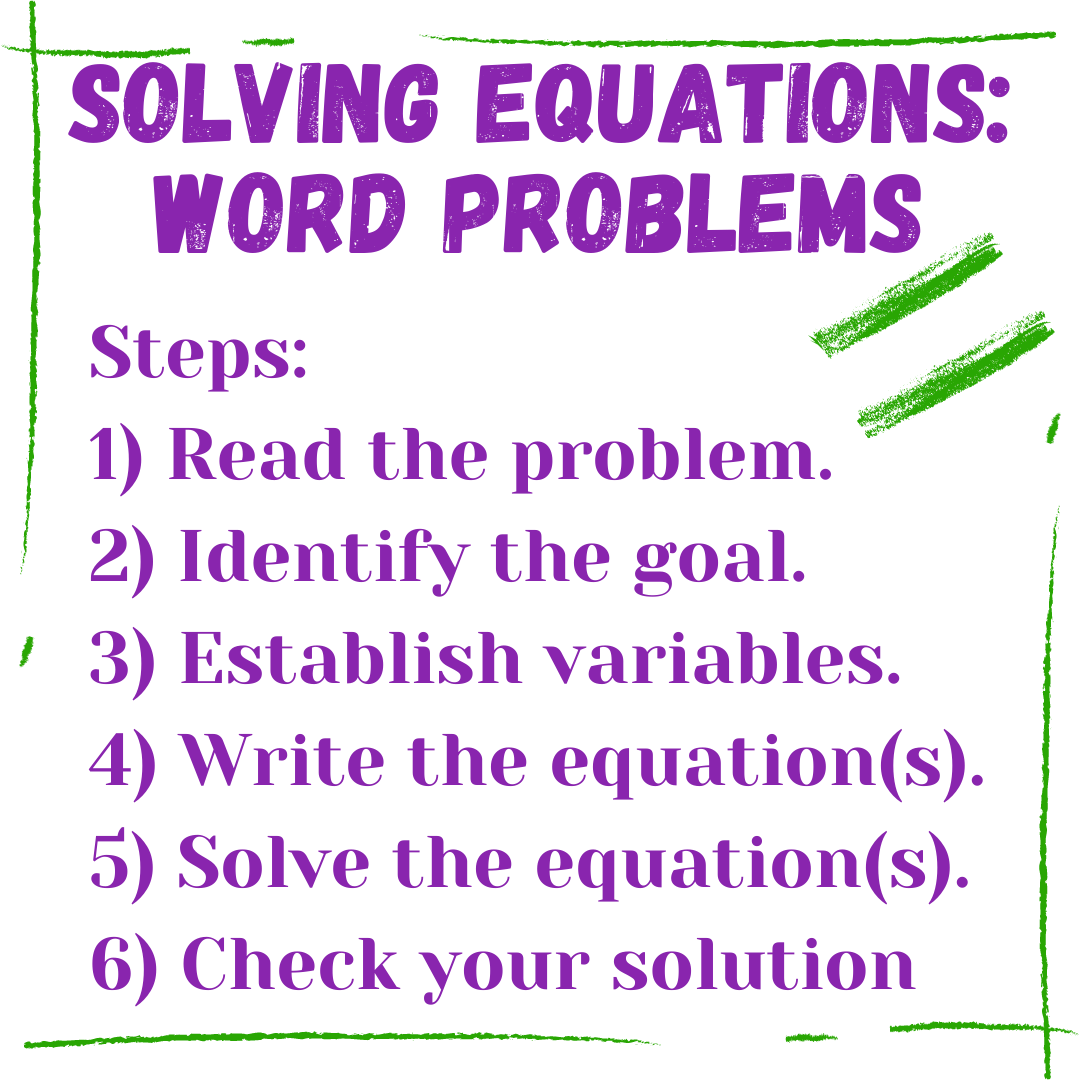
Let's be real for a second. Word problems are the worst. But sadly, you can't avoid them. Luckily there are tricks and steps you can learn to make solving them easier. It will still take lot's of practice but hopefully they can lead you in the right direction. The steps to solving word problems are:
- READ and understand the problem. It may seem like common sense but it's very important to read the whole problem and understand what it's about.
- DEFINE a variable. Figure out what the unknown in the problem is and assign a variable to it. For example it could be, or .
- WRITE an equation. Check out how to translate words into expressions.
- SOLVE the equation.
- CHECK your answer.
- STATE your answer. It's always good practice to state your answer at the end of a word problem. If the problem asks, "How many hot dogs did Lilly eat?" instead of saying write "Lilly ate hot dogs."
He then goes over an example:
Five times a number plus nineteen is eighty-four. What is the number?
Step 1: READ the problem. It's okay if you need to read it multiple times to fully understand.
Step 2: DEFINE a variable. The problem is asking you to find a number. So we can say, .
Step 3: WRITE an equation. We know that we are multiplying a number, , by five, so we can start with . We then add to that number, which gives us . This is all equal to , so our full equation is .
Step 4: SOLVE the equation.
Remember: whatever you do to one side of the equation, you have to do to the other. You may need to use the Addition and Subtraction Property of Equality or the Multiplication and Division Property of Equality.
Step 5: CHECK the answer. Check by plugging in everywhere we see . This is a true statement, so our answer is correct.
Step 6: STATE your answer.
(Video) Solving Word Problems
by mathman1024

This video works through a similar type of problem. We need to translate the problem
The sum of four times some number and forty-three is the same as three times the difference of the number and seventy-eight. Find the number.
We can use this statement to write an equation.
The left side of the equation is "the sum of four times some number and forty-three". We can make the unknown number . Four times this number gives us . The sum of that value and is .
The right side of the equation is "three times the difference of the number and seventy-eight". This implies that our unknown number is the same number as the left side of the equation, so we'll use again. "Three times the distance of..." implies a use of distribution over parentheses with subtraction inside, so we can start with . The last part is "difference of the number and seventy-eight", so we can subtract inside of the parentheses, .
Now we can set the two sides equal to each other and solve for . First, we're going to distribute over . Now, we can isolate on the left side by subtracting and from both sides.
Our final answer is .