Interactive · 6 questions
+5 contributors




A radical is any expression that uses some form of the sign. The radical you'll probably see most is the square root, but you could also see cube root () and other types of radicals, too (e.g., ).
It might also be helpful to know that we can also write these radical expressions with exponents. For example, is the same as , or raised to the power. In the same way, is the same as , or raised to the power.

Image source: by Hannah Bonville
When you see an equation with one or more radical expressions, the key is to isolate the radical, similar to solving equations by grouping.
Let's look at a few examples of how to do this:
Example 1
We will solve
The first goal we have is going to be to isolate the radical, , on one side of the equation.
Which of these choices shows the correct equation?
We now just need to solve
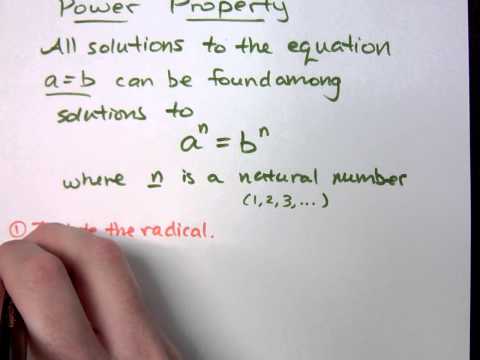
Now that we've got the radical all alone, we can get rid of it. We can eliminate a square root by squaring both sides of the equation. We can eliminate a cube root by cubing both sides of the equation (raising both sides to the power of ). The same pattern continues for other radicals.
For example, how could we eliminate ?
Notice how we're still doing everything to both sides of the equation, just like we would in equations without radicals. This is a pretty constant theme, regardless of what messiness you've got. If you do something to one side of the equation, you've got to do it to the other.
Let's come back to our inequality:
Simplify the equation by eliminating the square root. Which of these choices shows the correct result?
We simplify the equation by squaring both sides.
And look at that! We've been able to eliminate the radical, and we now have a regular ol' equation. Now, just solve for .
What is the value of ?
Make sure you combine like terms first to make solving easier.
If you want to check your solution, you can plug in the solution for , , back into the original equation. Having to check your answer is pretty consistent across different types of algebraic equations, so this skill will always come in handy.
Example 2
This time we will solve the equation
Hmph. Looks like we've got an equation with radicals on both sides.
To start a problem like this, we need to make sure the equation is as simplified as we can get it. (Ours is).
How can we eliminate the square roots on both sides of the equation?
We're going to take the same approach as before. To get rid of a square root, we need to square both sides of the equation.
The left side of the equation isn't a big deal to square. For the right side, you'll need to think of squaring it as: (If you are familiar with the FOIL method, this is a great place to use it).
As gross as that equation looks, it's important to note that there's now only one radical in it, which means that we can solve it like we did in Example 1. This is a good thing!
Let's start by simplifying as much as possible:
We've still got a square root on one side of the equation. How do we eliminate it?
We will square both sides again to get rid of the last radical left.
Once we simplify, the left side has a quadratic equation in standard form. Solve the resulting equation for by factoring or the quadratic formula.