Illustrated · 3 min

+1 contributors

Squaring Numbers Ending in 5: Challenge Problems
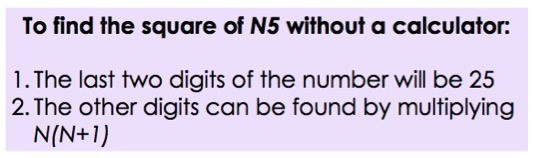
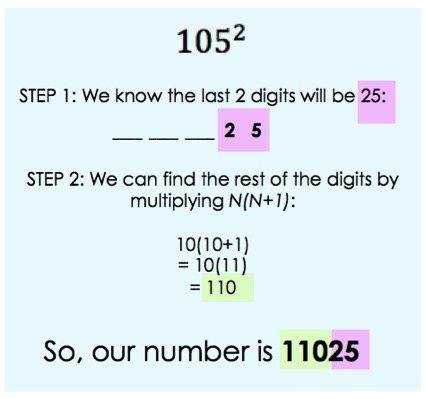
By now, you have learned how to square numbers ending in 5. As a quick refresher, let's say you have a number ending in and say the digits before the make up the number Then the digits of the square of this number will begin with and end with For example, take a look at

Image source: By Caroline Kulczycky
Now that we have the basics down, let's learn now to tackle some harder questions.
Squaring Decimals Ending in .5
So, how would we square a decimal ending in It's very similar to squaring integers ending in The only difference is that instead of tacking on a at the end, we tack on a For example, say we're trying to find
Step One: Identify :
Here, the number before the i.e., the whole part of the decimal number, is so
Step Two: Calculate :
Now, we multiply by i.e. we multiply by
Step Three: Add to the End:
Now, we just tack on a to the end of the to get the answer:
Taking the Square Root of Numbers Ending in 25
Sometimes, instead of being asked to square numbers ending in you will be asked to take the square root of certain whole numbers ending in Be aware that your answer will not always be a whole number. For example,
However, sometimes your solution will be a whole number, and you can reverse engineer your process of squaring numbers ending in in order to find that solution! Let's see how it works by looking at a previous example, but through the reverse lens: we will be finding We know this is from our earlier work, but we'll work through it in steps.
Step One: Identify the Number You're Taking the Square Root Of:
That's easy! It's
Step Two: Chop Off the from the End:
After doing this, we're left with
Step Three: Find :
This step is trickier. Remember how we multiplied with to find the beginning digits of our solution when we were squaring numbers ending in Now we have to do the opposite we need to figure out two consecutive numbers, and that multiply to will always be the smaller number.
We know that and are consecutive numbers that multiply to so If this was a different number, say we might have to go through some trial and error to figure out that and are and
Later, you will learn how to use the quadratic formula, which is a tool you could use to help you find Here's an example of how to use the quadratic formula (and the distributive property) to find and that multiply to in case you already know it:
Then by the quadratic formula:
Since cannot be negative, and thus cannot be must be
Step Four: Put in Front of :
Now that we have it's easy to find our solution! We just need to put in front of the number In our example, so:
Taking the Square Root of Decimals Ending in .25
The process of taking the square root of certain decimals ending in is pretty much the same as taking the square root of certain integers ending in Reminder: you won't always get a nice neat decimal. For example,
However, sometimes, your solution will be a decimal ending in and you can reverse engineer your process of squaring numbers ending in in order to find that solution! Let's see how it works by looking at a previous example, but through the reverse lens: we will be finding We know this is from our earlier work, but we'll work through it in steps.
Step One: Identify the Number You're Taking the Square Root Of:
Simple! It's
Step Two: Chop off the from the End:
After doing this, we're left with
Step Three: Find :
Like the previous example with we need to figure out two consecutive numbers, and that multiply to Remember, will always be the smaller number.
We know that and are consecutive numbers that multiply to so You might need to use the quadratic formula if the number is harder to factor.
Step Four: Put in Front of :
In our example, so: