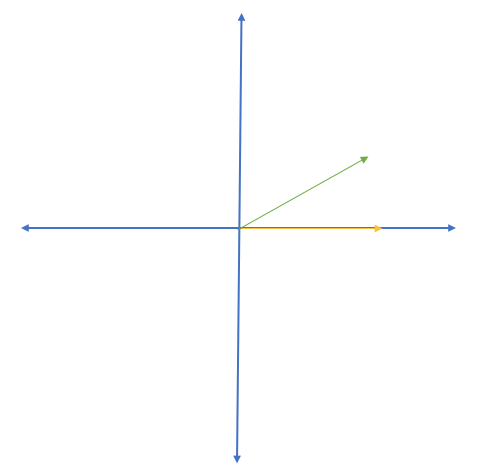
In trigonometry, one thing we like to do a lot is draw angles on the coordinate plane. This consists of drawing two rays which intersect, conventionally at the origin, to form an angle that has a measure between 0∘ and 360∘.
We want to be consistent in how we draw these angles, and we call these decisions the standard position of an angle. The first decision was to have the two rays intersect at the origin.
The second decision is to start the angle at the positive x-axis. That is, the first ray we draw will point outward to the right from the origin, traveling along the x-axis.
The final important thing to discuss is whether we travel clockwise or counterclockwise. When the angle measure is positive, we travel counterclockwise to determine where the second ray will be. If thought of in terms of the hands of a clock, a 90∘ angle will have one hand on the 3 and the other hand on the 12.
For another example, look at the picture below:
To be in standard position, we'd start by drawing the red line, then travel 45 degrees counterclockwise to determine the location of the blue line. In other words, this is what a 45∘ angle in standard position looks like.
In the next few lessons, you will learn about coterminal and reference angles and how to convert between radians and degrees.