Data Univariat dan Bivariat

Interactive · 2 questions

Univariate Data

Univariate data has the prefix "uni-", meaning one. Therefore, univariate data has one variable being studied.

If I have a list of travel times from Pittsburgh to Philadelphia, what is my variable that I am studying?

Choose one answer

Interactive · 2 questions

Univariate vs. Bivariate Data

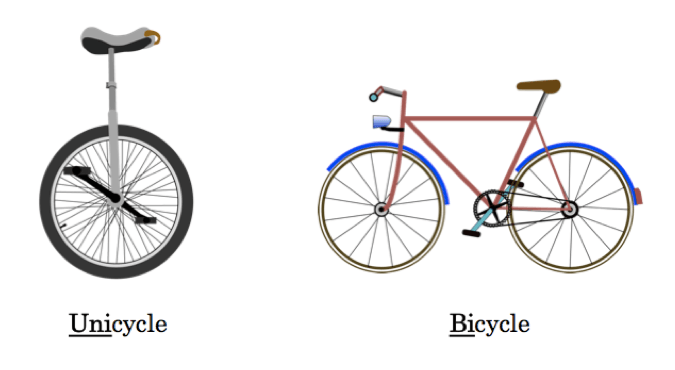
To prepare to enter into this explanation of uni- and bivariate data, let's start out by comparing unicycles and bicycles.

A Unicycle only has one wheel while a Bicycle has two wheels. Think of this when you need to compare Univariate (one variable) data and Bivariate (two variables) data.

One similarity between these two items: I would certainly fall off both. \\ Torker_Unicycle.JPG: The original uploader was AndrewDressel at English Wikipedia. derivative work: Underpants CC BY-SA 3.0

Bicycle image by Clker-Free-Vector-Images via Pixabay (License)

Clearly, the difference between a unicycle and a bicycle is the number of wheels; unicycles have one and bicycles have two.

Similarly, the difference between univariate and bivariate data is the number of variables. Univariate data involve one variable only (like a math unicycle), while bivariate data involve two variables (like a math bicycle).

Because there's only one variable, univariate data doesn't deal with cause and effect or relationships. It's just information on one thing.

Here's an example of univariate data: 8787% of the US Congress is white.

With bivariate data, we are looking at two variables. This lets us look at the relationship or overlap between variables.

Here's an example involving bivariate data: The teachers at School X met to examine the relationship between students' reading scores and their math scores.

In our bivariate data example, what are the two variables being studied? (Check them off)

Choose all correct answers

Read · 1 min

Univariate vs. Bivariate data\text{Univariate vs. Bivariate data}

An easy way to remember the difference between univariate and bivariate data is by paying attention to the prefixes of each word.

Think of words that begin with the prefix "uni-" such as unicycle, uniform, unique etc. All of these words mean one of something.

Now consider words that begin with "bi-" such as bicycle, bilingual, binoculars, etc. All of these words mean two of something.

Similarly, univariate data involves one variable while bivariate data has two. Univariate data is used to provide information on one topic. Bivariate data is used to describe the relationship between two things.

The tables below show an example of each type of data.

Univariate Data on Ice Cream Sales MonthAvg. Sales per DayJune15July26August40\begin{array}{|c|c|} \hline \text{Month}&\text{Avg. Sales per Day}\\ \hline \text{June}&15\\ \text{July}&26\\ \text{August}&40\\ \hline \end{array}

Bivariate Data on Ice Cream Sales MonthAvg. Sales per DayAvg. TemperatureJune1570July2672August4080\begin{array}{|c|c|c|} \hline \text{Month}&\text{Avg. Sales per Day}&\text{Avg. Temperature}\\ \hline \text{June}&15&70\\ \text{July}&26&72\\ \text{August}&40&80\\ \hline \end{array}

The univariate data only shows the average amount of ice cream sold per day while the bivariate data compares the sales to the temperature outside.

Video

(Video) Univariate vs. Bivariate

by Alex McEney

Alex McEney has a good video about understanding what univariate and bivariate data are and how to identify what you are given.

Summary\large{\text{Summary}}

He starts by explaining the difference between the two by comparing the two prefixes uni- and bi-. Uni- means "one" so univariate data looks at one variable. Bi- means "two" so bivariate data looks at two different variables.

He then goes trough some practice problems to show how to find what kind of data is being used in different types of problems.

Type a concept, like “slope” or “photosynthesis”.

↑ ↓ to choose · Enter to openSearch explanations and problems