Read · 1 min

Hypothesis Testing

Hypothesis testing is another form of statistical inference. The main purpose of hypothesis testing in statistics is to test the results of a research study with a random sample to see if the results are meaningful or not and look for evidence to support the null hypothesis. If we can confidently say our null hypothesis is true, we can then confidently make decisions with it.

Technically, we are testing if a population parameter is different from its hypothesized value.

Hypothesis testing (The Test To Guide Decision Making) developed by Neyman and Pearson looks at evidence that supports (H0H_0) being true.

This is done by setting up both a null hypothesis and an alternative hypothesis, choosing an acceptable rate of allowable error "alpha" (usually 0.05), then either accepting or rejecting the null hypothesis based on whether the p-value is above or below alpha. We can do so by changing the sample size.

  • if p−value<αp-value < \alpha --> reject the null hypothesis

  • if p−value>αp-value > \alpha --> fail to reject the null hypothesis

We need to make a decision soon, and suspect that our null hypothesis H0H_0 is true and will greatly influence our decision. Thus we see how unlikely we are to be wrong by examining the likelihood of the alternative hypothesis (HAH_A), and if we are sufficiently unlikely to be wrong we can assume the null statement H0H_0 is true and follow through confidently with our final decision.

Looking Further

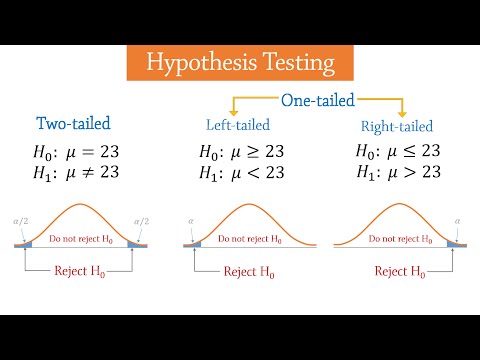
In the next lessons, we will dive deeper into Type 1 and Type 2 errors, as well as the tailed tests.

Read · 2 min

Statistical Tests (Significance Tests vs. Hypothesis Tests)

Statistical significance tests and hypothesis tests are often terms that are used interchangeably (often with the intention of actually referring to hypothesis tests).

Significance tests were developed first by Fisher, then later developed into hypothesis tests. Significance tests did not use language such as "reject the null" "fail to reject the null" but rather viewed the p-value as a continuous measure of evidence against the null hypothesis without actually creating a formalized decision making process.

It was not until later that Neyman & Pearson thought you could use the p-value as part of a formalized decision making process, introducing confidence/significance levels "alpha" α\alpha and a set of rules involving the p-value to either reject or fail to reject the null .

Hit "Continue" for explanations of both significance testing and hypothesis testing.

Significance testing (The Test To Guide Research) was developed by Fisher to try and quantify evidence against the null hypothesis (H0H_0) being true or false by examining something called a p-value.

Reason being, we believe our null hypothesis statement (H0H_0) may be true and hence we want to work out whether the statement H0H_0 is worth investing time making conclusions about it.

In order to ensure that we are confident in our statement H0H_0, we look at the opposite of this statement, the alternative hypothesis (HAH_A).

  • If HAH_A is quite likely (small p-value) then further study assuming H0H_0 to be true would seem to not make sense as the two hypothesis statements are mutually exclusive (cannot both occur at the same time). In other words, if HAH_A is very likely (small p-value), H0H_0 must then be very unlikely we have more evidence to "reject the null hypothesis".

  • However if HAH_A is extremely unlikely (large p-value) then H0H_0 is probably extremely likely to occur and further study assuming H0H_0 to be true would make sense and hence we would have more evidence to "fail to reject the null hypothesis".

Very similarly in methodology, but with different use cases and an added "alpha" variable...

Hypothesis testing (The Test To Guide Decision Making) developed by Neyman and Pearson looks at evidence that supports (H0H_0) being true.

This is done by setting up both a null hypothesis and an alternative hypothesis, choosing an acceptable rate of allowable error "alpha" (usually 0.05), then either accepting or rejecting the null hypothesis based on whether the p-value is above or below alpha.

  • if p−value<αp-value < \alpha, reject the null hypothesis

  • if p−value>αp-value > \alpha, fail to reject the null hypothesis

We need to make a decision soon, and suspect that our null hypothesis H0H_0 is true and will greatly influence our decision. Thus we see how unlikely we are to be wrong by examining the likelihood of the alternative hypothesis (HAH_A), and if we are sufficiently unlikely to be wrong we can assume the null statement H0H_0 is true and follow through confidently with our final decision.

Video

(Video) Introduction to Hypothesis Testing

by Joshua Emmanuel

In this video by Joshua Emmanuel, you will learn the basics of hypothesis testing.

Type a concept, like “slope” or “photosynthesis”.

↑ ↓ to choose · Enter to openSearch explanations and problems
