Video · + 2 min read

+3 contributors



(Video) Geometric Progressions
by Eddie Woo

Here's some videos by Eddie Woo going over geometric series and sequences.
Recall that each successive term in an arithmetic progression has a common difference, .
In this video he goes over:
Geometric Progressions
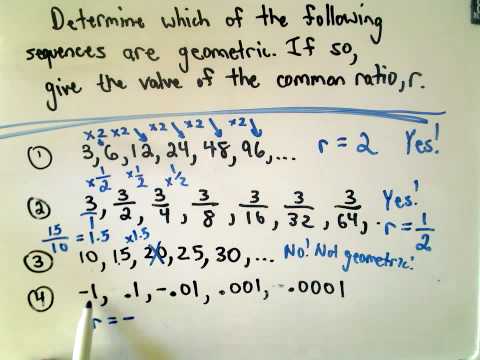
A geometric progression takes the idea of an algebraic progression and modifies it slightly. The idea for a geometric progression is to have a common multiplication or a common division. In other words, each successive term in a geometric progression has a common ratio, .
For example, when we listed all the even numbers, we saw they got bigger by two every time. Now what if we multiply by two instead? This would be a geometric progression. If we were to start at 1, the series would look like:
When we wrote a general series for arithmetic progression we got: A general series for geometric progression is similar.
The arithmetic progression term looked like: For the geometric progression, the term looks like:
(Video) Geometric Progressions
by Eddie Woo

Sum of a Geometric Series
With arithmetic progressions, the sum of the term is:
Now what about the geometric progression? We know the series looks like: To turn this into a more digestible form, we're going to multiply through by the common ratio, .
If we look at these above one another we see that they have some common terms. Actually all the terms are common except for two. Now we want to subtract these two. When we do this all the common terms will end up canceling. This is the way we write the sum formula for the term.
Some people or textbooks write it differently but they mean the same thing.
Suppose now we had a geometric series that was getting smaller. Let's think about how we'd find the sum. This series is known as a limiting sum or finite sum. It reaches a number and doesn't continue any further, where as when we multiplied by that went up to infinity (an infinite sum).
Proving a Geometric Progression
To prove an arithmetic progression we wanted to show that
Instead of subtraction, to prove that something is a geometric progression we want to use division.