Apakah permutasi dan faktorial?

Interactive · 6 questions

The product of all consecutive integers from 11 to a non-negative integer nn is known as nn factorial, denoted (n!)(n!).

This means that for any non-negative integer nn, n!=(1)×(2)×(3)×...×(n−2)×(n−1)×(n)n!=(1)\times(2)\times(3)\times ...\times(n-2)\times(n-1)\times(n)

Try this problem:

What is 4!4!?

Choose one answer

Interactive · 1 question

What is a Permutation?

A permutation of a set of distinct symbols is an arrangement of the symbols in a line in some order.

Finding Permutations

Given natural numbers kk and nn with k≤nk \leq n, the number of ways to place kk marbles of distinct colors into nn numbered boxes, at most one marble per box, is n!(n−k)!\frac{n!}{(n-k)!}.

Or in other words, the number of possible permutations on kk objects from a set of nn is n!(n−k)!\frac{n!}{(n-k)!}.

The number of permutations of nn symbols is n!n!.

Example 1:

How many couples can be selected from a group of 1212 women and 2020 men?

The number of ways to pair up women (marbles) and men (boxes) such that no woman is paired with the same man more than once is 20!(20−12)!=20!8!\frac{20!}{(20-12)!} = \frac{20!}{8!}.

Example 2:

There are 7!=50407! = 5040 ways in which 77 people can form a line. How many ways can you arrange those 77 people in a circle?

Your first though was probably the number of permutations on 77 people is 7!7! however, that is wrong. If you are standing in a circle and every person shifts left or right they would be standing in different places in the circle but standing next to the same people. Thus, the order of people has not changed. This can happen 77 times so the number of ways to arrange 77 people line a circle is 7!7=7⋅6!7=6!.\frac{7!}{7} = \frac{7\cdot 6!}{7} = 6!.

Test Yourself!

In how many ways can 1010 children and 55 adults stand in a circle so that no two adults stand next to eachother?

Choose one answer

Interactive · 2 questions

Factorials!!!

A factorial is the multiplication of all of the numbers from nn to 11 for any integer nn. So basically n!=n⋅(n−1)⋅(n−2)⋅⋯⋅2⋅1n! = n \cdot (n-1) \cdot (n-2) \cdot \cdots \cdot 2 \cdot 1. So a number like 5!5! will be 5⋅4⋅3⋅2⋅1=1205 \cdot 4 \cdot 3 \cdot 2 \cdot 1 = 120. Factorials are quite simple!

What is 6!6!?

Choose one answer

Interactive · 1 question

How many ways are there to order 66 people in a line?

For simplicity, lets call these 66 people: AA, BB, CC, DD, EE and FF respectively.

How many different people can be at the front of the line? Well, there are 66 people and there are no constraints in this question, so there are 66 different people that can be at the front of this line.

Lets say we decided who is going to be at the front of the line, how many different people can be the second in the line? Well, say that AA is at the front of the line, surely AA cannot be second in the line as well! Hence, AA cannot be second. The rest of the people are all possible candidates to be second. So there are 55 different people that can be second in the line. This holds true no matter who is at the front of the line, not just AA.

How about the third in line? If we already know who is going to be first and second, how many different people can be the third in line? Well, using the same argument as before, only 44 people can be third in line.

Using the same argument yet again, there are 33 people that can be forth in line; 22 people that can be fifth in line; and only 11 person can be last.

Hence, by the rule of product, the number of ways to order the 66 people is: 6×5×4×3×2×1=7206\times5\times4\times3\times2\times1=\boxed{720}

So what is a factorial? Do you think you can figure out what it is?

Choose one answer

Read · 1 min

COMBINATIONS, PERMUTATIONS, AND FACTORIALS

Combinations and permutations are used in math to show the number of different ways a set of elements (numbers, objects, things, etc.) can be arranged.

Permutations are used when the order of the elements matter such as a code for a lock or final placements in a race. Combinations are used when the order of the group doesn’t matter, such as finding all the different group of toppings you could put on a pizza.

FACTORIALS

Before we get into calculating combinations and permutations, you must first understand what a factorial is. The dictionary definition of a factorial is “the product of an integer and all the integers below it.” Written out in general terms, the equation would be: n!=(1)⋅(2)⋅(3)⋅...⋅(n−2)⋅(n−1)⋅(n)n!=\left(1\right)\cdot\left(2\right)\cdot\left(3\right)\cdot...\cdot\left(n-2\right)\cdot\left(n-1\right)\cdot\left(n\right) When you are finding a factorial, it is rather simple to calculate it, regardless of the looks of the above equation: 3!=3⋅2⋅1=64!=4⋅3⋅2⋅1=247!=7⋅6⋅5⋅4⋅3⋅2⋅1=5040\begin{align}3!&=3\cdot2\cdot1=6 \\ 4! &=4\cdot3\cdot2\cdot1=24 \\ 7! &=7\cdot6\cdot5\cdot4\cdot3\cdot2\cdot1=5040\end{align} The only time this doesn’t hold true is with 0!0!. If you ever come across 0!0! in a problem all you need to know is that 0!=10! = 1.

Video

(Video) Permutations and Factorials (Simplifying Math)

By Eric Buffington

In this video, we look at a couple examples of permutations.

Summary\large{\text{Summary}}

Factorials

Written as 6!6! 6!=6×5×4×3×2×1=7206!=6\times5\times4\times3\times2\times1=720 The video then goes through some more examples of factorials.

Note: 0!=10!=1

Permutations

Arrangements when order matters.

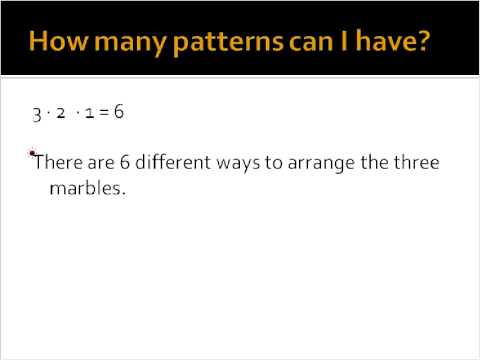
Example: You have 33 marbles. How many different patterns can you make?

For the first spot, you can put any of your 33 marbles in that spot. After the first marble is placed you only have 22 marbles to pick from. Finally, you are left with only 11 option for the third spot. So, you have 3×2×1=6=3!3\times{2}\times{1}=6=3! options.

There is also a formula: nPr=n!(n−r)!_nP_r=\frac{n!}{(n-r)!} where PP is the number of permutations, nn is the items taken, and rr is how many items are taken at a time.

There are some examples in the video using the formula. Try them out!

Type a concept, like “slope” or “photosynthesis”.

↑ ↓ to choose · Enter to openSearch explanations and problems