An Introduction to Probability
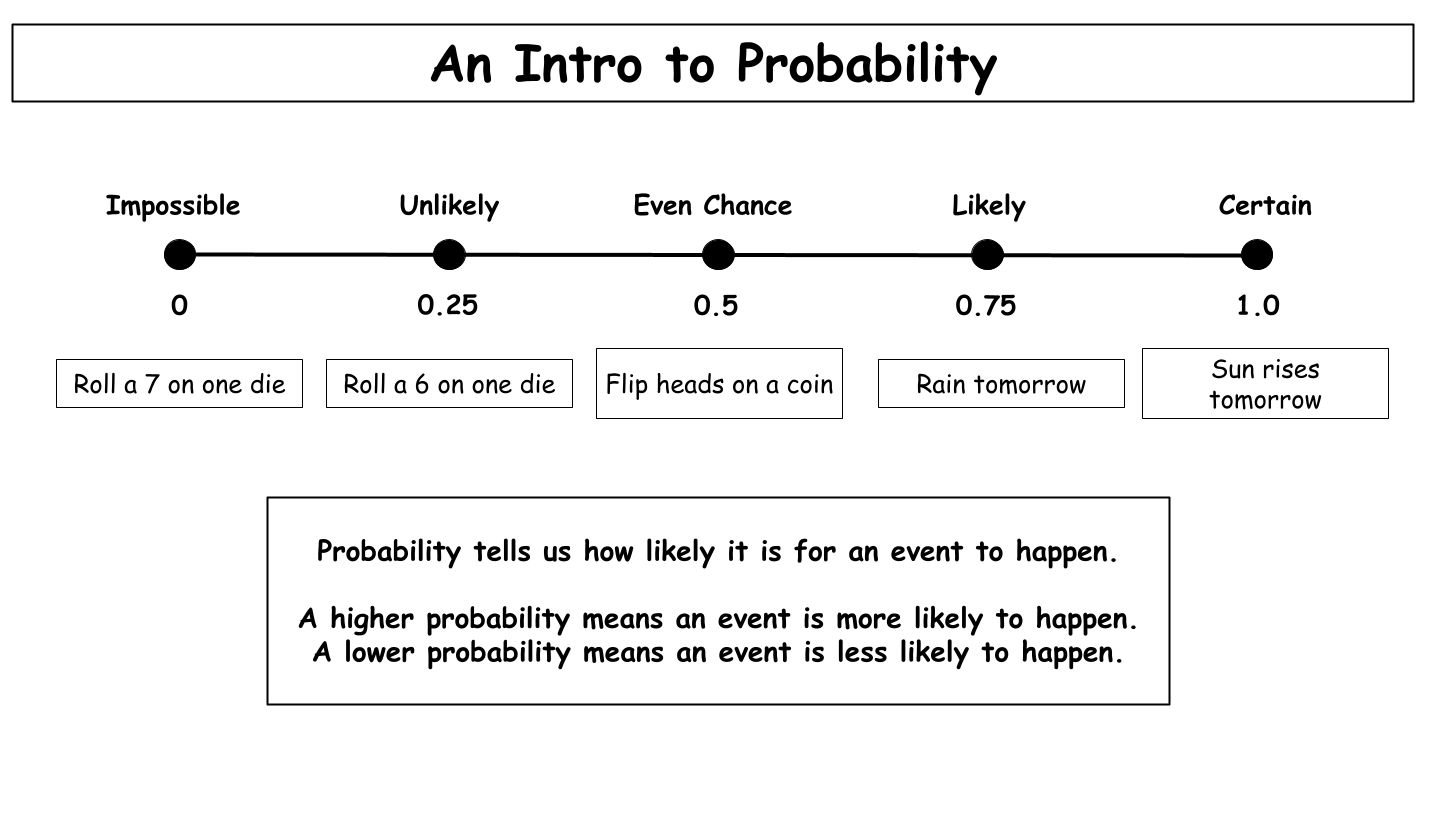
Probability tells us how likely an event is to happen.
We can show probability using numbers from 0 to 1. A probability of 0 means the event is impossible. A probability of 1 means the event is certain to happen.
Values closer to 0 describe events that are unlikely. Values closer to 1 describe events that are likely. A probability of 0.5, or 21, means there is an even chance.
For example, a fair coin has an equal chance of landing on heads or tails. Rolling a 7 on a standard six-sided die is impossible, so its probability is 0. The probability scale helps us compare events and understand how likely each one is.
Now, that you understand the basics, let's go a little deeper and look at some examples.
Probability is a branch of mathematics that measures how likely a random event is to occur. To find the probability of an event, divide the number of favorable outcomes by the total number of possible outcomes, also called the sample space. This can be written as the ratio of the number of successful outcomes to the total number of outcomes.
For example, when rolling a die, there are six possible outcomes. The chances of rolling an odd number are 63, because there are three odd numbers on a standard die. If you toss a coin, the head and tail are the two possible outcomes, so each has a probability of 21.
Probability can also be used with a deck of cards. The probability of drawing a face card is 5212, since there are 12 face cards in a standard deck.
If a bag contains 3 red balls and 5 blue balls, the probability of choosing a red ball is 83.
####Look Further
Probability is used in games of chance, science, sports, and everyday decision-making. When an experiment is repeated many times, the number of times an event occurs compared to the total number of trials gives an estimate of its probability. Understanding the outcome of an experiment helps us make predictions about what is likely to happen in the future.
In the next set of lessons, you will continue to learn the fundamentals of probability. We will start with expected value, then learn about the linearity of expectation and compound events.
As we move deeper, we will learn about independent and dependent events and conditional probability.