Adição nos denominadores

Interactive · 1 question

Add the numerators

In a fraction, the top number is the numerator and the bottom number is the denominator. Fractions are examples of rational numbers, alongside the whole numbers.

When two fractions have a common denominator, they have like denominators (the denominators are alike). In this case, to add the fractions together, all you have to do is add the numerators (the top numbers) together. Leave the bottom number the same!

You can visualize this by thinking of a pizza plate. The plate has space for 88 slices of pizza, and each slice is 18\frac{1}{8} of the pizza. Each slice of pizza is the same size.

A circle broken into 8 pieces. No pizza.
Then, a circle broken into 8 pieces. 1 slice of pizza.

Each new slice of pizza you put on the plate is like adding 18\frac{1}{8}. Notice that you're not changing the denominator—the plate can always hold up to 88 slices, so nothing is changing about that.

1/8 + 2/8 = 3/8

Now, try it yourself! What is 27+37\frac{2}{7} + \frac{3}{7}? Try drawing it out using a container with 77 slots, if you want to!

Choose one answer

Illustrated · 1 min

Definitions

A fraction is a part of a whole. Numbers such as 12\frac{1}{2} and −27521-\frac{27}{521} are fractions. Some numbers are written as percents instead, but they can be turned into fractions. Finally, some numbers are written as mixed numbers, but these can also be turned into fractions.

The number on top of the fraction line is the numerator. The number below the line is the denominator. Two fractions with the same denominator, or a common denominator, have "like denominators".

Simple Rule

To add fractions with like denominators, keep the denominator and add the numerators.

Example

Compute 15+25\frac{1}{5} + \frac{2}{5}.

Wrong Approach

When you add two fractions with like denominators, do NOT follow the method below:

15+25 =1+25+5 =310\begin{align} &\frac{1}{5} + \frac{2}{5} \\\ &= \frac{1+2}{5+5} \\\ &= \frac{3}{10} \end{align}

Correct Approach

Instead, you only add the numerators together. 15+25 =1+25 =35\begin{align} &\frac{1}{5} + \frac{2}{5} \\\ &= \frac{1+2}{5} \\\ &= \frac{3}{5} \end{align}

Let me say it again: this is for when the denominators are the same.

For a more visual approach, you can imagine you have 22 people eating a pizza. The pizza has 55 slices (because mathematicians like weird pizzas!). The 1st person only eats 11 slice, while the 22nd person eats 22 slices. The total amount of pizza eaten would be the sum you are computing, as pictured below.

1/5 + 2/5 = 3/5

If the denominators are not the same, this technique won't work. We'd have to do some extra steps to make the denominators the same.

Video

(Video) Adding and Subtracting Fractions

by PatrickJMT

This video by PatrickJMT covers adding and subtracting fractions with like denominators.

Summary\large{\text{Summary}}

First, check if the denominators if your two fractions match. Matching denominators means that you can add or subtract the numerators. ac+bc=a+bcac−bc=a−bc\begin{gather} \frac ac+\frac bc=\frac{a+b}c\\ \frac ac-\frac bc=\frac{a-b}c \end{gather}

He goes over this example. 411−311\frac4{11}-\frac3{11} To solve, keep the same denominator but subtract numerators. 411−311=4−311=111\frac4{11}-\frac3{11}=\frac{4-3}{11}=\frac1{11}

When to Reduce

In some cases the final result can be simplified. This is called reducing the fraction. Here's a quick example of this in action.

Example: Let's simplify 58+18\frac{5}{8} + \frac{1}{8}.

Just like before, the denominators are the same. So, we add the numerators:

58+18=5+18=68\frac{5}{8} + \frac{1}{8} = \frac{5 + 1}{8} = \frac{6}{8}

However, 66 and 88 share a common factor of 22, so we pull it out and cancel:

68=2×32×4=2×32×4=34.\frac{6}{8} = \frac{2 \times 3}{2 \times 4} = \frac{\cancel{2} \times 3}{\cancel{2} \times 4} = \boxed{\frac{3}{4}}.

Interactive · 3 questions

Subtract the numerators

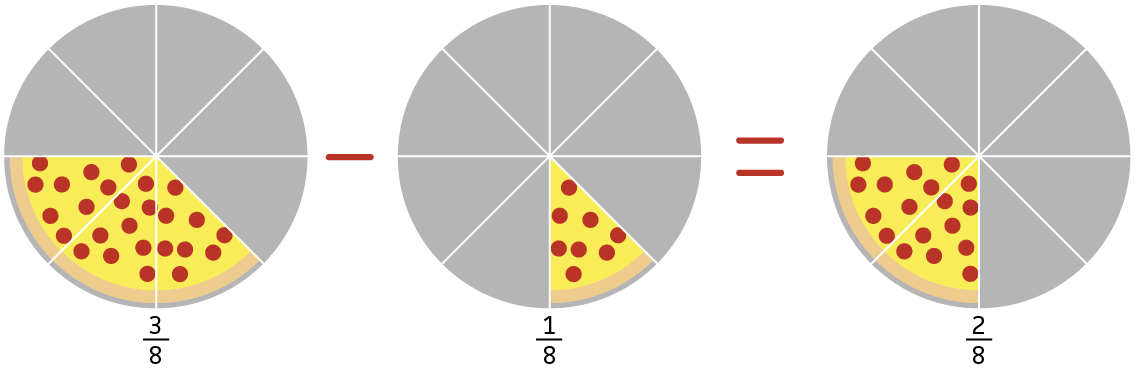
When you have to subtract fractions that have the same denominator, you can subtract one numerator from the other. In this case keep the same denominator. For example, if we have 33 pieces left of a pizza that originally had 88 pieces, then there is 38\frac{3}{8} of the pizza left.

3/8 of pizza.

38\frac{3}{8} (3 slices) of a pizza.

Now let's say that someone eats a slice of the pizza. How much of the pizza would that be?

Choose one answer

Type a concept, like “slope” or “photosynthesis”.

↑ ↓ to choose · Enter to openSearch explanations and problems