Interactive · 4 questions

+3 contributors



The Smallest Unit of an Element
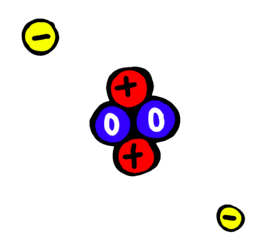
This is an atom, one of the particles that make up everything.

Can you see it? Image source: By Deena Hauze
Atoms are incredibly small, smaller than we can really comprehend.
They are the smallest unit of an element that still has the properties of that element. They cannot be broken down into other substances. They are made of three types of the subatomic particles called protons, neutrons, and electrons. If you cut an atom in half, you'll just have some subatomic particles that no longer have the properties of the element they represent.
Protons are positively charged particles while neutrons are neutral (they have no charge). These two types of particles are found in the center of the atom, called the nucleus. Electrons are negatively charged and much, much smaller than the protons and neutrons.

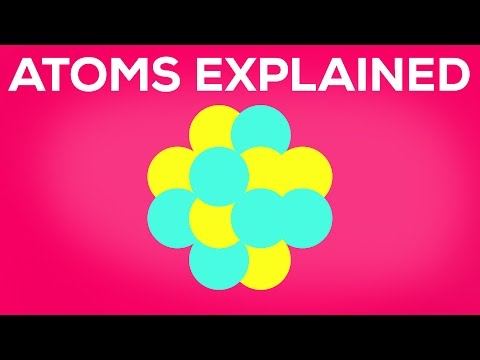
Image source: By Deena Hauze
Elements have the same number of protons and electrons. This makes them neutral, so they have no charge. That's because the electrical forces between the positively charged nucleus and the negatively charged electrons cancel out.
What is not one of the subatomic particles that make up an atom?
The Nucleus
Very strong forces bind protons and neutrons together to make up the nucleus, or core, of the atom. The nucleus makes up most of the mass of an atom.
Here's a trick to remember which subatomic particle in the nucleus is which:
- P = Proton = Positive charge
- N = Neutron = Neutral charge
The electrons constantly orbit the nucleus at break-neck speeds. Because they are negatively charged, they are attracted to the nucleus. However, the great speed they travel at keeps them orbiting outside the nucleus. You can think of it like satellites orbiting the earth. You think they should come crashing down, but they are moving fast enough to prevent it.
What is the charge on an electron?
What is the charge on a proton?
What is the charge on a neutron?
Representing Protons
The number of protons determines the atomic number of the atom, which is how we identify elements. We'll get more into this later when we discuss elements and the mass number.
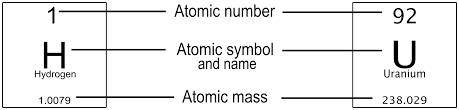
Hydrogen and uranium elemental properties
Image source: By Anynobody CC BY-SA 3.0, via Wikimedia Commons
: The smallest particle of an element that has the properties of that element
: The positively and neutrally charged subatomic particles, protons and neutrons, located in the center of the atom
: The mind-bogglingly small, negatively charged subatomic particles that orbit the nucleus
: The positively charged subatomic particles located in the nucleus
: The neutrally charged subatomic particles located in the nucleus
: A substance that can not be broken down into other substances. All atoms of an element have the same atomic numbers
: The number of protons in the nucleus, which lets us identify which element it is