Definição de Benford

Before this, knowEscala logarítmica

Read · 1 min

In our last lesson, we learned about logarithm scales. Now let's move onto our next topic in applications of logarithmic and exponential functions.

Benford's Law

Benford's Law is a property held by leading digits of numbers in large data sets seen in the real world.

At first, you might think that the digits 11 through 99 would appear as the first digit about the same number of times.

But that is not what happens.

Instead, the leading digits follow a logarithmic pattern. The number 11 appears most often as the first digit. The number 22 appears less often than 11, but more often than 33. This pattern continues all the way down to 99, which appears the least often.

Even though it may seem surprising, this pattern shows up again and again in real-world data. According to the law, the formula for the approximate frequencies for each digit dd is: P(d)=log⁡(1+1d)P(d)=\log\left(1+\frac{1}{d}\right)

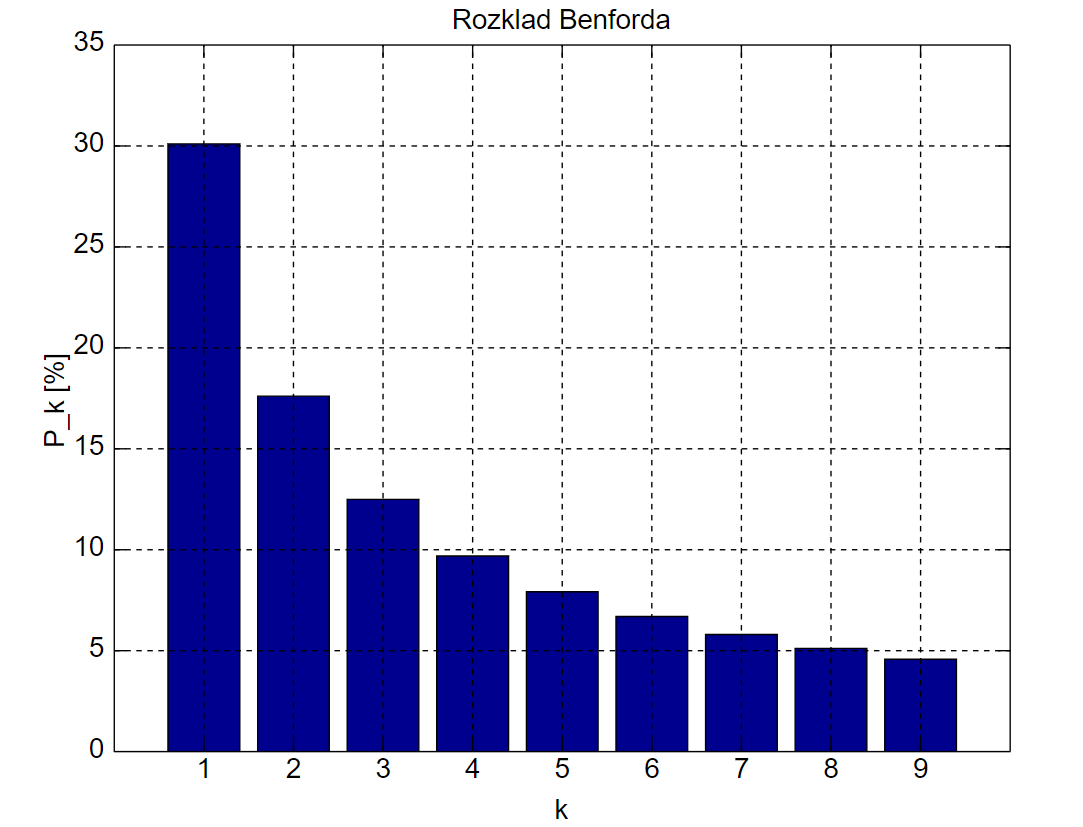
So in large sets of data, 11 appears as a leading digit approximately 3030% of the time, 22 appears approximately 17.617.6% of the time, all the way down to 9,9, which appears approximately 4.64.6% of the time. The sum of all of these frequencies must be 100100%, as they encompass every possible leading digit.

Leading DigitProbability130.1%217.6%312.5%49.5%57.9%66.7%75.8%85.1%94.6%\begin{array}{c|c} \text{Leading Digit} & \text{Probability}\\ \hline 1&30.1\%\\ 2&17.6\%\\ 3&12.5\%\\ 4&9.5\%\\ 5&7.9\%\\ 6&6.7\%\\ 7&5.8\%\\ 8&5.1\%\\ 9&4.6\% \end{array}

This pattern can appear in many types of data. For example, it can show up in the first digit of population numbers for different countries. It can also appear in numbers found in newspaper articles.

An interesting fact is that people are not very good at copying this pattern when they try to fake data.

Because of this, Benford’s Law is often used to help detect fraud. If the numbers do not follow the expected pattern, it may be a sign that something is wrong.

Video

(Videos) Number 1 and Benford's Law

by Numberphile

Here's an amazing video by Numberphile on Benford's law.

Benford’s Law looks at the first digit of numbers in large data sets, especially when the numbers vary in size.

You might think that since there are 99 possible first digits (11 through 99), each one would appear about the same amount. But that is not what happens.

Benford’s Law says that about one-third of the time, a number will start with 11. The chances slowly decrease as the digits get larger.

This means numbers are much less likely to start with 99 than with 11.

Illustrated · 1 min

Benford's Law

Benford’s Law is a pattern that describes how the first digits of numbers are distributed in real-world data.

In simple terms, it tells us how often we see certain digits when we look at numbers that appear naturally, like populations, prices, or measurements.

Instead of each digit appearing the same amount, some digits show up more often than others.

This pattern may seem surprising, but it appears again and again in many different types of data.

Graph of Benford's Law

By Gknor - Own work, Public Domain, Wikimedia

What we can see is that the number 11 appears about 30%30\% of the time and the rest of the numbers appear less and less as you go up the digits. This doesn't make a ton of sense when you think about it since you'd expect the numbers we see in the real world to be random, and therefore, you'd expect the digits to be evenly distributed.

What's interesting is that this pattern occurs in a wide variety of data sets, from house prices to lengths of rivers. There's no one unifying reason for why this occurs but we still have a formula for the distribution of the digits, which is: P(d)=log⁡10(1+1d)P(d) = \log_{10}\left(1+\frac{1}{d}\right) where P(d)P(d) represents the probability that a digit dd occurs in a data set.

Illustrated · 1 min

Benford's Law

In 1938, Frank Benford and Simon Newcomb posited that all numbers do not serve as leading numbers equally. This law is also known as the Newcomb-Benford Law.

Benford's Law
In many real-life situations, the leading number is a small value.

Image source: by Anusha Rahman

If we consider the world, many leading and naturally occurring numbers are not large numbers. In fact, about 3030% of all leading numbers are 11.

Benford's Law states that in many real-life situations, the leading number is a small value. This concept seems strange since we've always associated the real world with random numbers! However, it is true that smaller numbers occur more frequently.

Type a concept, like “slope” or “photosynthesis”.

↑ ↓ to choose · Enter to openSearch explanations and problems