Teorema De Moivre's

Before this, knowMultiplying and Dividing Complex Numbers in Polar Form

Read · 1 min

A common situation in algebra is when we have to find the expansion of a complex number, i.e. (rcis⁡θ)n(r\operatorname{cis}\theta)^n (where cis⁡θ=cos⁡θ+isin⁡θ\operatorname{cis} \theta = \cos \theta + i\sin\theta). An interesting result known as de Moivre's Formula actually says that (rcis⁡θ)n=rncis⁡nθ.(r\operatorname{cis}\theta)^n = r^n\operatorname{cis}n\theta.

We'll proceed by proving a more generalized statement of the multiplication of two complex numbers, and then we'll extend that to get de Moivre's Formula.

Let z1=r1cis⁡θ1z_1 = r_1\operatorname{cis}\theta_1 and z2=r2cis⁡θ2.z_2 = r_2\operatorname{cis}\theta_2. Multiplying the two complex numbers gives: r1r2(cos⁡θ1+isin⁡θ1)(cos⁡θ2+isin⁡θ2)r_1r_2(\cos \theta_1 + i \sin\theta_1)(\cos \theta_2+i\sin\theta_2) =r1r2((cos⁡θ1cos⁡θ2−sin⁡θ1sin⁡θ2)+i(sin⁡θ1cos⁡θ2+cos⁡θ1sin⁡θ2))=r_1r_2((\cos\theta_1\cos\theta_2-\sin\theta_1\sin\theta_2)+i(\sin\theta_1\cos\theta_2+\cos\theta_1\sin\theta_2)) =r1r2(cos⁡(θ1+θ2)+isin⁡(θ1+θ2))= r_1r_2(\cos(\theta_1+\theta_2) + i\sin(\theta_1+\theta_2)) =r1r2cis⁡(θ1+θ2)=r_1r_2\operatorname{cis}(\theta_1+\theta_2) So, we have just found that multiplying two complex numbers in polar form multiplies their magnitudes, and more interestingly, adds their arguments.

This makes de Moivre's Formula almost obvious. If we let z1=z2=z,z_1 = z_2 = z, then we get z1z2=z2=r2cis⁡(θ+θ)=r2cis⁡2θ.z_1z_2 = z^2 = r^2\operatorname{cis}(\theta + \theta) = r^2 \operatorname{cis}2\theta. Similarly, z3=z2z=r2rcis⁡(2θ+θ)=r3cis⁡3θz^3 = z^2z = r^2r\operatorname{cis}(2\theta + \theta) = r^3\operatorname{cis}3\theta We can continue in this process to find that zn=(rcis⁡θ)n=rncis⁡nθ.z^n = (r\operatorname{cis}\theta)^n = r^n\operatorname{cis}n\theta. A formal proof would be by induction, but this should give you a general idea of how it works.

Ultimately, we have proved two very strong statements: (r1cis⁡θ1)(r2cis⁡θ2)=r1r2cis⁡(θ1+θ2)(r_1\operatorname{cis}\theta_1)(r_2\operatorname{cis}\theta_2) = r_1r_2\operatorname{cis}(\theta_1+\theta_2) (rcis⁡θ)n=rncis⁡nθ(r\operatorname{cis}\theta)^n = r^n\operatorname{cis}n\theta

The former is very useful in say, coordinate geometry, because it means that multiplying by cis⁡θ\operatorname{cis}\theta rotates a point counterclockwise by an angle of θ\theta. The latter is strongly relevant in the next section, when we are faced with the challenge of finding roots to the equation zn−1=0.z^n - 1 = 0.

De Moivre’s Theorem is commonly used when finding roots of unity.

Spot the idea in disguise

In a contest problem, this idea hides inside a situation you have not seen before. Learning to spot it is the real skill. These are real problems from the AMC 12, the national math competitions for middle and high school students, each with a worked solution on LIVE by Po-Shen Loh.

Interactive · 2 questions

De Moivre's Theorem, named after the French statistician Abraham de Moivre, is simple enough to state, but the power of the formula lies in its ability to convert complex numbers to trigonometry and vice versa.

Here it is: (cos⁡(x)+isin⁡(x))n=cos⁡(nx)+isin⁡(nx)(\cos(x) + i \sin(x))^n = \cos(nx) + i \sin(nx) You'll very occasionally see cos⁡(x)+isin⁡(x)\cos(x) + i \sin(x) written as cis(x)\text{cis}(x), but this doesn't appear to be very popular ("cis" stands for "cos i sin"). We can convert this formula to exponentials with Euler's formula, and then it looks really easy to prove: e(xi)n=e(nx)ie^{(xi)n} = e^{(nx)i}

If you think that looks a little too easy, there's another proof by induction. Unfortunately, induction only works here on positive integers (there's such a thing as transfinite induction, but that is way, way beyond our scope).

First, note (cos⁡(x)+isin⁡(x))1=cos⁡(1x)+isin⁡(1x)(\cos(x) + i \sin(x))^1 = \cos(1x) + i \sin(1x)

Assume (cos⁡(x)+isin⁡(x))n=cos⁡(nx)+isin⁡(nx)(\cos(x) + i \sin(x))^n = \cos(nx) + i \sin(nx). Then, (cos⁡(x)+isin⁡(x))n+1=(cos⁡(x)+isin⁡(x))n(cos⁡(x)+isin⁡(x))=(cos⁡(nx)+isin⁡(nx))(cos⁡(x)+isin⁡(x))=cos⁡(nx)cos⁡(x)−sin⁡(nx)sin⁡(x)+i(cos⁡(nx)sin⁡(x)+cos⁡(x)sin⁡(nx))=cos⁡((n+1)x)+isin⁡((n+1)x)\begin{align*} (\cos(x) + i \sin(x))^{n+1} &= (\cos(x) + i \sin(x))^n(\cos(x) + i \sin(x))\\ &= (\cos(nx) + i \sin(nx))(\cos(x) + i \sin(x))\\ &= \cos(nx)\cos(x) - \sin(nx)\sin(x) \\&+ i(\cos(nx)\sin(x)+\cos(x)\sin(nx))\\ &= \cos((n+1)x) + i \sin((n+1)x) \end{align*} And we're done (for the positive integers...)!

Having proved this formula with one line, and then proved a much less general portion with much more lines, it's natural to ask what the purpose of this formula is. Well, for one thing, we can let x=2kπnx=\frac{2k\pi}{n}, for some integer k. Then,

(cos⁡(2kπn)+isin⁡(2kπn))n=cos⁡(2kπ)+isin⁡(2kπ)=1\left(\cos \left(\frac{2k\pi}{n} \right) + i \sin \left(\frac{2k\pi}{n} \right) \right)^n = \cos(2k\pi) + i \sin(2k\pi) = 1

If we can calculate cos⁡(2kπn)\cos \left(\frac{2k\pi}{n} \right) and sin⁡(2kπn)\sin \left(\frac{2k\pi}{n} \right), we can find the nnth roots of unity.

Find a sixth root of unity and write it in complex form.

Choose one answer

Illustrated · 1 min

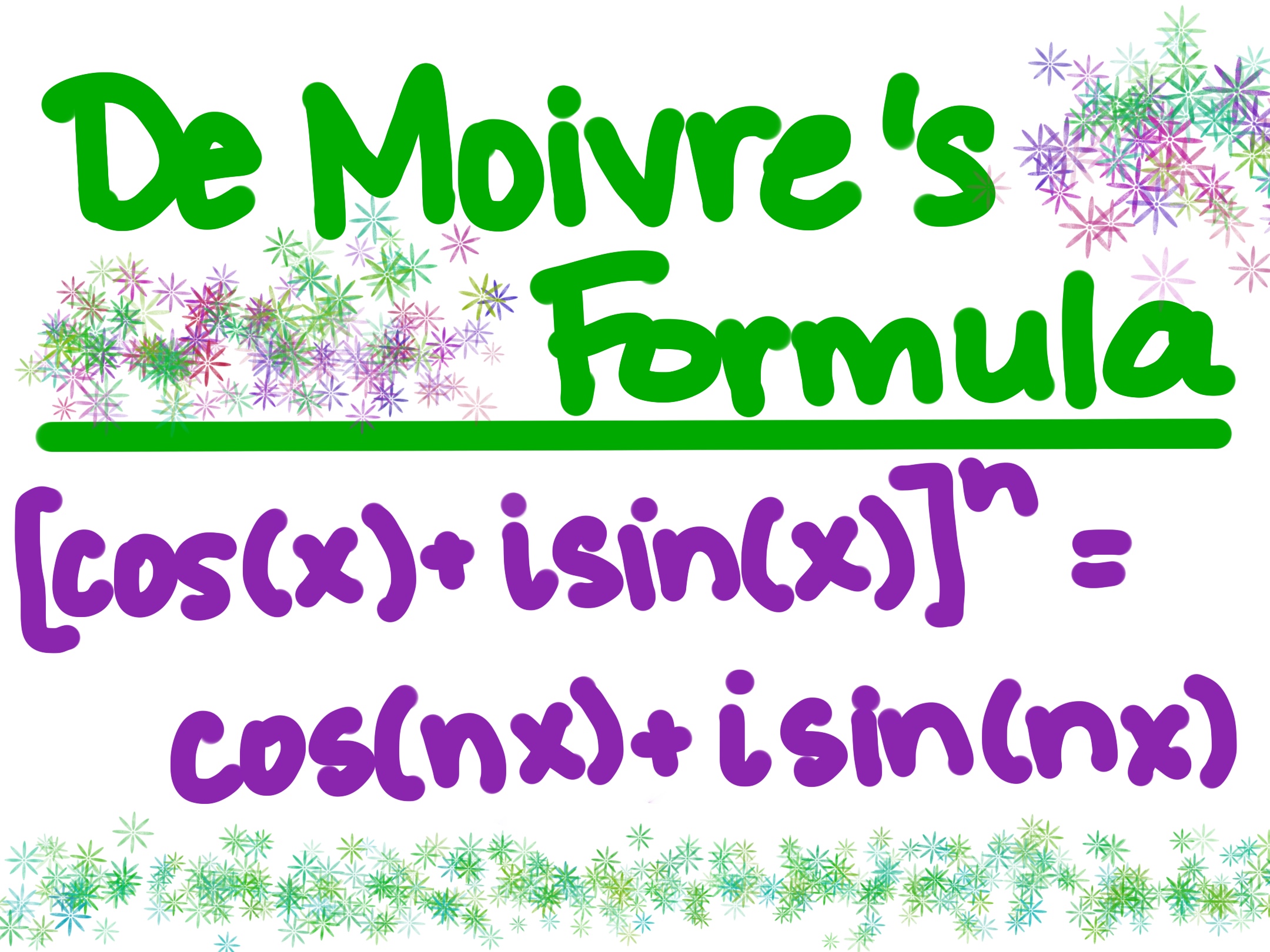
De Moivre's Formula

Using this formula, we can connect trigonometry with complex numbers. Instead of multiplying a complex number by itself over and over, the theorem provides a simple rule for raising it to any positive integer power.

It is especially useful when working with large powers and when finding the roots of complex numbers.

De Moivre's Formula
[cos(x) + i sin(x)]^n = cos(nx) + i sin (nx)

Image source: by Anusha Rahman

Suppose a complex number is written in polar form as:

z=r(cos⁡θ+isin⁡θ)z=r(\cos\theta + i\sin\theta)

Then, De Moivre's Theorem states that:

zn=rn(cos⁡(nθ)+isin⁡(nθ))z^n = r^n (\cos(n\theta) + i\sin(n\theta))

Here,

  • rr is the modulus
  • θ\theta is the argument
  • nn is any integer

The theorem says that you can raise the modulus to the power nn and multiply the angle by nn.

####Exponential Form

Using Euler's Formula,

eiθ=cos⁡θ+isin⁡θe^{i\theta} = \cos\theta + i\sin\theta

, a complex number can be written as:

z=reiθz = re^{i\theta}

If we involve De Moivre's Theorem, it becomes even simpler!

(reiθ)n=rneinθ(re^{i\theta})^n = r^ne^{in\theta}

This form is often the easiest to use in higher-level math.

Video

(Video) De Moivre's Theorem

by Anusha Rahman

In this video by Anusha Rahman, you will learn about De Moivre's Theorem.

Type a concept, like “slope” or “photosynthesis”.

↑ ↓ to choose · Enter to openSearch explanations and problems