
Interactive · 1 question
Derivatives equal to infinity!
Sounds crazy don't they?
First of all, recall: what is the derivative?
You, the excellent calculus learner you are, would say "Oh, that's just the slope of the tangent line at a point!"
And you are correct! That is the derivative...

You, the excellent calculus student, might be asking, "Mr. Teacher, what happens if the tangent line is vertical?"
That's a great question, You! And how convenient, I have an example of this:
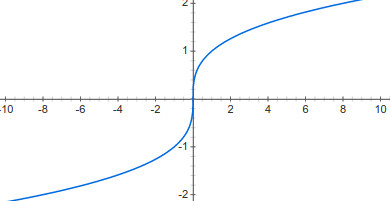
The graph of y = x^(1/3)
That, my friends, is the graph of , a perfect example of the infinite derivative!
Look at the point where . Draw the vertical line--it's vertical! So yes, this situation could definitely happen, and in fact, it happens to other function as well, such as .
But you may inquire: "What is the value of the derivative at that point?" The simple answer is: the derivative, , does not exist! Just like how diving by zero is undefined, the derivative at that point is undefined!
This makes sense; the derivative expression for is
(If you don't know how I got that, don't worry right now; that's covered in other sections.) We can see that if we let , the fraction collapses to , which is undefined.
So that's about it for derivatives equal to infinity!