Interactive · 2 questions
+4 contributors

In the previous section, we learned about linear approximations for a function around : This idea is sometimes stated in the perspective and terminology of differentials:
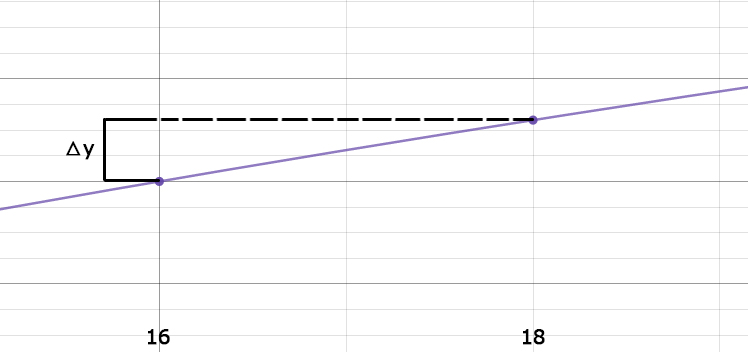
For the function above, differentiable at , the differentials and denote changes in and of the tangent line to the graph of at . Since the tangent line has slope , we then have where the expression on the right is an actual fraction, and not the notation for differentiation. Now, we can find a formula for the dependent differential : Of course, is the independent variable in this equation.
Now, let's return to our earlier notion of linear approximation: Can you find a way to rewrite this equation in terms of the differentials and ?
Let's say . Then this implies , and so
Great! Now, not only have we learned what differentials are, we also related it to our notions of linear approximation! This calls for some practice problems:
If , find in terms of at .
Since , we have
That was a bit simple, so let's try a harder problem.
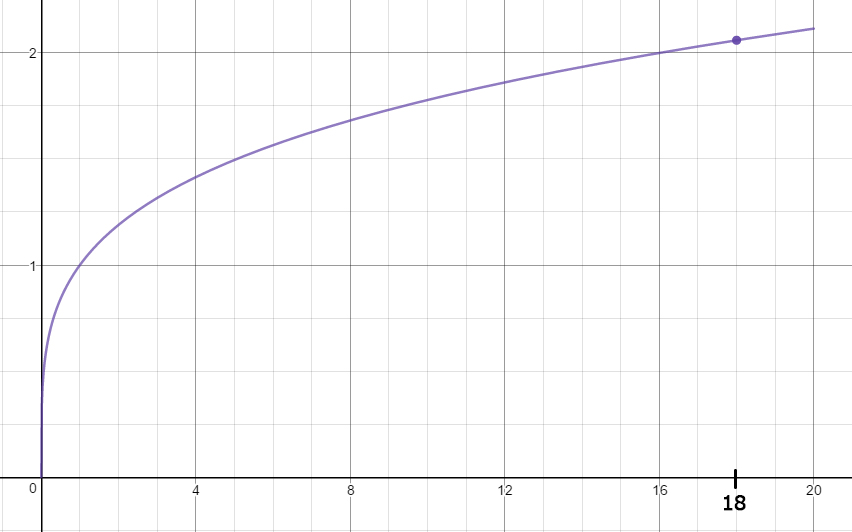
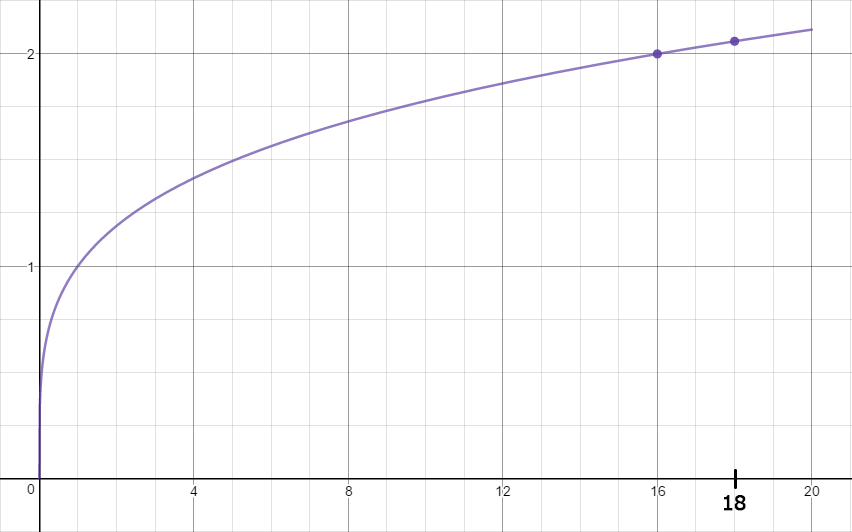
Using the ideas of differentials, find a linear approximation of .
Let's let . In our case, since , we'll set and . Then, since , we have Therefore, our linear approximation is
One last thing: although the terms and notations seem new, there is nothing conceptually different between this perspective and the previous approach for linear approximation. The notion of differentials just gives us another way to describe the process.