O que seria a propriedade distributiva?

Before this, knowO que seria uma propriedade associativa?

Video · + 2 min read

(Videos) The Distributive Property

by Math Antics

In these videos by mathantics, he goes over what the distributive property is and how you use it.

Summary\large{\text{Summary}}

To distribute something means we give it to each member of a group. So, the distributive property allows us to distribute a term to a group of terms. It is also sometimes called the distributive property of multiplication.

Let's look at the example: 3×(4+6)3\times(4+6). There are two ways we can simplify this. The first way is to use order of operations. The second way, we'll use the distributive property.

Order of Operations

Using this, we do the parentheses first. Then, we multiply. 3×(4+6)=3×(10)=30\begin{align} &3\times(4+6)\\ &=3\times(10)\\ &=\boxed{30} \end{align}

Distributive Property

With this property, we're going to distribute the 33 being multiplied to each term in the parentheses. 3×(4+6)=3×4+3×6=12+18=30\begin{align} &3\times(4+6)\\ &=3\times4+3\times6\\ &=12+18\\ &=\boxed{30} \end{align}

Why?

If they both give the same answer, why do we use the second method? In some cases, distributing will be more work. Take the example we just did; it's much easier to add inside the parentheses to get a 1010 and then multiply.

What about this problem? 8×(50+3)8\times(50+3) If we add first, this problem is much harder to do. If we distribute, it's easy. 8×(50+3)=8×50+8×3=400+24=424\begin{align} &8\times(50+3)\\ &=8\times50+8\times3\\ &=400+24\\ &=\boxed{424} \end{align}

Turning a Problem into a Distributive Problem

We can even turn problems into distributive problems to make them easier. Suppose we want to multiply: 5×475\times47 This isn't easy to do in your head. But, suppose we wrote 4747 as 40+740+7. 5×(40+7)5\times(40+7) This is much easier to do if we distribute. 5×(40+7)=5×40+5×7=200+35=235\begin{align} &5\times(40+7)\\ &=5\times40+5\times7\\ &=200+35\\ &=\boxed{235} \end{align}

Subtraction

Guess what! We can also distribute into terms being subtracted. 7×(10−4)7\times(10-4) We distribute the multiplication just like before, only we subtract the terms instead of add them. 7×(10−4)=7×10−7×4=70−28=42\begin{align} &7\times(10-4)\\ &=7\times10-7\times4\\ &=70-28\\ &=\boxed{42} \end{align}

Mix and Match

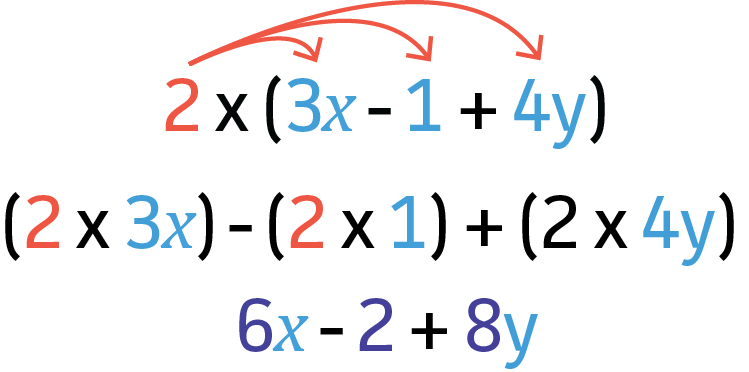
We can even distribute if there's a mix of addition and subtraction in the group. 4×(20+5−8)=4×20+4×5−4×8=80+20−32=68\begin{align} &4\times(20+5-8)\\ &=4\times20+4\times5-4\times8\\ &=80+20-32\\ &=\boxed{68} \end{align}

Doesn't Work

Distributing doesn't work when the members of the group are being multiplied or divided. 5×(2×3)≠5×2×5×34×(6÷2)≠4×6÷4×25\times(2\times3)\quad{\large{\ne}}\quad5\times2\times5\times3\\ 4\times(6\div2)\quad{\large{\ne}}\quad4\times6\div4\times2

In other words, we can't use multiplication and division inside the parentheses.

Variables

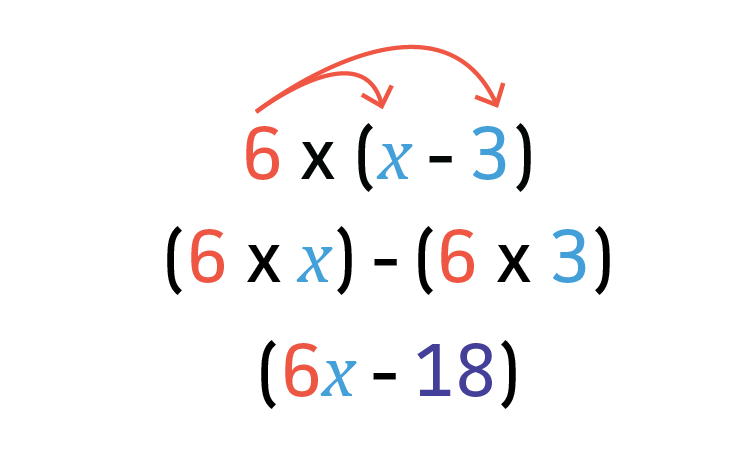
We can distribute if the group contains variables. 3×(x+6)3\times(x+6) We distribute the 33 to each term regardless of if it's a variable or not. 3×(x+6)=3×x+3×6=3x+18\begin{align} &3\times(x+6)\\ &=3\times x+3\times6\\ &=3x+18 \end{align}

Here's an example with only variables. a×(b−c)=a×b−a×c=ab−ac\begin{align} &a\times(b-c)\\ &=a\times b-a\times c\\ &=ab-ac \end{align}

Test Yourself: Simplify 7(3+x)7(3+x).

Choose one answer

Worth the struggle

Twenty minutes on one hard problem can teach more than ten easy exercises. These problems are worth staying with. These are real problems from the AMC 8, AMC 10 and AMC 12, the national math competitions for middle and high school students, each with a worked solution on LIVE by Po-Shen Loh.

Interactive · 1 question

Distributive Property\textbf{Distributive Property}
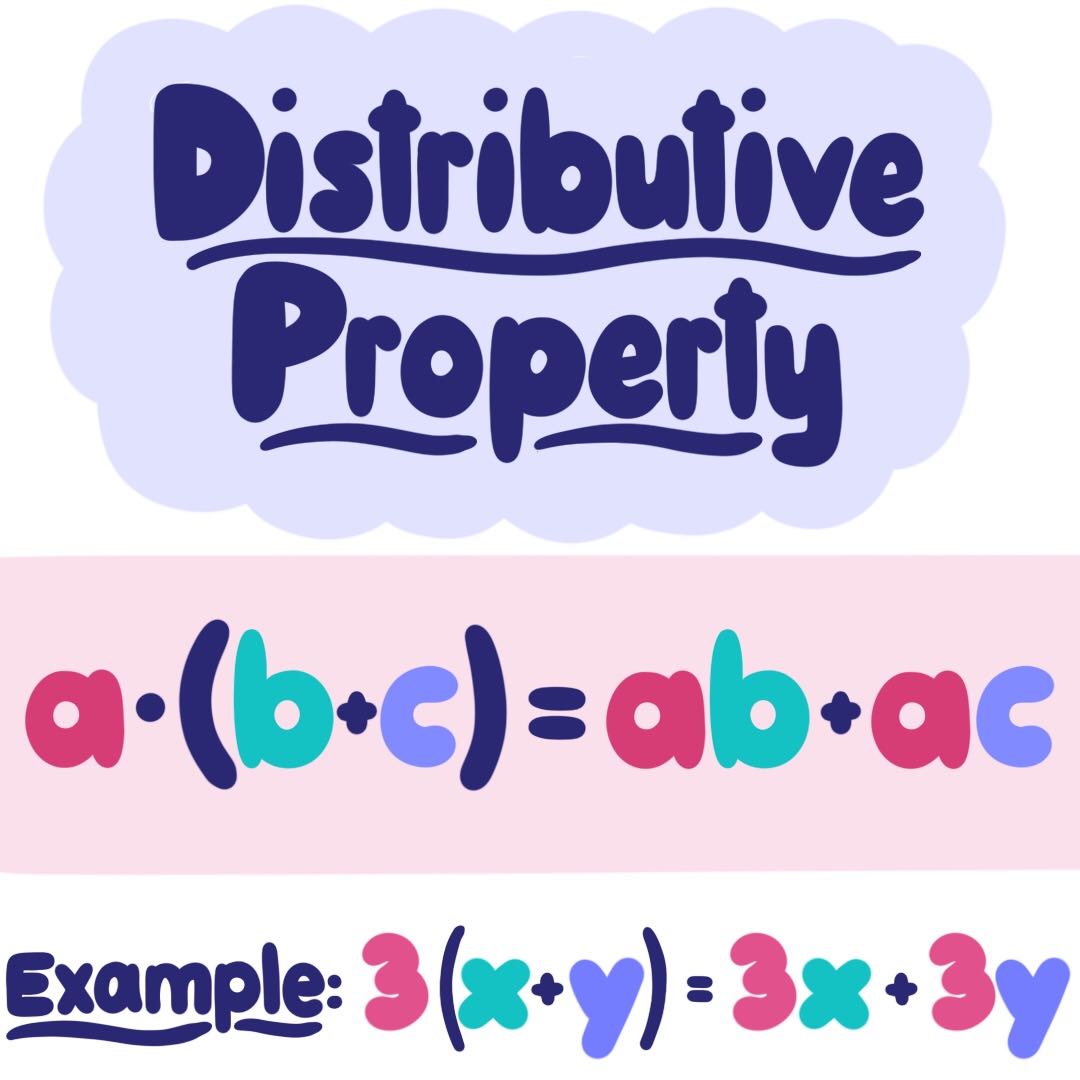
Distributive Property: a(b+c) = ab+ac. Example: 3(x+y)=3x+3y

Image by Caroline Kulczycky

Below is a visual representation of the distributive property. Imagine two rectangles with the same height but different width, there are 22 ways to calculate the total area of the two rectangles.

a x (b + c) = a x b + a x c

What does 3×(2+4)3\times (2+4) equal to?

Choose one answer

Interactive · 3 questions

The Distributive Property

The distributive property says that if you're multiplying an expression in parentheses by a number, you have to do that operation to every number within the parentheses. When you know what all the numbers are, that's easy: you can just follow the order of operations and add/subtract the numbers within the parentheses first.

For example, what is 4×(3+5)4 \times (3 + 5)?

Choose one answer

Type a concept, like “slope” or “photosynthesis”.

↑ ↓ to choose · Enter to openSearch explanations and problems