
Illustrated · 1 min

When considering functions and their properties, a common theme in mathematics is whether to consider the function locally around a certain point, or to consider the function over its entire domain. In the real world, this is a very important distinction to make. We often do not care about the behavior of a function in extreme cases but rather, only the cases we will deal with.
As an example, consider the function Here is the graph of the function:
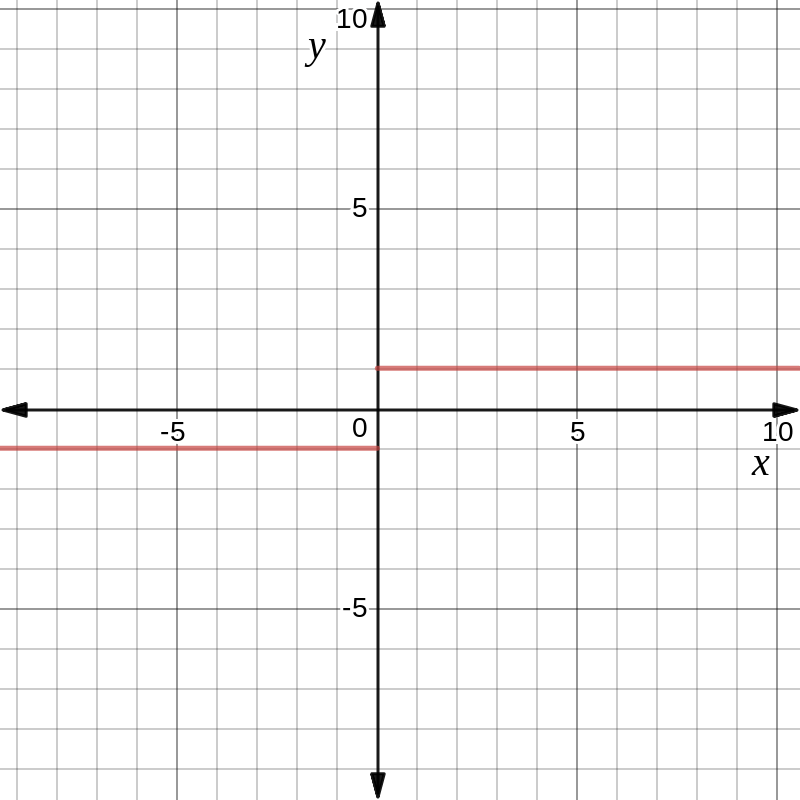
Notice that the function is continuous everywhere except at . Now, if we are thinking about this function globally (on its entire domain), we cannot say this function is continuous. However, if we look at the function locally around , we can see the function is locally continuous near and at that point.
It is also important to define what it means to consider points "near" a certain point. This concept will be dealt with in an introductory analysis/topology course, but for the purposes of real-valued functions (functions from ), it is just dealing with points in a small interval containing the point itself. The size of the interval doesn't matter as long as it is a proper interval and contains the point itself. For example, in the above example, we can say the function is continuous "near" because I can find an interval containing , like , where the function is continuous at every point in the interval.