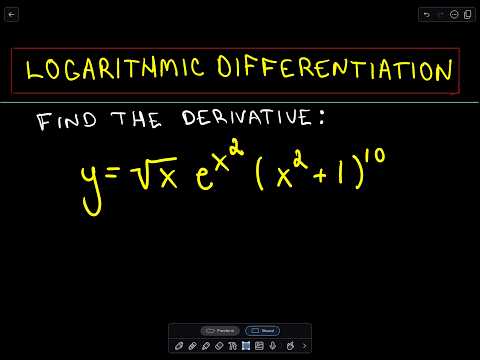
Let's start off with a nice, simple question on derivatives:
As you're probably thinking right now, this function is way too complicated to differentiate directly. (Of course you still can, but that would require lots of paper and time.) To avoid such problems, we use a method called logarithmic differentiation, which uses the ideas of implicit differentiation.
Before we begin, let's remind ourselves of a few rules regarding logarithms:
To recap, these are some of the rules of logarithms that we'll be using:
-
lnx+lny=ln(xy)
-
lnx−lny=ln(yx)
-
ln(xa)=alnx
Now, let's apply these laws. Suppose we start with a general equation
y=f(x).
We first take the logarithm of both sides to get
lny=lnf(x).
Next, we differentiate both sides. Remembering the chain rule and the fact that that dxd(lnx)=x1, we have
y1⋅dxdy=dxd(lnf(x)).
So, our final expression for the derivative is
dxdy=y⋅dxd(lnf(x)).
How will this be useful, you may ask? Well, let's take the example problem from above, and let f(x)=(x+13)(x−509)2(x−1)3(x+2)4. Plugging this in, we get
dxdy=f(x)⋅dxd(ln[(x+13)(x−509)2(x−1)3(x+2)4]).
Specifically, let's look at the complicated term on the right hand side:
ln[(x+13)(x−509)2(x−1)3(x+2)4].
This is the logarithm of a bunch of products! So, by using the log laws discussed above, we can simplify this as
ln(x+13)+ln(x−509)2+ln(x−1)3+ln(x+2)4
=ln(x+13)+2ln(x−509)+3ln(x−1)+4ln(x+2).
So, it follows that
dxdy=f(x)⋅dxd(ln(x+13)+2ln(x−509)+3ln(x−1)+4ln(x+2))
=f(x)⋅[dxdln(x+13)+2dxdln(x−509)+3dxdln(x−1)+4dxdln(x+2)]
=(x+13)(x−509)2(x−1)3(x+2)4⋅[x+131+x−5092+x−13+x+24].
This example was still relatively messy, but it required a lot less work than the usual method of differentiation. This shows you how powerful this method can be at times.
Now you try!
We use the method of logarithmic differentiation, and start by taking the logarithm of both sides to get
lny=lnxx=xlnx.
Now, we differentiate both sides:
y1⋅dxdy=dxd(lny)=dxd(xlnx)=xdxd(lnx)+lnxdxd(x)=lnx+1.
So, it follows that
dxdy=y(lnx+1)=xx(lnx+1).
In general, you can see that this method can be very useful for differentiating functions with several products or complicated exponents.