Fatores vs multiplos

Before this, knowO que seria um multiplo?

Interactive · 4 questions

Factors vs. Multiples

Multiples of a number are products of that number and an integer. They are usually written out in a list. Often we only ask for positive multiples. These are the multiples of a number which are also positive. We'll show an example of this later.

Factors of a number are integers that evenly divide into that number. For positive integers, each factor is less than or equal to the original number.

We are now going to take a look at some of the types of problems you might encounter about factors vs. multiples.

Before you start these problems, make sure to go over the basics of factors vs. multiples.
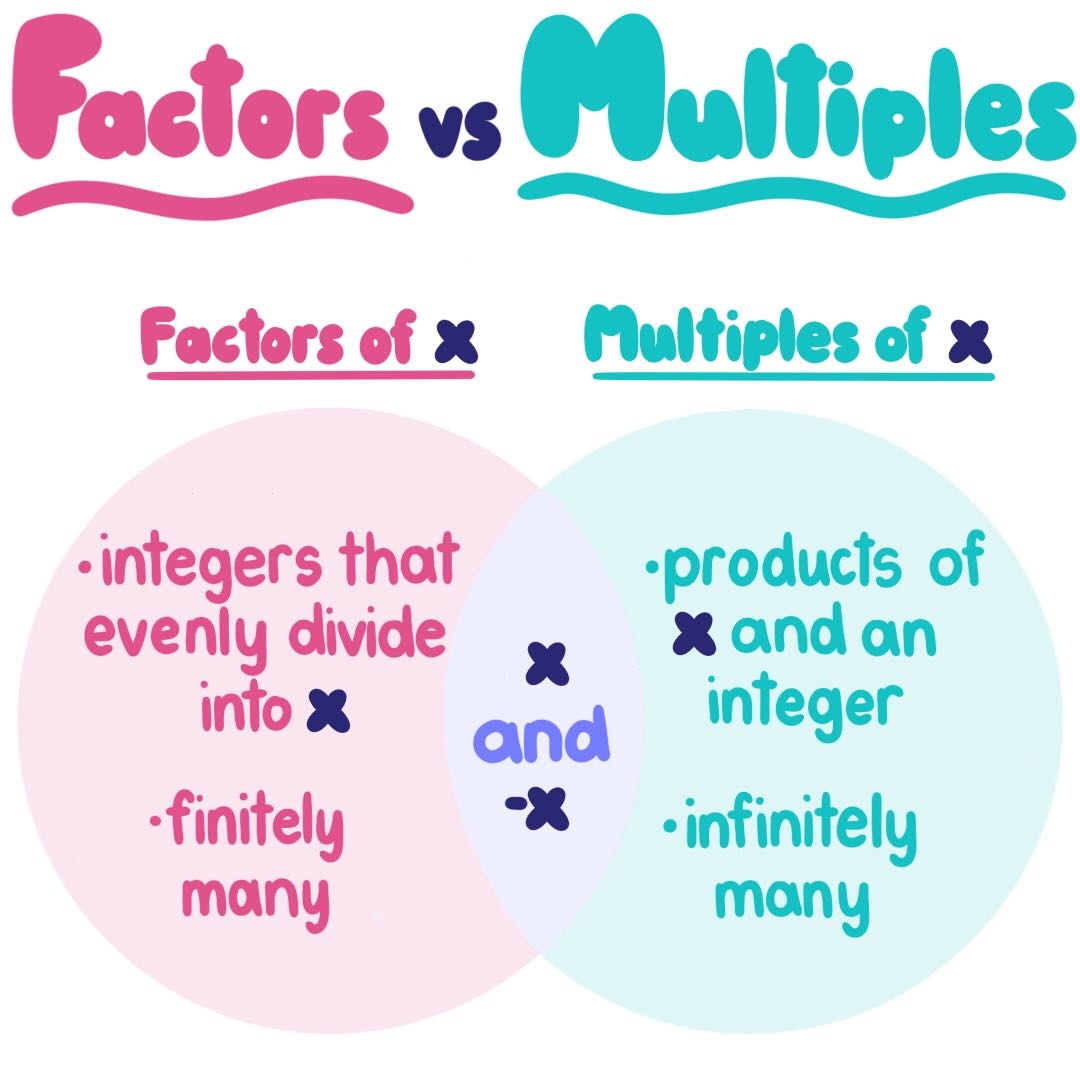
Factors vs Multiples. Factors of x: integers that evenly divide into x. Finitely many. Multiples of x: products of x and an integer. Infinitely many. x and -x are always factors and multiples of x.

Image source: By Caroline Kulczycky

Example 1 \\ Select all numbers that are positive multiples of 55.

Choose all correct answers

Interactive · 2 questions

All whole numbers have factors and multiples. These terms are often confused because their definitions are very similar to one another. Factors and multiples are also closely related to each other. \\

Multiples

Multiples of a number are the numbers we get as a result of multiplying a number xx by an integer yy. The product, zz, is a multiple of both xx and yy. For example, let x=2x=2 and y=3y=3. Then z=xy=2×3=6z = xy = 2 \times 3 = 6.

Thus, 66 is a multiple of 22. We can multiply 22 by an integer (3)(3) to get 66. With the same logic, 66 is also a multiple of 33. We can multiply 33 by an integer (2)(2) to get 66. In fact, a number will be a multiple of all of its factors. For instance, here is a list of factors of 1212:

1,2,3,4,6,121, 2, 3, 4, 6, 12

Then 1212 is a multiple for each number in the above list. Larger numbers usually have a greater number of factors. This excludes prime numbers, which only have two factors.

There's another way to think of multiples of numbers. It is thinking about counting by that number. This is also called skip-counting. For example, if we count by two, 2,4,6,8,10,12,…2,4,6,8,10,12, \dots, all of the numbers listed are multiples of two because they are all a product of 22 and another number. i.e.

{2×1,2×2,2×3,2×4,2×5,2×6}={2,4,6,8,10,12}\{2\times{\color{#29A603}{1}},2\times{\color{#29A603}{2}},2\times{\color{#29A603}{3}},2\times{\color{#29A603}{4}},2\times{\color{#29A603}{5}},2\times{\color{#29A603}{6}}\}=\{2,4,6,8,10,12\}

Just like we can count by twos forever, we can count multiples of numbers forever. Each number has an infinite amount of multiples.

Let's try it! Select all numbers that are multiples of 9.9.

Choose all correct answers

Video · + 1 min read

(Video) Factors Vs. Multiples

by Mr. Voland

Here's a good video by Mr. Voland that explains the difference between factors and multiples. The two concepts are closely related. However, they don't exactly mean the same thing!

Summary\large{\text{Summary}}

There are a finite number of factors, but an infinite amount of multiples.

He shows some helpful techniques using pictures to demonstrate. For example, if a number was a tree, its factors would be the roots. The multiples would be the leaves. This analogy might help you remember the difference.

You can think of your original number as the trunk of the tree. It connects the leaves and the roots.

Image of an illustrated tree with visible roots. The number 10 is visible on the trunk.  On the roots on the bottom of the tree, the numbers 1, 2, 5, and 10 are showing, denoting that they are factors of 10.  In the leaves at the top of the tree, the numbers 20, 30, 40, 50, 60, 70, 80, 90 and 100 are all visible, denoting that they are multiples of 10.

Image by Sarah Walker

Factors are smaller and finite. They're the numbers that make up the your number. So, for the tree example above, the trunk is 1010. The roots (factors) of the tree are 1,2,5,1, 2, 5, and 1010. There are only 44 factors of 1010, which means that the number of factors are finite. You can physically count how many factors there are. They will all be positive integers less than the number on the trunk.

Multiples are larger and infinite. They're the numbers that can be made with your number. So, for the tree example above, the multiples (leaves) of 1010 are 20,30,40,50,60,70,80,90,20, 30, 40, 50, 60, 70, 80, 90, and 100100. Now, there are many more multiples of 1010. In fact, there are an infinite number of multiples of 1010! This means you cannot physically count all the multiples of 1010. You could start now, and by the time you're 8585 years old, you still won't be done counting!

Interactive · 2 questions

Both factors and multiples have to do with multiplication. Let's take a look at a few examples and see if we can identify the difference between factors and multiples. If we list some factors and some multiples, maybe we can solve the puzzle!

4 x 5 = 20

First, notice 4,54,5 are factors of 2020. These aren't all the factors. We just need a few for the moment.

Moreover, 2020 is a multiple of both 44 and 55.

What are the other factors of 2020?

1 x 20 = 20
2 x 10 = 20

1,2,10,201,2,10,20 are also factors of 2020. Notice that the factors are all whole numbers. This is true regardless of what number we're factoring.

What are some other multiples of 55?\\ A number is a multiple of 55 if we can multiply 55 with a whole number and get that number.

5 x 1 =5
5 x 2 = 10
5 x 3 = 15

5, 10, and 15 are all multiples of 5.

In fact, for any number, there is an infinite amount of multiples! That is, it would take forever to list them all.

Some facts about factors and multiples

Factors \\ The factors of a number are smaller or equal to that number. \\ The factors of a number are integers. \\ For any number, there is a limited amount of factors.

Multiples \\ A multiple of a number is bigger or equal to that number. \\ A multiple of a number is an integer. \\ For any number, there is an infinite amount of multiples.

Try practicing with these concepts now.

Which of the following are not factors of 4646?

Choose all correct answers

Type a concept, like “slope” or “photosynthesis”.

↑ ↓ to choose · Enter to openSearch explanations and problems