Gráfico com linhas horizontais e verticais

Before this, knowGRÁFICO: Usano x e y interceptados

Interactive · 1 question

Representing Horizontal and Vertical Lines with Standard Form

First, take a look at the Cartesian Coordinate system and think about this:

How do we specify a horizontal or vertical line? They are less complex than the other lines we would have, since we already know they are either parallel to the xx-axis or the yy-axis.

These rules are for straight lines.

Cartesian coordinate plane.

Made using Desmos

Horizontal Lines

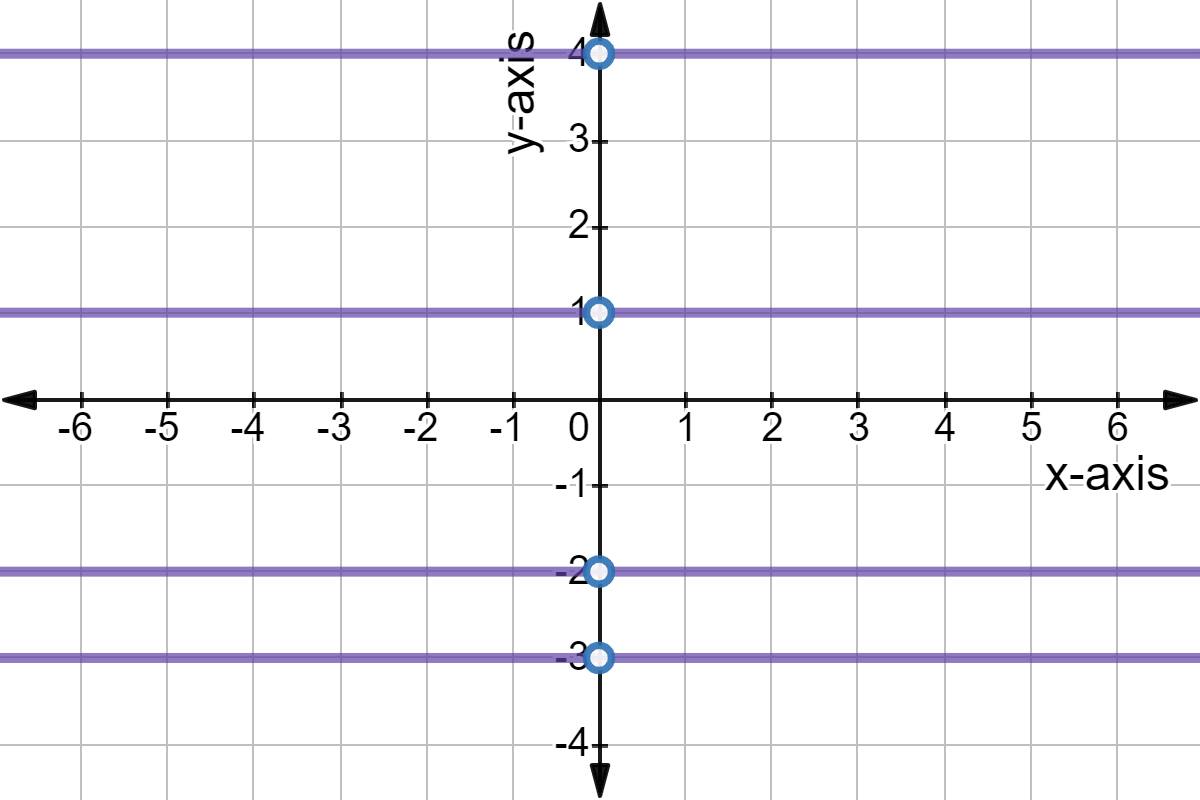
All horizontal lines are parallel to the xx-axis. They cross (or intersect with) the yy-axis.

Graph of y = 4, y = 1, y = -2, and y = -3.

All of these are horizontal lines.

Made using Desmos

To write the equation of a horizontal line, we only need to specify where it intersects with the yy-axis. This will look like y=k,y=k, where kk is where the line crosses the yy-axis.

y = k
y=ky=k

=== Made using Desmos

Can we reach this conclusion from the standard form of linear equations? The answer is yes. A line is horizontal when A=0\color{#8925ae}{A=0} in the equation Ax+By=C{\color{#8925ae}{A}}x+By=C.

When A=0A=0, we can rearrange the standard from equation to be: Ax+By=C(0)x+By=CBy=Cy=CB\begin{align} Ax+By&=C\\ ({\color{#8925ae}{0}})x+By&=C\\ By&=C\\ y&=\frac CB \end{align} We can further gather that the yy-intercept, kk, is the same as CB\frac{C}{B}. y=k=CBy=k=\frac{C}{B}

Vertical Lines

All vertical lines are parallel to the yy-axis. They all cross (or intersect with) the xx-axis.

Vertical lines x = 4, x = 1, x = -2, and x = -3.

All of these are vertical lines.

Made using Desmos

To write the equation of a vertical line, we only need to specify where it intersects with the xx-axis. This will look like x=j,x=j, where jj is where the line crosses the xx-axis.

x = j
x=jx=j

=== Made using Desmos

We can reach this conclusion from the standard form of linear equations by letting B=0\color{#8925ae}{B=0}.

When B=0B=0, we can rearrange the standard from equation to be: Ax+By=CAx+(0)y=CAx=Cx=CA\begin{align} Ax+By&=C\\ Ax+({\color{#8925ae}{0}})y&=C\\ Ax&=C\\ x&=\frac CA \end{align} We can further gather that the xx-intercept, jj, is the same as CA\frac{C}{A}. x=j=CAx=j=\frac{C}{A}

Recap

When using the standard form of an equation

  • the line will be horizontal when A=0A=0.
  • the line will be vertical when B=0B=0.

Practice Problem

Select all the equations below that are for vertical lines.

Choose all correct answers

Video · + 1 min read

(Video) Standard Form of Horizontal and Vertical Lines

by Sarah Messing

This video by Sarah Messing shows how to find the standard form of a horizontal or vertical line given a point.

Summary\large{\text{Summary}}

Example 1

Suppose we want to write the standard form of the equation of the horizontal line through (6,−5)(6,-5).

To start, we can plot the given point, (6,−5)(6,-5), and draw a horizontal line through it.

Horizontal line through the point (6,-5).

Made using Desmos

Notice that the yy-coordinate at any point on this line is always −5-5. It's a constant. So we can write: y=−5y=-5 This is the same as writing it as 0x+y=−50x+y=-5 but we just simplify and remove the 0x0x. So, y=−5y=-5 is in standard form.

Example 2

Suppose now we want to write the equation in standard form of the vertical line that passes through (−2,−7)(-2,-7).

Graphing this gives us:

Vertical line through the point (-2,-7).

Made using Desmos

This time the xx-coordinate is always constant. At any point on the line, the xx-coordinate is −2-2. So we say, x=−2x=-2 We could write this as x+0y=−2x+0y=-2, but this is more simplified.

In General

The standard form for an equation is: Ax+By=CAx+By=C

Let's plug in some values.

Any horizontal line will have A=0A=0. 0x+By=CBy=Cy=CB\begin{align} 0x+By&=C\\ By&=C\\ y&=\frac CB \end{align} This CB\frac CB is just the yy-intercept.

Any vertical line will have B=0B=0. Ax+0y=CAx=Cx=CA\begin{align} Ax+0y&=C\\ Ax&=C\\ x&=\frac CA \end{align} This CA\frac CA is just the xx-intercept.

Illustrated · 1 min

Horizontal Line Equations

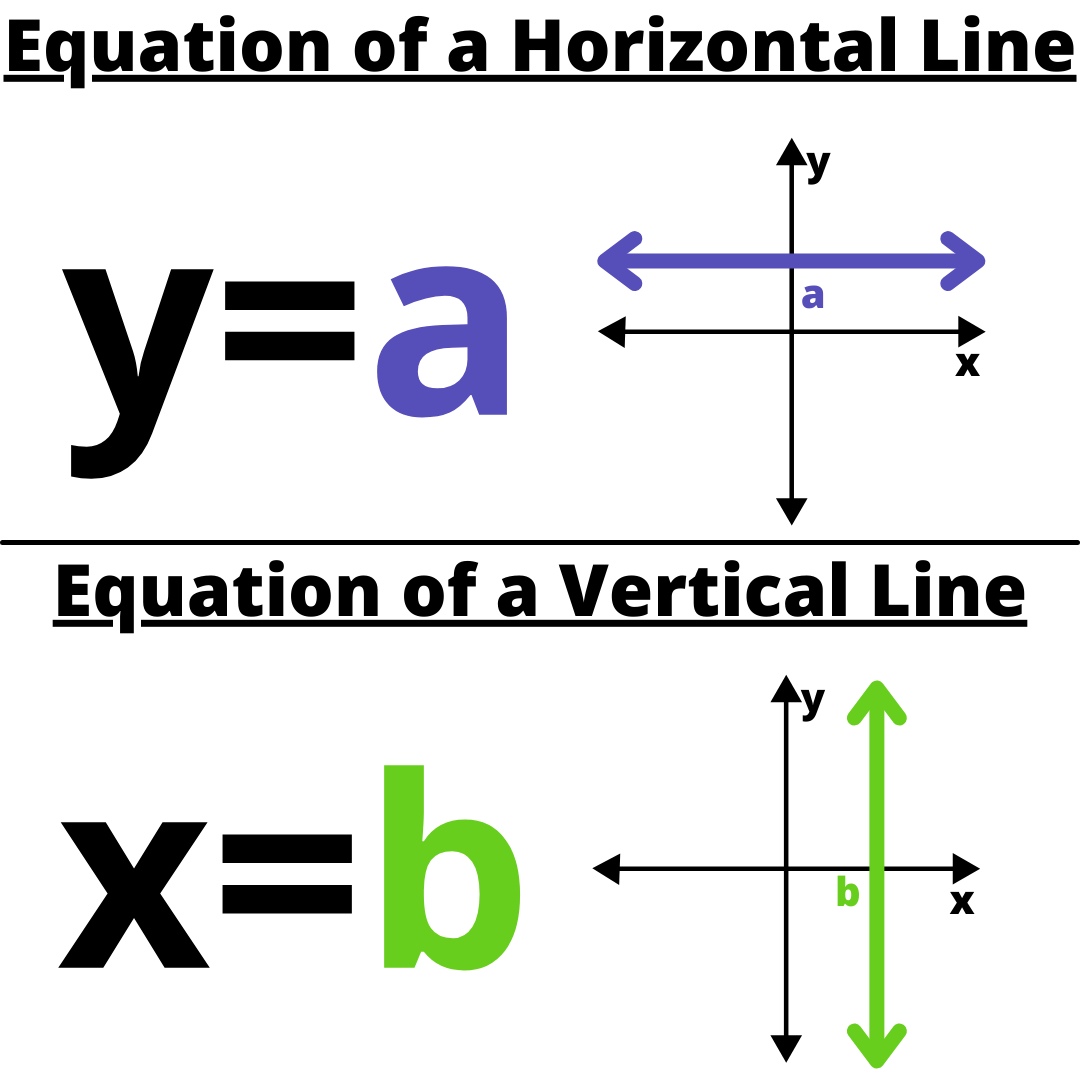
Horizontal lines have varying xx-values, but a constant yy-value. In other words, the yy-value is not dependent on any xx-value...it is constant! Horizontal lines have equations that look like this: y=ay=a where aa is a real number. In this equation, aa is the fixed value that yy must take, despite the varying xx-values.

Vertical Line Equations

Vertical lines have varying yy-values, but a constant xx-value. Vertical lines have equations that look like this: x=bx=b where bb is a real number. In this equation, bb is the fixed value that xx must take, despite the varying yy-values.

Equation of a Horizontal Line: y=a. (Picture of a graph of a horizontal line with y-value of a). Equation of a Vertical Line: x=b. (Picture of a graph of a vertical line with x-value of b).

Image source: By Caroline Kulczycky

Type a concept, like “slope” or “photosynthesis”.

↑ ↓ to choose · Enter to openSearch explanations and problems