Limite como aproximação infinitesimal

Before this, knowQual a definição de limite infinito?Definição de limites

Read · 3 min

A sequence is a list of elements, also known as members. If the order of the members of the sequence are switched, then the sequence is not the same.

The length of a sequence is the number of elements in it; it can either be finite or infinite. For example the sequence (1,2,3,...) is an infinite sequence, and the sequence (1,3,5) is a finite sequence.

There are several different notations for sequences, and the one shown above will be used in this article. Other types can be found on the web.

Note that the nthn^{th} element in a sequence is denoted as ana_n. This can be used to do a variety of things.

There are 3 main types of sequences: arithmetic, geometric, and recurrences.

Arithmetic sequences are ones where there is a common difference between every consecutive term. Ex:(1,3,5) is an arithmetic sequence since the common difference is 22.

The common difference is commonly denoted as the variable dd. This can be used to find the sum of a finite arithmetic sequence (also known as a series). The formula for an arithmetic series is:

(n)(2a1+(n−1)d)2\frac{(n)(2a_1+(n-1)d)}{2} where nn is the length of the sequence. Note that for infinite arithmetic series, the sum is obviously infinity. See if you can derive it by yourself! (Algebraically or intuitively)

Geometric sequences are very similar, apart from the fact that they do not have a common difference, instead they have a common... ratio! Here's an example: (1,3,9) is an geometric sequence since the common ratio is 33.

The common ratio is commonly denoted as the variable rr.This be used to find the sum of a geometric sequence (also known as a series). The formula for a geometric series is:

(a)(1−rn)(1−r)\frac{(a)(1-r^n)}{(1-r)} where aa is the first term. Don't bother memorizing this formula since it's rather complicated. Instead, just try to prove it!

Hint: The proof is very simple, but beautiful at the same time.

When the geometric series is infinite, the formula becomes:

a1−r\frac{a}{1-r}. See why this happens!!!

The final general type of sequences are recurrences. Recurrences are sequences where several initial terms are given, and the remaining terms are defined as a function of the previous ones.

A very famous example are the Fibonacci numbers. Their recurrence relation is:

Fn=Fn−1+Fn−2F_n = F_{n-1} + F_{n-2}

Where F0=0F_0 = 0.

Now you may be thinking, what if I want to find the 100th term of the Fibonacci sequence? Do I have to compute all the previous terms before it?(This is a lot of computation!)

Lucky for you, there is a simpler way! This is known as the close form of a recurrence. All recurrences have closed forms, some more complicated than others.

Closed forms do not require the values of previous terms, an Ex. is an=5n−12+17n−27a_n = \frac{5^{n-1}}{2} + \frac{17^{n-2}}{7}. The 100th term can be found by just plugging in 100 into the formula! Isn't that convenient!

Sadly, deriving the closed form of a recurrence can be very pain-staking. If you really want to have a go at it, I would recommend trying it on a simpler recurrence than the Fibonacci sequence.* This is because the closed form of the Fibonacci sequence is rather complicated. It is known as Binet's formula; go check it out if you're curious!

*Hint: Try substituting cnc^n into the recurrence for ana_n and then divide by cn−2c^{n-2}. This is also known as the characteristic equation.

Sequences are one of the most interesting parts of mathematics, and I would recommend looking them up if you're interested. This article only scratches the surface of the topic, so go looking for other interesting branches!

Interactive · 3 questions

There are two types of sequences. The first type of sequence is an arithmetic series. Arithmetic sequences are sequences that have a consistent intervals.

Which of these is an arithmetic sequence?

Choose one answer

Video · + 1 min read

(Video) Limits at Infinity

by PatrickJMT

Here's a video by patrickJMT showing you how to find limits of functions as they approach infinity.

When we take a limit as it approaches infinity we're looking at what happens when we put in larger and larger numbers.

The first example he looks at is: lim⁡x→∞3x2+5x+4x3+7x\lim_{x\rightarrow\infty}\frac{3x^2+5x+4}{x^3+7x} So we start putting in larger and larger numbers 100,1000,1000000,1000000000,...100,1000,1000000,1000000000,... and if the output starts getting closer and closer to a number that's what we say the limit is.

When solving limits that approach infinity for rational functions, you always look at the highest power in the denominator. 3x2+5x+4x3+7x\frac{3x^2+5x+4}{\color{red}{x^3}+7x} Here x3x^3 is our highest power in the denominator, so what we do is divide every term in our function by x3x^3. =lim⁡x→∞3x2x3+5xx3+4x3x3x3+7xx3=lim⁡x→∞3x+5x2+4x31+7x2\begin{align} &=\lim_{x\rightarrow\infty}\frac{\frac{3x^2}{x^3}+\frac{5x}{x^3}+\frac{4}{x^3}}{\frac{x^3}{x^3}+\frac{7x}{x^3}}\\ &=\lim_{x\rightarrow\infty}\frac{\frac3x+\frac5{x^2}+\frac4{x^3}}{1+\frac7{x^2}} \end{align} As xx gets closer to infinity, 3x\frac3x gets closer to zero. Same thing goes for all the terms with an xx in the denominator. =lim⁡x→∞0+0+01+0=01=0=\lim_{x\rightarrow\infty}\frac{0+0+0}{1+0}=\frac01=0

So therefore, lim⁡x→∞3x2+5x+4x3+7x=0\lim_{x\rightarrow\infty}\frac{3x^2+5x+4}{x^3+7x}=0

The next example he solves is lim⁡x→−∞x4+x5x3+7\lim_{x\rightarrow-\infty}\frac{x^4+x}{5x^3+7} Here's the highest term in the denominator is x3x^3 so we divide each term by this. =lim⁡x→−∞x4x3+xx35x3x3+7x3=lim⁡x→−∞x+1x25+7x3\begin{align} &=\lim_{x\rightarrow-\infty}\frac{\frac{x^4}{x^3}+\frac{x}{x^3}}{\frac{5x^3}{x^3}+\frac7{x^3}}\\ &=\lim_{x\rightarrow-\infty}\frac{x+\frac1{x^2}}{5+\frac7{x^3}} \end{align} Like before, any term with an xx in the denominator becomes zero. =lim⁡x→−∞−∞+05+0=−∞5=−∞=\lim_{x\rightarrow-\infty}\frac{-\infty+0}{5+0}=\frac{-\infty}5=-\infty So therefore, lim⁡x→−∞x4+x5x3+7=−∞\lim_{x\rightarrow-\infty}\frac{x^4+x}{5x^3+7}=-\infty

There are 3 different cases when dealing with the limits of rational functions as they approach infinity.

  1. Degree in Numerator = Degree in Denominator. The limit is the ratio of the coefficients. lim⁡x→±∞=4x10+10000x95x10+4=45\\ \lim\limits_{x\rightarrow\pm\infty}=\dfrac{\color{red}{4}x^{10}+10000x^9}{\color{red}{5}x^{10}+4}=\dfrac45
  2. Degree in Numerator < Degree in Denominator. The limit is always zero. lim⁡x→±∞3x75x8+10x+2=0\\ \lim\limits_{x\rightarrow\pm\infty}\dfrac{3x^7}{5x^8+10x+2}=0
  3. Degree in Numerator > Degree in Denominator. The limit will be either positive or negative infinity. lim⁡x→∞x4x3+5=∞\\ \lim\limits_{x\rightarrow\infty}\dfrac{x^4}{x^3+5}=\infty

Illustrated · 3 min

(Video) Infinite Limits

by PatrickJMT

In a video by patrickJMT he gives a good explanation of infinite limits.

Infinite limits are of the form lim⁡x→aM(x)N(x)=NonzeroZero\lim_{x\rightarrow a}\frac{M(x)}{N(x)}=\frac{\text{Nonzero}}{\text{Zero}} where aa can be any number or either positive or negative infinity.

Suppose we have some function M(x)M(x) and some function N(x)N(x) that are reduced and simplified. The top limit gives us something nonzero but the bottom limit gives us zero

Typically your solution will be one of three things:

  1. ∞\infty
  2. −∞-\infty
  3. Does not exist. DNE.

Before he begins he gives a quick remark. Suppose we take some finite nonzero number and suppose we divide this my a small number. What type of number are you going to get out? Well let's look at some examples and see. 10.11010.0110010.0011000\begin{array}{c|c} \frac1{0.1}&10\\ \frac1{0.01}&100\\ \frac1{0.001}&1000 \end{array} Notice how when the number in the denominator gets smaller and smaller, our answer gets larger and larger. So the main idea is a finite nonzero number over a small number is going to be a big number (either positive or negative depending on signs).

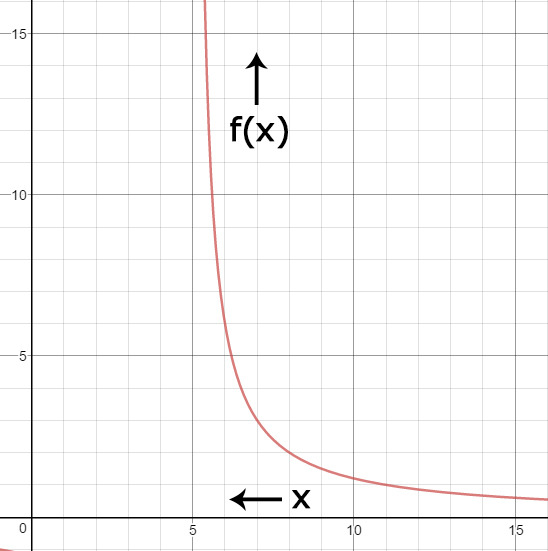
Let's look at an example now. lim⁡x→5+6x−5\lim_{x\rightarrow5^+}\frac{6}{x-5} All that the ++ means is we're approaching 5 from the right. Notice what happens when we plug in x=5x=5. 6x−5=6(5)−5=60\frac6{x-5}=\frac6{\color{red}{(5)}-5}=\frac60 This is undefined.

So let's see what happens when we approach 5 from the right. This means we have numbers that are bigger than 5. So 5.1,5.01,5.001,5.0001,...5.1,5.01,5.001,5.0001,... We're getting closer and closer to the number 5. What happens if we plug these numbers into our denominator? As we get closer and closer to 5, x−5x-5 gets closer and closer to zero. x→5+⇒x−5→0x\rightarrow5^+\Rightarrow x-5\rightarrow0 We have to ask though is it going to be bigger than zero or smaller than zero? Well since the numbers we're putting are bigger than 5, when we subtract 5 the result will be bigger than zero. So: x→5+⇒x−5→0+x\rightarrow5^+\Rightarrow x-5\rightarrow0^+ This means we're approaching zero from the right as well.

Patrick explains that he thinks about the fraction now being 60+\dfrac6{0^+}. When he sees a number divided by zero that means infinity and then we look at the signs. On the top it's positive and on the bottom it's positive, so our infinity is positive. 60+=+∞\frac6{0^+}=+\infty So the limit will approach positive infinity. lim⁡x→5+6x−5=+∞\lim_{x\rightarrow5^+}\frac6{x-5}=+\infty

f(x)=6x−5f(x)=\frac6{x-5}

The next example he looks at is lim⁡x→0x−1x2(x+2)\lim_{x\rightarrow0}\frac{x-1}{x^2(x+2)}

Remember that for a limit to exist, the limit from the left hand side has to equal the limit from the right hand side. lim⁡x→0−=lim⁡x→0+\lim_{x\rightarrow0^-}=\lim_{x\rightarrow0^+}

Let's start by finding the limit of the left hand side. lim⁡x→0−x−1x2(x+2)\lim_{x\rightarrow0^-}\frac{x-1}{x^2(x+2)} So everything is reduced and simplified. We can't cancel anything. So we want to plug in this number zero. x−1(x2)(x+2)=0−1(0)2(0+2)=−1(0)(2)\begin{align} \frac{x-1}{(x^2)(x+2)}&=\frac{\color{red}{0}-1}{(\color{red}{0})^2(\color{red}{0}+2)}\\ &=\frac{-1}{(0)(2)} \end{align} So the main point we want to focus on is the x2x^2 part. So our zero is being approached from the left which means we're taking numbers a little bit smaller than zero. −0.1,−0.001,−0.0001,...-0.1,-0.001,-0.0001,... So now we need to look at what happens when we start plugging these numbers into x2x^2. The square of a negative number is positive. So we know our zero value in the denominator would be approaching zero from the right side. −1(0+)(2)=−10+=−∞\frac{-1}{(0^+)(2)}=\frac{-1}{0^+}=-\infty So this is infinity and since we have a negative on top and a positive on the bottom, the infinity is negative. lim⁡x→0−x−1x2(x+2)=−∞\lim_{x\rightarrow0^-}\frac{x-1}{x^2(x+2)}=-\infty

Next we have to calculate the right hand limit. lim⁡x→0+x−1x2(x+2)\lim_{x\rightarrow0^+}\frac{x-1}{x^2(x+2)} We use the same process as before and you can probably quickly see it's going to come out being the same thing. −1(0+)(2)=−10+=−∞\frac{-1}{(0^+)(2)}=\frac{-1}{0^+}=-\infty So lim⁡x→0+x−1x2(x+2)=−∞\lim_{x\rightarrow0^+}\frac{x-1}{x^2(x+2)}=-\infty

Since both the left hand side and right hand side have the same limit we can say our solution to the original problem is negative infinity. lim⁡x→0x−1x2(x+2)=−∞\lim_{x\rightarrow0}\frac{x-1}{x^2(x+2)}=-\infty

f(x)=x−1x2(x+2)f(x)=\frac{x-1}{x^2(x+2)}

Type a concept, like “slope” or “photosynthesis”.

↑ ↓ to choose · Enter to openSearch explanations and problems