Trabalho

Video · + 2 min read

(Videos) Work and Hooke's Law

by PatrickJMT

In physics work is defined as force times distance, or the force exerted over a distance. But when the force isn't constant, we need to break out integrals to help us find work.

The idea for work in calculus terms is:

Suppose an object moves along the xx-axis in the positive direction from x=ax=a to x=bx=b. At each point xx in [a,b][a,b] let f(x)f(x) be the force on the object. Then the work, WW, needed to move the object from x=ax=a to x=bx=b is: W=∫abf(x)dxW=\int_a^bf(x)dx

Hooke's Law deals with the force of a spring when it is stretched or compressed.

Hooke's Law states that the force required to maintain a spring stretched 'xx' units beyond its natural length is proportional to xx (the distance that you stretch it): f(x)=kxf(x)=kx

Here, kk is referred to as the spring constant.

The first example that Patrick looks at is:

A force of 10lb is required to hold a spring stretched 4in beyond its natural length. How much work is done in stretching it from its natural length to 6in beyond its natural length? (Use foot-pounds.)

So, we want to find work and we're using a spring. Therefore, we can throw Hooke's Law into our integral equation. W=∫(kx)dxW=\int(kx)dx

The spring is starting from its natural length. You can think of this as the spring not being stretched or stretched a distance of 0. So our lower limit of integration is 0. W=∫0(kx)dxW=\int_0(kx)dx

The spring is being stretched 6in or 1/2ft. So this becomes our upper limit of integration. W=∫012(kx)dxW=\int_0^{\frac12}(kx)dx

To integrate this, we need to figure out the value of kk. We can do this by looking at the force equation (Hooke's Law) and using the information given in the first sentence. F=kxF=kx We need 10lbs to stretch the spring 4in, or 1/3ft. 10=k(1/3)30=k\begin{align} 10&=k(1/3)\\ 30&=k \end{align}

Now, we can plug this into our integral and solve. W=∫012(kx)dx=∫012(30x)dx=30∫012x dx=30[12x2]012=15[x2]012=15[x2]012=154 ft-lb\begin{align} W&=\int_0^{\frac12}(kx)dx\\ &=\int_0^{\frac12}(30x)dx\\ &=30\int_0^{\frac12}x\,dx\\ &=30\left[\frac12x^2\right]_0^{\frac12}\\ &=15\left[x^2\right]_0^{\frac12}\\ &=15\left[x^2\right]_0^{\frac12}\\ &=\boxed{\frac{15}4\text{ ft-lb}} \end{align}

In this video, Patrick looks at a more complicated example of Hooke's Law.

Suppose 2J of work is needed to stretch a spring from its natural length of 30cm to a length of 42cm. How much work is required to stretch it from 35cm to 40cm?

This problem is a little tricky to set up. Notice that 30cm is it's natural length. So when we look at the limits of integration (35cm to 40cm) we have to redefine them as distances from the natural length: 35−30=535-30=5 and 40−30=1040-30=10.

Furthermore, Joules are Newton-meters. So we need to convert these centimeters into meters: 0.05m and 0.1m. Therefore, the problem we want to solve is: W=∫0.050.1(kx)dxW=\int_{0.05}^{0.1}(kx)dx

To find kk, we can look at the first sentence which is what's given. 2=∫00.12(kx)dx2=\int_0^{0.12}(kx)dx

We can integrate and then solve for kk. 2=∫00.12(kx)dx2=k∫00.12x dx2=k[12x2]00.122=12k[x2]00.122=12k[0.0144]k=40.0144k=25009\begin{align} 2&=\int_0^{0.12}(kx)dx\\ 2&=k\int_0^{0.12}x\,dx\\ 2&=k\left[\frac12x^2\right]_0^{0.12}\\ 2&=\frac12k\left[x^2\right]_0^{0.12}\\ 2&=\frac{1}2k\left[0.0144\right]\\ k&=\frac{4}{0.0144}\\ k&=\frac{2500}9 \end{align}

Finally, we can plug this back into the integral we want to solve, and, well, solve. W=∫0.050.1(kx)dx=∫0.050.1(25009x)dx=25009∫0.050.1x dx=25009[12x2]0.050.1=12509[x2]0.050.1=12509[(0.1)2−(0.05)2]=12509[0.0075]=2524J\begin{align} W&=\int_{0.05}^{0.1}(kx)dx\\ &=\int_{0.05}^{0.1}\left(\frac{2500}{9}x\right)dx\\ &=\frac{2500}{9}\int_{0.05}^{0.1}x\,dx\\ &=\frac{2500}{9}\left[\frac12x^2\right]_{0.05}^{0.1}\\ &=\frac{1250}{9}\left[x^2\right]_{0.05}^{0.1}\\ &=\frac{1250}{9}\left[(0.1)^2-(0.05)^2\right]\\ &=\frac{1250}{9}\left[0.0075\right]\\ &=\boxed{\frac{25}{24}J} \end{align}
Video · + 3 min read

(Videos) The Cable/Rope Problem

by PatrickJMT

In this first video by PatrickJMT, Patrick looks at a problem where you calculate the work recuired to pull a rope up. The hardest part of this problem is setting it up.

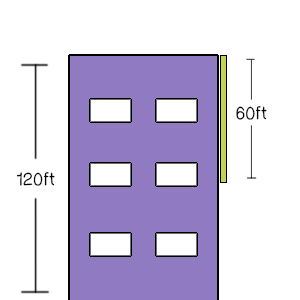
The problem is: > A heavy rope, 60ft long, weighs 2lbs/ft and hangs over the edge of a building 120ft high. How much work is required to pull the rope to the top?

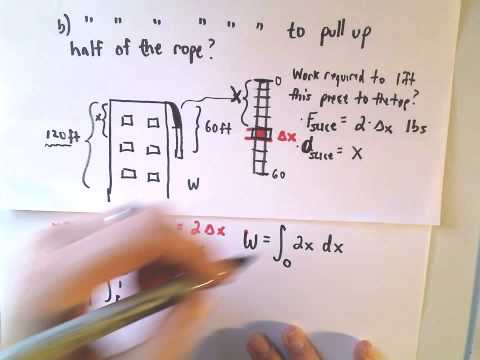
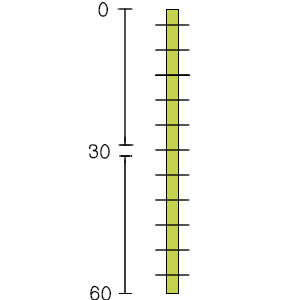
The first step is to draw a diagram.

Patrick explains that the height of the building isn't really important in the problem. It's only needed to know that the rope isn't taller than the building.

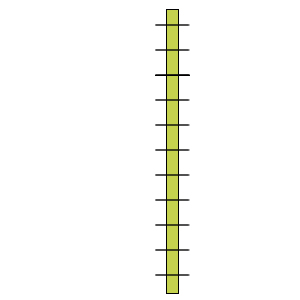
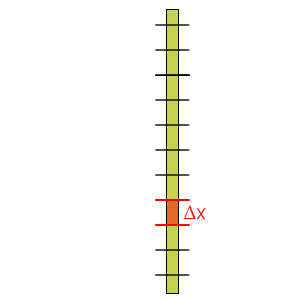
Next, to fully understand how the problem is set up, we look at a close up of the rope but chopped into nn pieces.

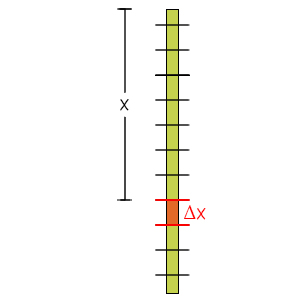
We want to focus on one little slice of this rope. Assume it is a length of Δx\Delta x.

We want to find the work required to lift this small slice up. To do this we first need to find the force on the slice.

The problem says the rope weighs 2lbs/ft. If we have Δx\Delta x feet of rope, then the rope will weigh 2Δx2\Delta x.

> Keep in mind that pounds are a unit of force. The SI equivalent is Newtons. So if the problem is in pounds, then the gravity constant is already calculated into it. If it is in kilograms, then you need to calculate by 9.8.

So the force of the slice is: Fslice=2ΔxF_{\text{slice}}=2\Delta x

We now need to label the distance the slice moves to reach the top. Since the distance will vary for each slice we use a variable (shocking I know). Let's call this distance, xx. dslice=xd_{\text{slice}}=x

We can write the work required to move each slice up as a Riemann sum. W=lim⁡n→∞∑i=1nForce⋅DistanceW=lim⁡n→∞∑i=1n2Δx⋅xiW=lim⁡n→∞∑i=1n2xiΔx\begin{align} W&=\lim_{n\rightarrow\infty}\sum_{i=1}^n\text{Force}\cdot\text{Distance}\\ W&=\lim_{n\rightarrow\infty}\sum_{i=1}^n2\Delta x\cdot x_i\\ W&=\lim_{n\rightarrow\infty}\sum_{i=1}^n2x_i\Delta x\\ \end{align}

We can then turn our Riemann sum into the respective integral. W=∫2x dxW=\int2x\,dx

The limits of integration will be the values that the distance, xx, varies between. Near the top of the rope the distance will be 0 to pull it to the top and near the bottom the distance will be 60 since the rope is 60 feet long. Those are our limits of integration. W=∫0602x dxW=\int_0^{60}2x\,dx

Finally, we integrate. W=∫0602x dx=2∫060x dx=2[12x2]060=[x2]060=3600 ft-lbs\begin{align} W&=\int_0^{60}2x\,dx\\ &=2\int_0^{60}x\,dx\\ &=2\left[\frac12x^2\right]_0^{60}\\ &=\left[x^2\right]_0^{60}\\ &=\boxed{3600\text{ ft-lbs}} \end{align}

Suppose now you wanted to only lift half of the rope. Would it take half the work? Would it be more than half? Less than half?

To solve this, we need to break our rope up into two halves.

To calculate the work required to pull up the first half of the rope, we use the same method as before. This time our limits of integration are from 0 to 30. W1=∫0302x dxW_1=\int_0^{30}2x\,dx

But what about the second section of rope? It's not being pulled all the way to the top but it is being pulled up as we pull up the first section. Therefore, we need add on the work required to pull that part up.

Before, the distance the rope traveled was denoted as xx. For this section of the rope we can't use xx since that's the distance traveled to the top of the building. Actually, each section for the second part moves up a distance of 30ft. So our second integral becomes: W2=∫30602⋅30 dxW_2=\int_{30}^{60}2\cdot30\,dx

So, we add these two together to get the total work required to move half the rope up. W=W1+W2=∫0302x dx+∫306060 dx=2∫030x dx+60∫3060dx=2[12x2]030+60[x]3060=[x2]030+60[x]3060=[302]+60[60−30]=[900]+60[30]=900+1800=2700 ft-lbs\begin{align} W&=W_1+W_2\\ &=\int_0^{30}2x\,dx+\int_{30}^{60}60\,dx\\ &=2\int_0^{30}x\,dx+60\int_{30}^{60}dx\\ &=2\left[\frac12x^2\right]_0^{30}+60\left[x\right]_{30}^{60}\\ &=\left[x^2\right]_0^{30}+60\left[x\right]_{30}^{60}\\ &=\left[30^2\right]+60\left[60-30\right]\\ &=\left[900\right]+60\left[30\right]\\ &=900+1800\\ &=\boxed{2700\text{ ft-lbs}} \end{align}

Video · + 2 min read

(Video) Work Required to Drain a Tank

by PatrickJMT

In this video by PatrickJMT he talks about the third common type of work problem encountered: calculating the work required to drain a tank.

Work can be defined as the integral of Force multiplied by Displacement (distance). W=∫F⋅dW=\int F\cdot d

The general steps in these problems are:

  1. Find the "volume" of a generic cross sectional slice.
  2. Multiply by either 62.5lb/ft362.5\text{lb/ft}^3 if in feet or 9.8×10009.8\times1000 in meters. This will give us the force.
  3. Calculate displacement.
  4. Find limits of integration.
  5. Integrate.

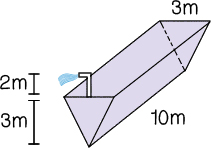
The problem that Patrick looks at is: > The tank (below) is full of water. Find the work required to pump the water out of the spout.

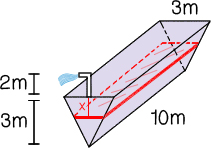
The first step is to take a generic cross sectional slice of the tank.

We drop down xx units from the top of the tank and select the cross sectional slice. This slice has a height of Δx\Delta x

So, we want to find the volume of this slice. This is the tricky part of the problem. We think of this cross sectional slice as a rectangular box Vslice=l⋅w⋅hV_{\text{slice}}=l\cdot w\cdot h

We know the height already. The length will always be 10m. But what about the width. Notice that the width changes depending on how far down xx is. For now, let's leave it as ww. Our volume becomes: Vslice=10⋅w⋅ΔxV_{\text{slice}}=10\cdot w\cdot\Delta x

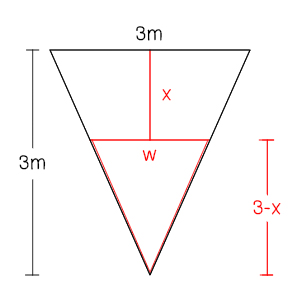
Now, we need to find a way to express ww in terms of xx. To do this we can use similar triangles. Let's take a look a closer look the front of the tank.

big heightbig width=small heightsmall width33=3−xw3w=3(3−x)w=3−x\begin{align} \frac{\text{big height}}{\text{big width}}&=\frac{\color{red}{\text{small height}}}{\color{red}{\text{small width}}}\\ \frac{3}{3}&=\frac{\color{red}{3-x}}{\color{red}{w}}\\ 3w&=3(3-x)\\ w&=3-x \end{align}

We can plug this back into our volume equation. Vslice=10(3−x)ΔxV_{\text{slice}}=10(3-x)\Delta x

Step 2 tells us that to get the Force of the slice, we need to multiply it by 9.8×10009.8\times1000 since our original problem is in meters. Fslice=(9.8×1000)10(3−x)ΔxF_{\text{slice}}=(9.8\times1000)10(3-x)\Delta x

Step 3 is finding the displacement, or the distance this slice of water has to move to go up and out. The distance down of the slice is xx units. So it has to travel xx to get to the top of the tank. But then it also has to travel up the pipe which is 2m2m. So the total displacement is x+2x+2. dslice=x+2d_{\text{slice}}=x+2

Step 4 is to find the limits of integration. Since xx represents the depth of the tank, we want to find the ranges of the depth. The depth can go from 0 to 3, so these are our limits.

Step 5 is to set up our integral and integrate. W=∫03(x+2)(9800)(10)(3−x)dx=∫0398000(x+2)(3−x)dx=98000∫03(x+2)(3−x)dx=98000∫03(x−x2+6)dx=98000[∫03x dx−∫03x2 dx+∫036 dx]=98000[∫03x dx−∫03x2 dx+6∫03dx]=98000[[12x2]03−[13x3]03+6[x]03]=98000[12[x2]03−13[x3]03+6[x]03]=98000[12[9]−13[27]+6[3]]=98000[92−9+18]=1323000J\begin{align} W&=\int_0^3(x+2)(9800)(10)(3-x)dx\\ &=\int_0^398000(x+2)(3-x)dx\\ &=98000\int_0^3(x+2)(3-x)dx\\ &=98000\int_0^3(x-x^2+6)dx\\ &=98000\left[\int_0^3x\,dx-\int_0^3x^2\,dx+\int_0^36\,dx\right]\\ &=98000\left[\int_0^3x\,dx-\int_0^3x^2\,dx+6\int_0^3dx\right]\\ &=98000\left[\left[\frac12x^2\right]_0^3-\left[\frac13x^3\right]_0^3+6\left[x\right]_0^3\right]\\ &=98000\left[\frac12\left[x^2\right]_0^3-\frac13\left[x^3\right]_0^3+6\left[x\right]_0^3\right]\\ &=98000\left[\frac12\left[9\right]-\frac13\left[27\right]+6\left[3\right]\right]\\ &=98000\left[\frac{9}2-9+18\right]\\ &=\boxed{1323000J} \end{align}

Type a concept, like “slope” or “photosynthesis”.

↑ ↓ to choose · Enter to openSearch explanations and problems