Here's a video by mathman1024 showing you how to divide two rational expressions. Dividing rational expressions is a lot like multiplying them. There's just one extra step. Instead of dividing, you can flip the second fraction and multiply instead. Flipping the fraction is called using the reciprocal.
Summary
The example he solves is: x2−8x−202x2+7x+6÷x2−5x−506x2+19x+15
The first step is to change the division into multiplication by flipping the second fraction (i.e. taking the reciprocal).
x2−8x−202x2+7x+6÷x2−5x−506x2+19x+15=x2−8x−202x2+7x+6⋅6x2+19x+15x2−5x−50
Next, factor each of the four polynomials. This will help us see what common factors we can cancel out.
=(x+2)(x−10)(2x+3)(x+2)⋅(2x+3)(3x+5)(x+5)(x−10)
As you can see, there's a factor of (2x+3), a factor of (x+2), and a factor of (x−10) in both the numerator and denominator. Removing these, we get the final answer of:
=3x+5x+5
A rational number is a number that can be expressed in the form ba where a and b are integers and b=0. These are numerical fractions.
A rational expression is a fraction expressed in the form ba, but instead of a and b being integers, a and b will be polynomials.
Some examples of expressions with rational numbers are: x+13,x3−1x−6,34x2−x+1
Working with variables in expressions that include fractions or decimals is similar to working with regular expressions.
The main difference is that you may see more fractions.
Also, the variables might appear on the top or the bottom of a fraction.
Even though the expressions may look more complicated, the basic rules of algebra still apply.
Example 1
Let’s take a look at an example.
Simplify 3x4+x8+x.
First, notice that the denominators are different. Since the denominators are different, we cannot add the two expressions. We need to multiply the second expression by 33.
3x4+(33⋅x8+x)
Multiply.
3x4+3x3(8+x)
Simplify the expression.
3x4+3x24+3x
Since the expressions now have the same denominator, we can add them. Just add the top numbers (numerators) and keep the bottom the same.
3x4+3x24+3x=3x4+24+3x=3x28+3x
Example 2
Let’s take a look at another example.
Simplify x−37÷x−319 if x=3.
Notice that we can turn the problem into a multiplication problem by taking the reciprocal of the second fraction.
x−37÷x−319=x−37×19x−3
Cancel out any terms that appear in both the numerator and denominator.
x−37×19x−3=x−37×19x−3=197
Now, let's look at some types of problems you might see when working with expressions that have rational numbers.
Practice Problem 1
Simplify the following expression.
x2−3x+2x2−4x−45⋅x+5xx−7x+10
It's always helpful to first factor the numerators and denominators. That makes the fractions easier to work with.
Practice Problem 2
Simplify the following expression.
4x41−x8−2
First, notice that the denominators are different. Since the denominators are different, we cannot subtract the three expressions. We need to multiply the second expression by 44 and the third expression by 4x4x.
4x41−(x8⋅44)−(2⋅4x4x)
Multiply.
4x41−4x32−4x8x
Since the expressions now have the same denominator, we can subtract the expressions. Remember to only subtract the numerators.
4x41−4x32−4x8x=4x41−32−8x=4x9−8x
A rational expression is a fraction where the numerator and/or the denominator are polynomials.
Image Source: By Trisha
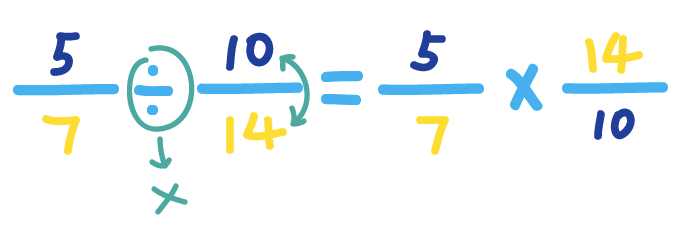
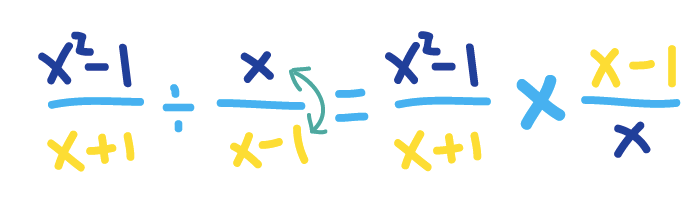
When we divide rational expressions, we follow a rule that is similar to dividing regular fractions. Instead of dividing, you multiply by the reciprocal.
The reciprocal of a fraction means flipping the numerator and denominator. So dividing rational expressions turns into multiplication.
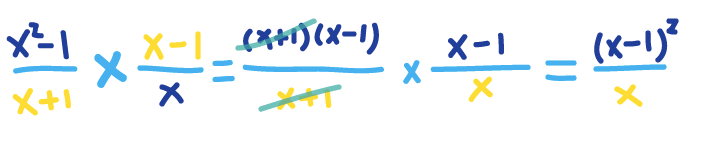
As we can see in the above image, rewrite the division as multiplication by flipping the second fraction. Next, look for factors you can simplify or cancel before multiplying. Canceling factors makes the expression easier to work with.
After simplifying, multiply the numerators together and the denominators together.
Always check that no values make the denominator equal to zero, because those values are not allowed in rational expressions.
Looking Further
Let's continue to build on this idea. In these lessons, you will learn how to: