Tópicos de problemas

Before this, knowvariação combinada e aproximações

Video · + 1 min read

(Videos) Variation and Proportionality Word Problems

by mathman1024

This video by mathman1024 goes over a word problem based on variation.

Summary\large{\text{Summary}}

The problem says, Johnny earns $594\$594 when he works twenty-two hours. How much would he earn if he were to work thirty-seven hours?

We know that this is a direct variation problem because it deals with hours worked and pay. If you work more hours, you get paid more.

Once we know the variation we're using we can define our variables. P=amount of paycheckP=\text{amount of paycheck} h=number of hoursh=\text{number of hours}

So we can now define our paycheck to be: P=khP=kh

The goal for these problems is to find the value of kk (the constant of proportionality) and use it to solve for the desired value. To find kk, take the specific example the problem has given. The given problem states Johnny earns $594\$594 when he works twenty-two hours. So we can plug those into our equation. P=kh(594)=k(22)59422=22k2227=k\begin{align} P&=kh\\ \color{#8925AE}{(594)}&=k\color{#8925AE}{(22)}\\ \frac{594}{\color{#8925AE}{22}}&=\frac{22k}{\color{#8925AE}{22}}\\ 27&=k \end{align}

So what does this mean in terms of this problem? Well, it means that you make $27\$27 per hour. Thus, kk is now a known quantity, and our equation becomes: P=27hP=27h

Now we can answer the question they ask, How much would he earn if he were to work thirty-seven hours? P=27hP=27(37)P=999\begin{align} P&=27h\\ P&=27\color{#8925AE}{(37)}\\ P&=999 \end{align}

We state, When he works 37 hourshe earns 999 dollars.\text{When he works }37\text{ hours}\\ \text{he earns }999\text{ dollars.}

Interactive · 4 questions

Direct Proportionality in Science

Directly proportional variables are used in the sciences. They come up most in the math-y sciences like chemistry and physics (i.e., the sciences that use variables).

That's where we're going to get our examples from today.

If you need a refresher on direct proportionality in general, click here.

There's also a page on inverse proportionality here.

Beakers

By Masterdeis CC BY-SA 3.0, from Wikimedia Commons

Chemistry: Gas Laws

Chemical gas laws are a great example of proportionality. There are several of these, but they all involve the same 33 variables:

  • PP (pressure)
  • VV (volume)
  • TT (temperature).

Let's look at Charles' Law, which relates the volume and temperature of a gas.

Charles’ Law\text{Charles' Law} V1T1=V2T2\frac{V_1}{T_1}=\frac{V_2}{T_2} V1= original volumeV2= new volumeT1= original temperatureT2= new temperature\begin{align} V_1 &= \text{ original volume}\\ V_2 &= \text{ new volume}\\ T_1 &= \text{ original temperature}\\ T_2 &= \text{ new temperature}\\ \end{align}

In this case, volume and temperature are directly proportional. If volume goes up, temperature does too. The ratio between temperature and volume is constant.

Let's practice.

In a jar, Math Gas has a volume of 20 liters (L)20\text{ liters (L)} and a temperature of 100 Kelvin (K)100\text{ Kelvin (K)}.

What is the ratio of volume to temperature for Math Gas?

Choose one answer

Interactive · 4 questions

Proportionality: Word Problems

Real quick, before we jump into problems. Here are some links in case you need refreshers on any of the topics involved:

  • Direct proportionality: general explanation here and science examples here

  • Inverse proportionality: general explanation here

If you're ready to test out some word problems, let's get started!

The best approach to word problems is to translate it from words to numbers.

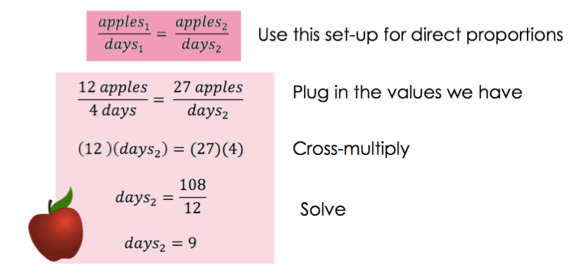
Here's a hint for translating problems directly proportional variables:

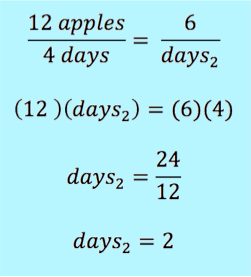
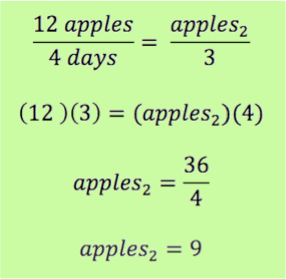
Use fractions to show direct proportionality. Cross-multiply to solve.

Image source: by Hannah Bonville

Let's try this method out.

Anya eats 1212 apples over 44 days. Assuming that she eats the same number of apples each day, what is the ratio of apples to days?

Choose one answer

Video · + 1 min read

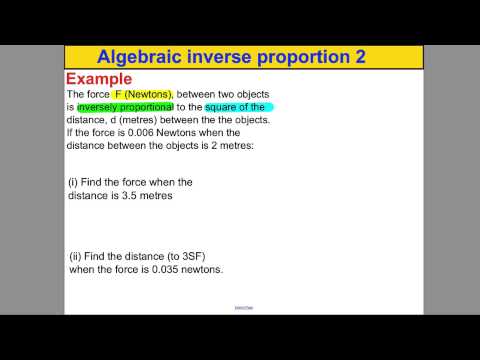
(Video) Algebraic Inverse Proportion

by HEGARTYMATHS

Thies video by HEGARTYMATHS goes over some word problems based on inverse proportionality.

Summary\large{\text{Summary}}

Word problems involving proportionality will usually give you one set of points and ask you to find part of a second set given only some of the information. Using the first set of points you solve for the constant kk. Then, with kk and part of the second set, you can find the final part of the second set.

Let's work through the first problem together.

y is inversely proportional to x. If y=10 when x=2, find:(i) A Formula for y in terms of x(ii) y when x=5(iii) x when y=8\begin{align}&\text{y is inversely proportional to x. If y=10 when x=2, find:}\\ &\text{(i) A Formula for y in terms of x}\\ &\text{(ii) y when x=5}\\ &\text{(iii) x when y=8}\end{align}

The first step is to write our basic formula. We know that basic inverse formula has the form y=k⋅1xy=k\cdot \frac1{x}, or y=kxy=\frac{k}{x}.

We know that y=10y=10 when x=2x=2. Let's plug those in then solve for kk. y=kx10=k220=k\begin{align}y&=\frac{k}{x}\\ 10&=\frac{k}{2}\\ 20&=k \end{align}

Our constant, kk, is 2020. We're going to use k=20k=20 and x=5x=5 to solve for yy in the second part. y=kxy=205y=4\begin{align}y&=\frac{k}{x}\\ y&=\frac{20}{5}\\ y&=4 \end{align}

When x=5x=5, y=4y=4.

We use the constant k=20k=20 to solve the second part as well. y=kx8=20x8x=20x=208x=52 or 2.5\begin{align}y&=\frac{k}{x}\\ 8&=\frac{20}{x}\\ 8x&=20\\ x&=\frac{20}{8}\\ x&=\frac52 \text{ or } 2.5\end{align}

Here's a graphic with another example!

Direct Variation Word Problems. Aiden earns $1000 every 40-hour work week. How much does he earn in 100 hours? 
Step One: Set up the direct variation equation.
k dollars/hour * x hours = y dollars

Step Two: Plug known values into the equation to solve for k.
k dollars/hour * 40 hours = 1000 dollars
k = 25 dollars/hour

Step Three: Use k to solve for the unknown value.
k dollars/hour * x hours = y dollars
25 dollars/hour * 100 hours = 2500 dollars

Image source: By Caroline Kulczycky

Test Yourself: Amy's phone's battery life is inversely proportional to the number of new features on it. Her old phone had 77 new features and a battery life of 1414 hours. Her new phone has 1616 new features. How long is her battery life now?

Choose one answer

Type a concept, like “slope” or “photosynthesis”.

↑ ↓ to choose · Enter to openSearch explanations and problems