Inversa de uma função linear

Interactive · 1 question

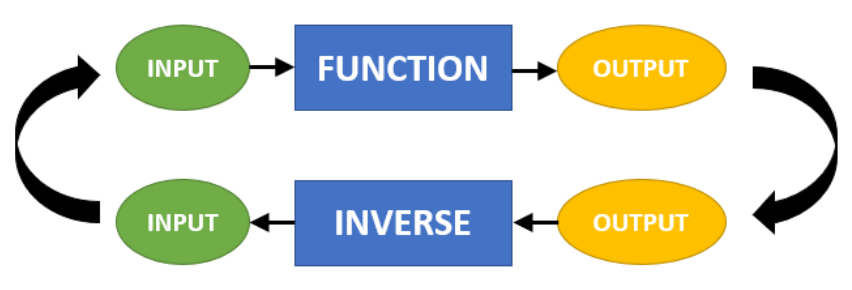
Inverses are very interesting creations. You can think of them as things that you use to "undo" what you just did. Say, let's take the variable xx and apply function ff to xx to get the result f(x)f(x). Now, to get back to xx or "undo" are application of function ff, we can take the inverse of ff, which is written as ff to the −1-1 (don't confuse this as reciprocal). The inverse of ff would undo ff leaving f−1(f(x))=xf^{-1}(f(x)) = x. Yay, that was a wordy introduction. Here's a fun picture to understand this better.

A visualization of applying a function f to a number, and then applying the inverse function to the result; you should get the number you started with

We put apples into function f to get lemons. When we put the lemons into the inverse function f^{-1} we get our original apples!

Which of the following are true?

Choose all correct answers

Video · + 1 min read

(Videos) Inverse Functions

by PatrickJMT

Here are some great video by PatrickJMT where he talks about what an inverse function is. An inverse function is a function that reverses what another function does. We denote functions with f(x)f(x) and we denote inverse functions with f−1(x)f^{-1}(x). It's very important to keep in mind that the −1-1 is NOT and exponent. It is simply just the way we denote inverse functions. Another important property is that not all functions will have inverses. You can use the horizontal line test to determine if the graph of a function will have an inverse. If there's any point where, if you draw a horizontal line, it touches two or more points, then the graph will NOT have an inverse.

The second video by PatrickJMT shows you how to find the inverse of a function. The steps he uses are:

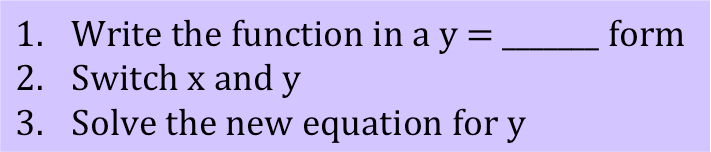
  1. Replace f(x)f(x) with yy.
  2. Switch xx's and yy's.
  3. Solve for yy.
  4. Replace yy with f−1(x)f^{-1}(x).

Test Yourself: Find the inverse of f(x)=3x+8f(x)=3x+8.

Choose one answer

Video

(Video) Inverse Functions

by yaymath

Here's a video by yaymath showing you how to find the inverse of a function. An inverse function is just the reverse of a function. A function is denoted by f(x)f(x) and an inverse function is denoted by f−1(x)f^{-1}(x). It is important to note that the −1-1 is NOT and exponent but just a way to denote it's the inverse. To find the inverse function the steps are:

  1. Flip the xx's and yy's in the equation.
  2. Solve for yy.

When looking at a graph, the inverse of a function is the function but flipped over the line y=xy=x.

Test Yourself: Find the inverse of f(x)=x2−53f(x)=\dfrac{x}{2}-\dfrac{5}{3}

Choose one answer

Interactive · 6 questions

What is an Inverse of a Linear Function?

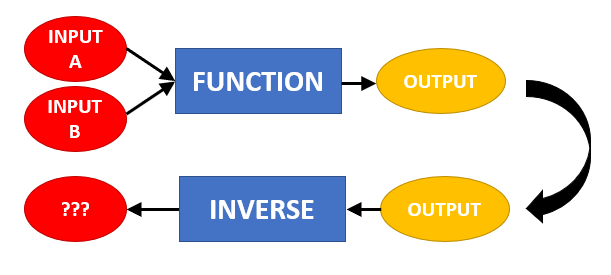
A function and its inverse undo each other. What exactly does that mean? Think of a function, often written like f(x)f\left(x\right), like a math machine - you plug in one value and you get out another.

So, the inverse of a function is like a second machine that allows you to plug in the output of the first machine to get back to the original value.

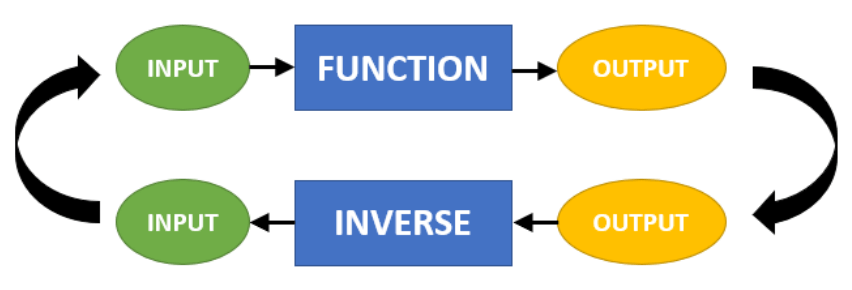
The image below shows the relationship between a function and its inverse. Notice how we plug in xx to our function ff and get yy. We can then plug in yy to our inverse function f−1f^{-1} and get back to xx.

f takes you from X to Y; f^{-1} takes you from Y back to X

Consider this function and its inverse. Notice how we label the inverse by writing f(x)−1f\left(x\right)^{-1}. The letter used (f,g,h...)\left(f,g,h...\right) doesn't matter, but it's most common to use ff.

f(x)=4x−5f−1(x)=x+54\begin{align} f(x) &= 4x - 5 \\ f^{-1}(x) &= \frac{x + 5}{4} \end{align}

Let's say x=2x=2. What is the value of the first function, f(2)f\left(2\right)?

Choose one answer

Video

(Video) How to Find the Inverse of a Function

by Nancy Pi

The general idea is that if a function y=f(x)y = f(x) has an inverse, you can find it by writing the equation as x=f(y)x = f(y) and solving for y.y. Try it on this example where ff is linear!

Find f−1(x)f^{-1}(x) if f(x)=2x+7.f(x) = 2x + 7.

Choose one answer

Video

(Video) Finding the Inverse of the Linear Function f(x)=x+2f(x)=x+2

by The Math Sorcerer

In this video by The Math Sorcerer an example of finding the inverse of a linear function is worked through.

Here is another example to try on your own.

Find the inverse of the function f(x)=x−5.f(x) = x - 5.

Choose one answer

Video · + 3 min read

Inverses occur in everyday life! Dirty dishes are washed to become new again. Borrowed library books are returned. The trip from school or work brings you back home.

Functions transform input values into output values.

Inverses transform the output values back into the input values they were before.

take an input and plug it into a function to get an output; if the output is plugged into the inverse you get the original input back!

The outputs of a function become the inputs of the inverse. The outputs of the inverse are the inputs of the original function.

As a example: Your teacher decides to curve everyone's test scores! Every test score is raised by adding 10%10\% to it. If Jon scored a 82%82\% on his test, what would be his curved score?

Choose one answer

Type a concept, like “slope” or “photosynthesis”.

↑ ↓ to choose · Enter to openSearch explanations and problems