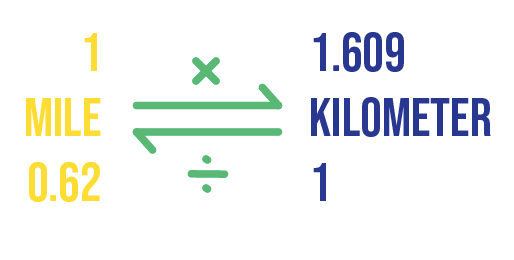
For every mile, there are 1.60934 kilometers...and for every kilometer, there are 0.62137 miles. The mile is part of the Imperial units system, and the kilometer is part of the metric system.
When we want to convert from miles to km, we can multiply by: 1 mi=1 mi1.60934 kmor by1 km=0.62137 km1 mi
If we do this, the multiplication will cause the miles to cancel out.
Convert Kilometers to Miles
When we want to convert from kilometers to miles, we can do the reverse; multiply by:
1 km=1.60934 km1 mior by1 mi=1 mi0.62137 km
For example, if we want to convert 1 mile to kilometers, we do the following:
1 mi×1 mi1.60934 km=1 mi1 mi×1.60934 km=1.60934 km
If we do this, the multiplication will cause the kilometers to cancel out.
Your Turn
Try the question below yourself.
Convert 500 kilometers to miles. Be careful with the decimal!
The kilometer is a unit of measurement, as is the mille. However, a mile is longer than a kilometer. "Mile" is a bigger unit. These are all units used to measure distance. On the other hand, some units measure a different quantity, such as time.
Multiply to convert bigger to smaller units, divide to convert smaller to bigger units! In this case, multiply to convert from kilometers to miles. Also, divide to convert from miles to kilometers.
Image Source: Christine Shen
Why do we care??
Different countries use different units of length for measuring things. Miles and kilometers are both used a lot when traveling. For instance, if you were to drive from Nashville, Tennessee to Fayetteville, Arkansas, that's 531 miles of driving. But maybe you want to know how far that is in kilometers.
Examples
What is 5 miles in kilometers?
Since we are converting miles to kilometer, from a bigger unit to a smaller unit, we multiply.
This quick video by Simon Deacon explains how to convert miles (mi) to kilometers (km).
Problem-Solving Strategy
One type of problem will have a car traveling at some miles per hour over a distance of some kilometers. You need to find how long it will take to drive that distance. When we say "how long," we mean the distance traveled. In other cases we might want to know the amount of time.
Example: A car is driving at 60 miles per hour (mph). How long will it take the car to go 120 km?
To solve this, we need to know the conversion from kilometers to miles. Here it is! Ta-da!
1 km=0.6214 mi
In words this means 1 kilometer of length equals 0.6214 miles. The number 0.6214 has four digits past the decimal point. So you might want a calculator.
To make things a little easier, and if you don't need to be 100percent accurate (for instance in a Fermi Problem), you can use the quick conversion:
8 km≈5 mi
For right now though we're not in any hurry. So we'll use the
1 km=0.6214 mi
conversion. Let's solve this problem now. We can set up a conversion table.
We can also convert between other units of distance. This includes feet and meters, and centimeters, meters, and kilometers. The meter is the base unit for distance. This means scientists like to convert between meters and other units for distance, including miles and kilometers. Nonetheless it's important to know how to do conversions in both directions.
Finally, the same strategy is used to convert between units of time, such as minutes and seconds, and also to convert between units of mass, such as grams and kilograms. The conversion tables will look very similar. It's just the exact numbers used that will be different.