Limite como funções racionais

Before this, knowLimites como funções polinomiais

Read · 1 min

A rational function is essentially any function that can be expressed as a rational function. For example::

y=x(10x20)y=\frac{\sqrt{x}}{(10x^{20})}

Video

(Video) Calculating a Limit by Factoring and Canceling

by PatrickJMT

Here's a video by patrickJMT showing you how to find a limit of a function using the factor canceling technique.

He demonstrates this technique by looking at an example: lim⁡x→2x2−4x−2\lim_{x\rightarrow2}\frac{x^2-4}{x-2} Notice what happens when we plug in 2 straight away. x2−4x−2=(2)2−4(2)−2=4−42−2=00\begin{align} \frac{x^2-4}{x-2}&=\frac{\color{red}{(2)}^2-4}{\color{red}{(2)}-2}\\ &=\frac{4-4}{2-2}\\&=\frac00 \end{align} So we have to be creative and figure something else out. We can instead factor this expression. lim⁡x→2x2−4x−2=lim⁡x→2(x+2)(x−2)x−2\lim_{x\rightarrow2}\frac{x^2-4}{x-2}=\lim_{x\rightarrow2}\frac{(x+2)(x-2)}{x-2} When we factor the top we get an x−2x-2 in both the numerator and denominator. This can be canceled out. lim⁡x→2(x+2)(x−2)x−2=lim⁡x→2x+2\lim_{x\rightarrow2}\frac{(x+2)\color{red}{(x-2)}}{\color{red}{x-2}}=\lim_{x\rightarrow2}x+2 Now that it's simplified let's try plugging 2 back in. x+2=(2)+2=4x+2=\color{red}{(2)}+2=4 So lim⁡x→2x2−4x−2=4\lim_{x\rightarrow2}\frac{x^2-4}{x-2}=4

If we graph the function y=x2−4x−2y=\dfrac{x^2-4}{x-2} it's going to look a lot like the function y=x+2y=x+2 except it will be undefined at x=2x=2 because we have a zero in the denominator.

y=x2−4x−2y=\frac{x^2-4}{x-2}

As you can see when we put in points getting closer and closer to 2, the function gets closer and closer to 4.

Video

(Video) Calculating a Limit by Expanding and Simplifying

by PatrickJMT

Here's a video by patrickJMT showing you how to find a limit of a function using the expanding and simplifying technique.

He demonstrates this with the example: lim⁡h→0(4+h)2−16h\lim_{h\rightarrow0}\frac{(4+h)^2-16}{h} Notice what happens when we plug in h=0h=0. (4+h)2−16h=(4+(0))2−16(0)=42−160=00\begin{align} \frac{(4+h)^2-16}{h}&=\frac{(4+\color{red}{(0)})^2-16}{\color{red}{(0)}}\\ &=\frac{4^2-16}{0}\\ &=\frac00 \end{align} So we have to do something algebraic in order to figure out this limit. Notice that there's this (4+h)2(4+h)^2 that can be expanded, so let's do that. lim⁡h→0(4+h)2−16h=lim⁡h→016+8h+h2−16h\begin{align} &\lim_{h\rightarrow0}\frac{(4+h)^2-16}{h}\\ &=\lim_{h\rightarrow0}\frac{16+8h+h^2-16}{h} \end{align} The 16's will cancel out and then we can factor out an hh from the numerator and denominator. lim⁡h→016+8h+h2−16h=lim⁡h→08h+h2h=lim⁡h→08+h\begin{align} &\lim_{h\rightarrow0}\frac{16+8h+h^2-16}{h}\\ &=\lim_{h\rightarrow0}\frac{8h+h^2}{h}\\ &=\lim_{h\rightarrow0}8+h \end{align} Now we can plug in h=0h=0. 8+h=8+(0)=88+h=8+\color{red}{(0)}=8 So lim⁡h→0(4+h)2−16h=8\lim_{h\rightarrow0}\frac{(4+h)^2-16}{h}=8

Video · + 1 min read

(Video) Calculating a Limit by Getting a Common Denominator

by PatrickJMT

Here's a video by patrickJMT showing you how to find the limit of a function using the common denominator technique. Note: he solves this problem in a slightly different way than I do. Both get the same result.

The example he looks at is: lim⁡h→0(3+h)−1−3−1h\lim_{h\rightarrow0}\frac{(3+h)^{-1}-3^{-1}}{h} Notice what happens when we plug in h=0h=0. (3+h)−1−3−1h=(3+(0))−1−3−1(0)=3−1−3−10=00\begin{align} \frac{(3+h)^{-1}-3^{-1}}{h}&=\frac{(3+\color{red}{(0)})^{-1}-3^{-1}}{\color{red}{(0)}}\\ &=\frac{3^{-1}-3^{-1}}{0}\\ &=\frac00 \end{align} Since this doesn't work we have to figure out a way to rearrange it until it does work. One thing to note is we have terms raised to the negative power. We can rewrite them in the denominator with a positive power. Be careful though, they're combined with a negative sign so we can't just put them in the denominator. We have to break the fraction up first. lim⁡h→0(3+h)−1−3−1h=lim⁡h→0(3+h)−1h−3−1h\begin{align} &\lim_{h\rightarrow0}\frac{(3+h)^{-1}-3^{-1}}{h}\\ &=\lim_{h\rightarrow0}\frac{(3+h)^{-1}}{h}-\frac{3^{-1}}{h} \end{align} Now we can move the terms to the denominator. lim⁡h→0(3+h)−1h−3−1h=lim⁡h→01h(3+h)−13h\begin{align} &\lim_{h\rightarrow0}\frac{(3+h)^{-1}}{h}-\frac{3^{-1}}{h}\\ &=\lim_{h\rightarrow0}\frac{1}{h(3+h)}-\frac{1}{3h} \end{align} We can now find a common denominator for these fractions in order to combine them. lim⁡h→01h(3+h)−13h=lim⁡h→01h(3+h)⋅33−13h⋅3+h3+h=lim⁡h→033h(3+h)−3+h3h(3+h)=lim⁡h→03−(3+h)3h(3+h)=lim⁡h→0−h3h(3+h)=lim⁡h→0−13(3+h)=lim⁡h→0−13h+9\begin{align} &\lim_{h\rightarrow0}\frac{1}{h(3+h)}-\frac{1}{3h}\\ &=\lim_{h\rightarrow0}\frac{1}{h(3+h)}\color{red}{\cdot\frac33}-\frac{1}{3h}\color{red}{\cdot\frac{3+h}{3+h}}\\ &=\lim_{h\rightarrow0}\frac{3}{3h(3+h)}-\frac{3+h}{3h(3+h)}\\ &=\lim_{h\rightarrow0}\frac{3-(3+h)}{3h(3+h)}\\ &=\lim_{h\rightarrow0}\frac{-h}{3h(3+h)}\\ &=\lim_{h\rightarrow0}-\frac{1}{3(3+h)}\\ &=\lim_{h\rightarrow0}-\frac{1}{3h+9} \end{align} Now we can plug in h=0h=0. −13h+9=−13(0)+9=−19\begin{align} -\frac{1}{3h+9}&=-\frac{1}{3\color{red}{(0)}+9}\\ &=-\frac19 \end{align} So lim⁡h→0(3+h)−1−3−1h=−19\lim_{h\rightarrow0}\frac{(3+h)^{-1}-3^{-1}}{h}=-\frac19 Usually, when there's fractions lying about, it's a good idea to find common denominators and combine.

Video

(Videos) Calculating a Limit by Multiplying by a Conjugate

by PatrickJMT

Here's a video by patrickJMT showing you how to find the limit of a function using the conjugate technique.

He shows how to use this technique by looking at an example. lim⁡x→7x+2−3x−7\lim_{x\rightarrow7}\frac{\sqrt{x+2}-3}{x-7} Notice what happens when we plug in 7. x+2−3x−7=(7)+2−3(7)−7=3−37−7=00\begin{align} \frac{\sqrt{x+2}-3}{x-7}&=\frac{\sqrt{\color{red}{(7)}+2}-3}{\color{red}{(7)}-7}\\ &=\frac{3-3}{7-7}\\ &=\frac00 \end{align} We have to do something to this in order to change it. The key things to spot are that there's a radical and two terms in the numerator. A common trick when we have a radical is to multiply by the conjugate.

Remember that if you have a±ba\pm b the conjugate is the same thing but the sign is reversed: a∓ba\mp b.

So let's multiply the top and bottom by the conjugate of the numerator. lim⁡x→7x+2−3x−7=lim⁡x→7x+2−3x−7⋅x+2+3x+2+3=lim⁡x→7(x+2)−9(x−7)(x+2+3)=lim⁡x→7x−7(x−7)(x+2+3)=lim⁡x→71x+2+3\begin{align} &\lim_{x\rightarrow7}\frac{\sqrt{x+2}-3}{x-7}\\ &=\lim_{x\rightarrow7}\frac{\sqrt{x+2}-3}{x-7}\color{red}{\cdot\frac{\sqrt{x+2}+3}{\sqrt{x+2}+3}}\\ &=\lim_{x\rightarrow7}\frac{(x+2)-9}{(x-7)(\sqrt{x+2}+3)}\\ &=\lim_{x\rightarrow7}\frac{x-7}{(x-7)(\sqrt{x+2}+3)}\\ &=\lim_{x\rightarrow7}\frac{1}{\sqrt{x+2}+3} \end{align} Now we can plug in x=7x=7. 1x+2+3=1(7)+2+3=13+3=16\begin{align} \frac{1}{\sqrt{x+2}+3}&=\frac{1}{\sqrt{\color{red}{(7)}+2}+3}\\ &=\frac1{3+3}\\ &=\frac16 \end{align}

So lim⁡x→7x+2−3x−7=16\lim_{x\rightarrow7}\frac{\sqrt{x+2}-3}{x-7}=\frac16

Try it Yourself!

Evaluate, lim⁡x→0xx+9−3\lim_{x\rightarrow0}\frac{x}{\sqrt{x+9}-3}

Choose one answer

Video · + 1 min read

(Video) Limits at Infinity

by PatrickJMT

Here's a video by patrickJMT showing you how to find limits of functions as they approach infinity.

When we take a limit as it approaches infinity we're looking at what happens when we put in larger and larger numbers.

The first example he looks at is: lim⁡x→∞3x2+5x+4x3+7x\lim_{x\rightarrow\infty}\frac{3x^2+5x+4}{x^3+7x} So we start putting in larger and larger numbers 100,1000,1000000,1000000000,...100,1000,1000000,1000000000,... and if the output starts getting closer and closer to a number that's what we say the limit is.

When solving limits that approach infinity for rational functions, you always look at the highest power in the denominator. 3x2+5x+4x3+7x\frac{3x^2+5x+4}{\color{red}{x^3}+7x} Here x3x^3 is our highest power in the denominator, so what we do is divide every term in our function by x3x^3. =lim⁡x→∞3x2x3+5xx3+4x3x3x3+7xx3=lim⁡x→∞3x+5x2+4x31+7x2\begin{align} &=\lim_{x\rightarrow\infty}\frac{\frac{3x^2}{x^3}+\frac{5x}{x^3}+\frac{4}{x^3}}{\frac{x^3}{x^3}+\frac{7x}{x^3}}\\ &=\lim_{x\rightarrow\infty}\frac{\frac3x+\frac5{x^2}+\frac4{x^3}}{1+\frac7{x^2}} \end{align} As xx gets closer to infinity, 3x\frac3x gets closer to zero. Same thing goes for all the terms with an xx in the denominator. =lim⁡x→∞0+0+01+0=01=0=\lim_{x\rightarrow\infty}\frac{0+0+0}{1+0}=\frac01=0

So therefore, lim⁡x→∞3x2+5x+4x3+7x=0\lim_{x\rightarrow\infty}\frac{3x^2+5x+4}{x^3+7x}=0

The next example he solves is lim⁡x→−∞x4+x5x3+7\lim_{x\rightarrow-\infty}\frac{x^4+x}{5x^3+7} Here's the highest term in the denominator is x3x^3 so we divide each term by this. =lim⁡x→−∞x4x3+xx35x3x3+7x3=lim⁡x→−∞x+1x25+7x3\begin{align} &=\lim_{x\rightarrow-\infty}\frac{\frac{x^4}{x^3}+\frac{x}{x^3}}{\frac{5x^3}{x^3}+\frac7{x^3}}\\ &=\lim_{x\rightarrow-\infty}\frac{x+\frac1{x^2}}{5+\frac7{x^3}} \end{align} Like before, any term with an xx in the denominator becomes zero. =lim⁡x→−∞−∞+05+0=−∞5=−∞=\lim_{x\rightarrow-\infty}\frac{-\infty+0}{5+0}=\frac{-\infty}5=-\infty So therefore, lim⁡x→−∞x4+x5x3+7=−∞\lim_{x\rightarrow-\infty}\frac{x^4+x}{5x^3+7}=-\infty

There are 3 different cases when dealing with the limits of rational functions as they approach infinity.

  1. Degree in Numerator = Degree in Denominator. The limit is the ratio of the coefficients. lim⁡x→±∞=4x10+10000x95x10+4=45\\ \lim\limits_{x\rightarrow\pm\infty}=\dfrac{\color{red}{4}x^{10}+10000x^9}{\color{red}{5}x^{10}+4}=\dfrac45
  2. Degree in Numerator < Degree in Denominator. The limit is always zero. lim⁡x→±∞3x75x8+10x+2=0\\ \lim\limits_{x\rightarrow\pm\infty}\dfrac{3x^7}{5x^8+10x+2}=0
  3. Degree in Numerator > Degree in Denominator. The limit will be either positive or negative infinity. lim⁡x→∞x4x3+5=∞\\ \lim\limits_{x\rightarrow\infty}\dfrac{x^4}{x^3+5}=\infty

Illustrated · 1 min

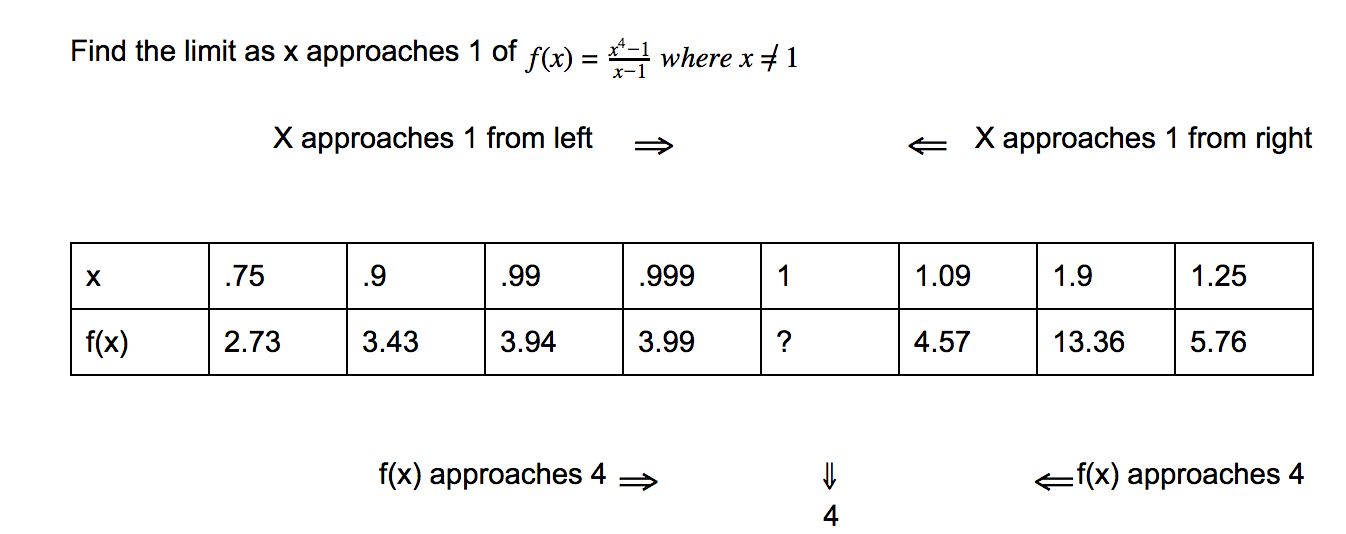
By representing a function as a table and plugging in x and y values, we are able to intuitively find the limit that the function approaches. Similarly, we are able to assess whether or not the limit does not exist (i.e. undefined).

Before constructing the table, try to define the limit algebraically. Then check using the table.

Interactive · 1 question

(Video) Limits Involving Absolute Value

by PatrickJMT

Here's a video by patrickJMT showing you how to find the limit of function with absolute values.

The example he looks at is lim⁡x→1∣x−1∣x−1\lim_{x\rightarrow1}\frac{|x-1|}{x-1} As always, notice what happens when we plug in x=1x=1. ∣x−1∣x−1=∣(1)−1∣(1)−1=00\frac{|x-1|}{x-1}=\frac{|\color{red}{(1)}-1|}{\color{red}{(1)}-1}=\frac00

Recall that with the absolute value function, we can express it as a piecewise function that's broken up into two parts. ∣x∣={−x,x<0   x,x≥0|x|=\begin{cases}-x,&x<0\\\ \ \ x,&x\geq0\end{cases} So what this means is when using absolute value you either leave the expression as is, or leave the expression as is and put a minus sign out front. Also notice that we break it up at the value where the inside is zero.

We're going to do the same thing with the value ∣x−1∣|x-1|. ∣x−1∣={   x<1   x≥1|x-1|=\begin{cases}\ \ \ &x<1\\\ \ \ &x\ge1\end{cases} If we put in a value of xx greater than 1 we get out a positive number. So we can write ∣x−1∣={   x<1(x−1),x≥1|x-1|=\begin{cases}\ \ \ &x<1\\(x-1),&x\ge1\end{cases} If we plug a value smaller than 1 inside, we get a negative number. So the absolute value would make that positive. So we write ∣x−1∣={−(x−1),x<1   (x−1),x≥1|x-1|=\begin{cases}-(x-1),&x<1\\\ \ \ (x-1),&x\ge1\end{cases} Notice that our function changes around 1. In general, for a limit to exist we want the left hand side to equal the right hand side. So we have to look at the limit as x approaches 1 from the left lim⁡x→1−\lim_{x\rightarrow1^-} and the limit as x approaches 1 from the right lim⁡x→1+\lim_{x\rightarrow1^+} If these are equal then we say the limit exists. If not, then the limit does not exist.

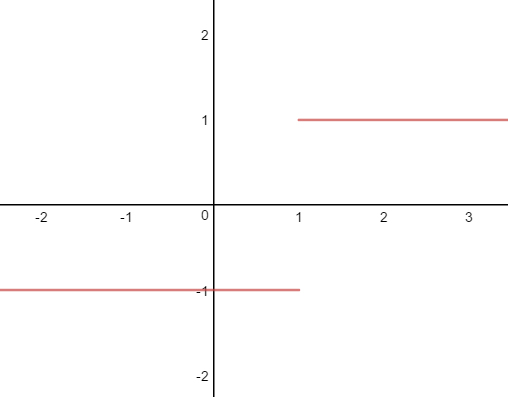
Let's start by calculating the limit as x approaches 1 from the left. lim⁡x→1−∣x−1∣x−1=lim⁡x→1−−(x−1)x−1=lim⁡x→1−−1\begin{align} \lim_{x\rightarrow1^-}\frac{|x-1|}{x-1}&=\lim_{x\rightarrow1^-}\frac{-(x-1)}{x-1}\\ &=\lim_{x\rightarrow1^-}-1 \end{align} The limit of a constant is just a constant so lim⁡x→1−∣x−1∣x−1=−1\lim_{x\rightarrow1^-}\frac{|x-1|}{x-1}=-1

Next we have to calculate the right hand limit. lim⁡x→1+∣x−1∣x−1=lim⁡x→1+x−1x−1=lim⁡x→1+1=1\begin{align} \lim_{x\rightarrow1^+}\frac{|x-1|}{x-1}&=\lim_{x\rightarrow1^+}\frac{x-1}{x-1}\\ &=\lim_{x\rightarrow1^+}1=1 \end{align} So lim⁡x→1+∣x−1∣x−1=1\lim_{x\rightarrow1^+}\frac{|x-1|}{x-1}=1 Because the left hand limit does not equal the right hand limit our conclusion is the limit of our original function does not exist. lim⁡x→1+∣x−1∣x−1 DNE\lim_{x\rightarrow1^+}\frac{|x-1|}{x-1}\text{ DNE} Here's a picture of the graph to show how the two sides don't converge to the same point.
Try it yourself!

lim⁡x→0−(1x−1∣x∣)\lim_{x\rightarrow0^-}\bigg(\frac1x-\frac1{|x|}\bigg)
Choose one answer

Type a concept, like “slope” or “photosynthesis”.

↑ ↓ to choose · Enter to openSearch explanations and problems