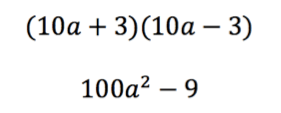
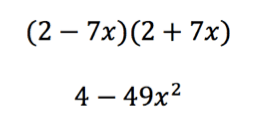
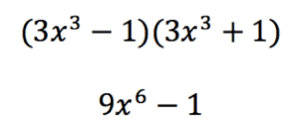
produto da soma pela diferença

Before this, knowTabelasUltimo

Interactive · 2 questions

Difference of Squares with Geometry

a^2 - b^2 = (a + b)(a - b)

Image source: By Christine

Can we understand this with geometry?

Imagine two squares, an blue square with length of aa and an orange square with side length of bb. aa is shorter than bb.

Take a square with side length a, and carve out a smaller square with side length b out of a corner of the bigger square

Image source: By Christine

We know the formula for the area of a square, where we square the side length, i.e., x2x^2. Since we know that the area of the blue square is a2a^2, and we know that the area of the orange square is b2b^2, we also know that:

The difference of area between the two squares is a2−b2a^2-b^2.

Alternatively, we can also calculate the difference of area by adding two small rectangles (11 and 22) together.

Rectangle 1: length a - b, height b; Rectangle 2: length a, height a - b (everything except the square with side length b)

Image source: By Christine

[(a−b)×b]+[(a−b)×a]=(a−b)×(a+b)=(a−b)(a+b)\begin{align} &[(a-b)\times b] + [(a-b)\times a] \\ =&(a-b)\times(a+b) \\ =&(a-b)(a+b) \end{align}

We can rewrite any difference of two squares to be the product of two binomials.

Which of the following is equivalent to 9x2−4y29x^2 - 4y^2?

Choose one answer

Stretch your creativity

Contest problems rarely look like the examples you studied. Solving one means finding your own way in. These are real problems from the AMC 8, AMC 10, AMC 12 and AIME, the national math competitions for middle and high school students, each with a worked solution on LIVE by Po-Shen Loh.

Video · + 1 min read

(Video) Multiplying Binomial Conjugates

by mathman1024

This video by mathman1024 covers multiplication with binomial conjugates.

Summary\large{\text{Summary}}

A conjugate is when you change the sign in the middle of the two terms. So if you have 3x+13x+1 then its conjugate would be 3x−13x-1.

When we multiply two conjugates together the middle terms end up canceling each other out. (a+b)(a−b)a2−ab+ab+b2a2−b2\begin{gather} (a+b)(a-b)\\ a^2-ab+ab+b^2\\ a^2-b^2 \end{gather} So we're left with the difference of two squares. This becomes a new formula for us to quickly multiply binomials. (a+b)(a−b)=a2−b2(a+b)(a-b)=a^2-b^2

He looks at the example: (x+5)(x−5)(x+5)(x-5). (x+5)(x−5)(x)2−(5)2x2−25\begin{gather} (x+5)(x-5)\\ (x)^2-(5)^2\\ x^2-25 \end{gather}

Try these next ones yourself and then see if you get the same answers.

  1. (x+7)(x−7)(x+7)(x-7)

  2. (x−11)(x+11)(x-11)(x+11)

  3. (5x+8)(5x−8)(5x+8)(5x-8)

(Video) Difference of Squares

by mathman1024

Here's another video with some more complicated examples. You still use the formula exactly the same. Try doing these on your own first.

  1. (9x15+2x11)(9x15−2x11)(9x^{15}+2x^{11})(9x^{15}-2x^{11})

  2. (110x13y4−47)(110x13y4+47)(\frac1{10}x^{13}y^4-\frac47)(\frac1{10}x^{13}y^4+\frac47)

  3. (8a5b−7x2y3)(8a5b+7x2y3)(8a^5b-7x^2y^3)(8a^5b+7x^2y^3)

Remember the rules for multiplying exponents and monomials!

Here is one other problem that uses this expansion pattern in the denominator.

Example: Find 1a+4+1a−4\frac{1}{a + 4} + \frac{1}{a - 4} if a=35.a = \frac{3}{5}.

Solution: Let's add the fractions together and simplify before plugging in a:a:

1a+4+1a−4=a−4(a+4)(a−4)+a+4(a+4)(a−4)=2aa2−16.\frac{1}{a + 4} + \frac{1}{a - 4} = \frac{a - 4}{(a + 4)(a - 4)} + \frac{a + 4}{(a + 4)(a - 4)} = \frac{2a}{a^2 - 16}.

Now plug in a=35:a = \frac{3}{5}:

2(35)(35)2−16=65925−16=−30391.\frac{2\left(\frac{3}{5}\right)}{\left(\frac{3}{5}\right)^2 - 16} = \frac{\frac{6}{5}}{\frac{9}{25} - 16} = \boxed{-\frac{30}{391}}.

Interactive · 5 questions

Multiplying Matching Binomials

What do we do when we want to multiply a pair of "matching" binomials (i.e. two binomials that happen to be the sum and difference of the same two terms), like 2x−52x-5 and 2x+52x+5?

We could certainly use FOIL but it turns out that there's an even easier approach available to us when our binomials have "matching" terms.

Let's break it down.

Use FOIL to multiply (2x−5)\left(2x-5\right) and (2x+5)\left(2x+5\right). What is the result?

The result is 4x2−254x^2 - 25.

See how the expression we got from FOILing together our two binomials contained a couple of middle terms that simply canceled out?

Well, this observation sets us up to learn a new shortcut for multiplying matching binomials.

When we've got matching binomials, we can simply perform the following two steps:

1. Square the binomials' first term

2. Square the binomials' second term and subtract the result from the previous step's result

Note that we can only use this shortcut because, since our two binomials have the same terms, and since one binomial uses addition while the other uses subtraction, we know that any middle terms that result from multiplying them together will cancel out.

Let's try this shortcut out on our two matching binomials from before: (2x−5)\left(2x-5\right) and (2x+5)\left(2x+5\right).

1. Square the binomials' first term

What is the value of our binomials' first term (2x)\left(2x\right) when squared?

Choose one answer

Type a concept, like “slope” or “photosynthesis”.

↑ ↓ to choose · Enter to openSearch explanations and problems