In a moment we're going to be talking about i, but before that let's start off with a very easy question.
What happens when you multiply a number by −1?
When you take a number like 5 and multiply it by −1, you get −5. Let's think about what change happens when you do that.
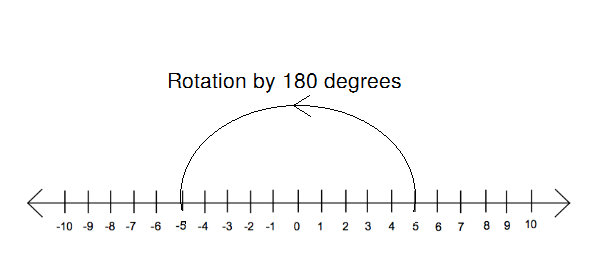
A picture might clear things up. Take a look.
So multiplying something by −1 rotates that number by 180∘ on the number line.
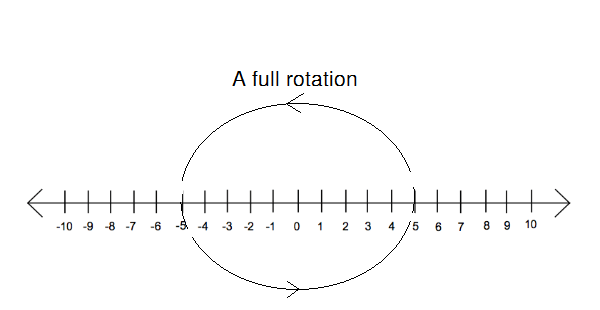
Now you can imagine what happens when you multiply that number by −1 again.
It gets rotated by 180∘ again doing a full rotation and going back to where it started from!
So this is a great way to visualize why −(−x)=x.
But let's not get off-topic. We're supposed to talk about i here.
Well, let's get to it!
Now think of a number k such that when you multiply any number by it, it gets rotated by 90∘. You should have no trouble with this I hope. After all we just saw a number that rotates everything by 180∘. So a 90∘ -rotator number shouldn't be that hard.
Now what happens when you multiply a number (say 5) by k twice?
Well, doing it once rotates the number by 90∘. So doing it twice should rotate the number by 90∘+90∘=180∘. And a rotation by 180∘ is equivalent to a multiplication by −1.
In other words,
5×k2=5×(−1)
So, k2=−1.
This number k is what everyone calls i. This is the so-called imaginary unit. Surely it's not a real number. But it's no more imaginary than −1.
Simplifying expressions with i involves using patterns in powers of imaginary numbers.
That's all for now! I hope you had fun learning this.
Until next time!